Tag Archives: Westcott Bay

A Walk in the Park

By Kimberly Mayer

On Gardening 102

First rule of weeds:

pull them out.

Second rule of weeds:

prevent them from seedling.

Third rule of weeds:

mow them.

And after all that fails, call them

Wildflowers.

—David Mark Jenkins

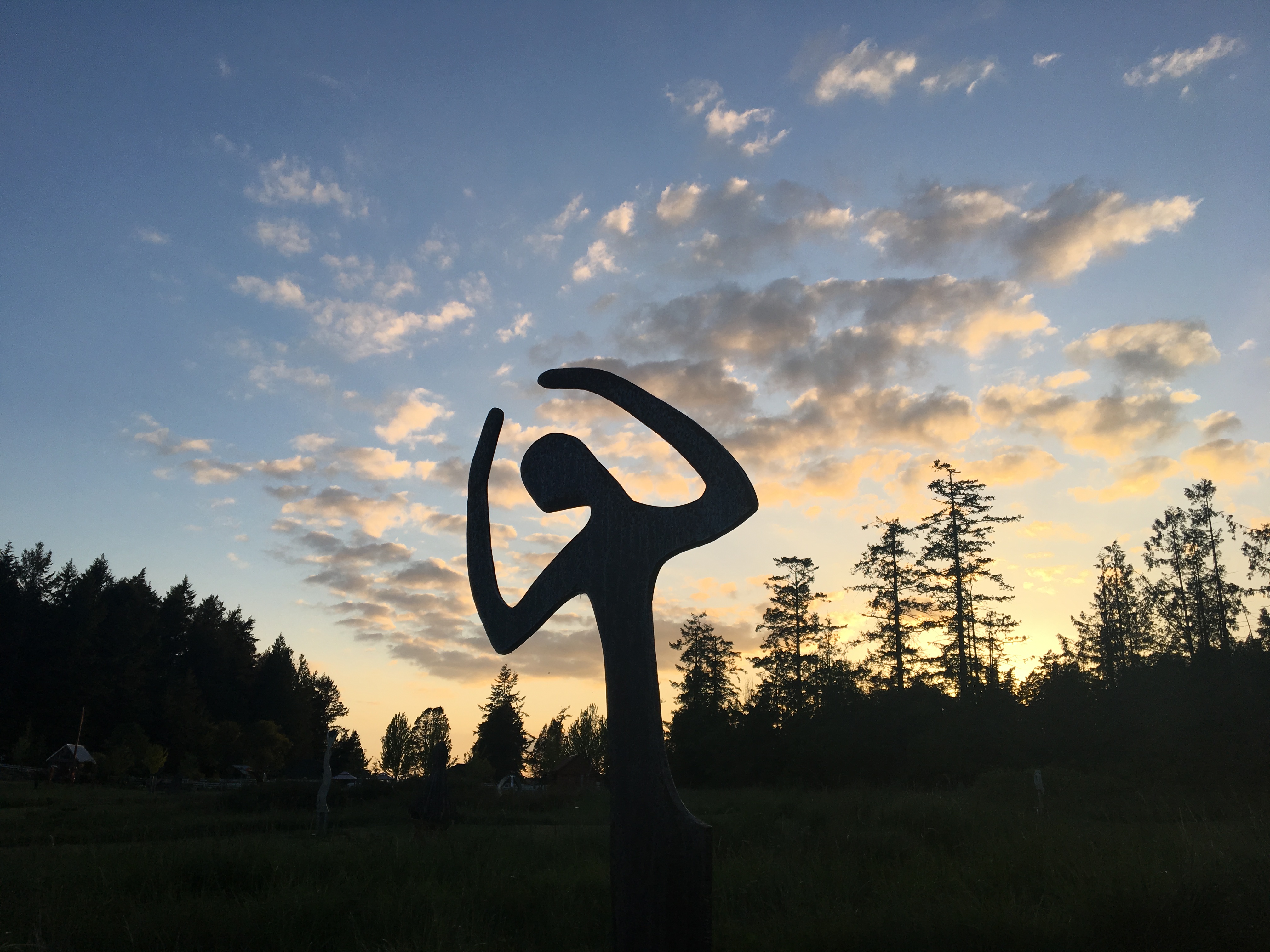
Rumor had it when I first moved on island, that the caretaker of the San Juan Islands Sculpture Park & Nature Reserve was a former curator from The Smithsonian. How extraordinarily fortunate for us, I thought. Rumor had it pretty close. An exhibit designer with zoos, David Jenkins consulted with museums, and ultimately as the Associate Director of the National Zoo at the Smithsonian Institution. Upon retirement to San Juan Island he became involved with the Trails Committee, and from there he segued into the Sculpture Park, “weeding, cleaning things up, and adding paths. Creative mowing, I call it.” 

Touring the 20-acre park in his Gator I thought of the fruit orchard farm the land had been at one time, prior to the park. Today, paths tell multiple narratives as they wind over meadows, around a pond, through woods, and down by the saltwater mud flat on Westcott Bay. Visitors come to walk, to meditate, to observe birds, wildlife, and art. Approximately 150 sculptures are there at any given time, predominantly from the Pacific Northwest. Works of art are on commission, Roche Harbor owns the land, and with 65,000 visitors a year the Sculpture Park is self-supporting. And a non-profit, did I mention that? 

David points out new Coast Redwoods and Giant Sequoias planted for future shade and privacy in the park. He’s planted Butterfly Bush, and pussy willows to grow into shrubs in a ditch that will fill in with run off from the private little airport nearby. Each year 1,000 daffodil bulbs are planted by hand, now totaling 12,000.

We circle the poetry contest for locals, and I know it’s David who brought poetry to the park. At the installation of one of my favorite exhibits, three Orcas in cedar by Jim Burgess, David mentions how much he enjoys it when synergy happens, and sure enough there’s a nearby sculpture, “Forged Boundaries” in steel and glass by James Mcluen revealing 20 salmon, or what one orca can eat in a day. “I believe any installation should be information,” David tells me.

Some exhibits defy information, however. The Starfish Project where children and visitors can build their own sculptures with natural beach finds in a large starfish-shaped sand area. The Prayer Wheels by Chris Moebch.  And what will be the Sculpture Park’s last project for this year: a Wind Phone, in which a visitor, any one of us, can sit and talk to someone who has passed. There are no words for that.

Originally published September 9, 2026 in the Journal of the San Juan Islands

Leave a comment

Filed under San Juan Island

Walking in the World

White Point sign

BY KIMBERLY MAYER

There are people in our lives who have an influence they’d never know. My parents instilled a love for Cape Cod that we find in many ways living here on San Juan Island in Washington. The friend in California who suggested a year or so ago that I rein in this blog to a remodeling theme: remodeling a house, remodeling a life—the same thing, in my book. Our daughter, now living in Argentina, who upon visiting before her departure grew my daily walk by a beautiful mile or two. And in sending me a video of the works of sculptor Anthony Howe on neighboring Orcas Island, my cousin in Atlanta reminding me to stay with art every day. And to try not to stray.

They are all part and parcel of who I am, why I’m here, and how I see it.

“Walking the loop” began as a tradition while living on upper Queen Anne in Seattle and continues out here today. That first loop took me around the perimeter of the hill, overlooking the Space Needle and downtown Seattle, Lake Union, and Puget Sound. Today’s loop takes me alongside Westcott Bay, and through the red, white and blue nostalgic quality of Roche Harbor Resort where everyone looks good in the light. Finally, the road meanders through an old growth forest of cedar, fir, and pine where everything grows dark and green, and back to my home on the bay.

Where the road dips down to the shoreline I experience what I call a Cape Cod moment, framed by flatlands, grasses, marshes, and horizon. In the course of this walk I may pass only one or two cars on the road, a few more in summer, on an island where every driver waves.

This is the walk my daughter grew, taking it out on a point to new terrain, the posh end of White Point Road. Here I pass tennis courts where nobody’s playing, a pond with a dock establishing someone’s swimming hole, and a private golf course back in there somewhere, for I’ve seen it from the water. Horse fencing and regally high pampas grasses standing like sentry guide the way. Crushed white shells underfoot line the one-lane road at sea level. It’s as private as private can be, except for me, out on this point.

Here I gape at houses, something that seems to be my lot in life: the desire to see myself in other spaces, other places. On walks I finish unfinished houses in my mind, or tear them down and start again. As anyone in the field knows, design is never done. When the bones are good, I may mentally repaint it, or envision it clad in cedar shingles, dark, red, natural or a weathered gray.

At home, the short video on the kinetic sculpture of Anthony Howe awaits me. It’s mesmerizing. How did my cousin know to send this now? I needed it. Isn’t art what ultimately pulls us through? All the arts, always. And art as balm, particularly in troubling times. Which is where we are today.

“After reading the newspaper on Sunday, I sit quietly and simply look at art books.” Michael Graves

10 Comments

Filed under art, design, remodeling, walking

Musings on Another House

Pemberton House

At home on the island, our project of late has been remodeling the master bath. For what has seemed like weeks, the door’s been off and there have been neither mirrors nor lights. The bath’s tile floor has been scattered with cabinet doors and baseboards, tub filled with discarded insulation, countertops laden with a jigsaw, fine tool drill, chiscels, screwdrivers and hammers.

I usually take my toothbrush from a drawer and a towel off the hook and go visit the guest bath, rather than risk my neck.

It didn’t have to be like this.

“I had a farm in Africa,” wrote Isak Dinesen. Well I nearly had a house that reminded me of her farm “at the foot of the Ngong Hills.”

This is the home I loved on San Juan Island. Situated in an interior valley with a white horse fence surrounding 6+ acres with a pond, bordered by over 500 acres of conservation land and a forever view. All light and sky and immense width and depth of landscape, looking off to snowcapped Olympics and The Strait of Haro, a glint of sea in the distance.

To me it was an Out of Africa moment every time I returned to visit this home. But to my husband it was just that little glint of sea.

The house was perfect. I could have moved in and put everything away, and within days been at work revising my book. Planning gardens, planting fruit trees, setting up a bocce court, horseshoes, a badminton net, who knows where it would have gone?

Instead we are in our seventh month of a remodel in a-home-that-needed-nearly-everything on Westcott Bay. I don’t know what it says about us that given a choice between a newer, lovely home in pristine condition and remodeling, we chose remodeling.

But I do know we did it for the chance to live on the water.

Yes, I might have been immensely happy in the other house with all the south facing light and vistas, but Paul would not have been. Where’d he go? I would wonder. And then I would know, down to the marina…

And in time it would have caught up with me too, the desire to live by the sea.

I know this every morning as I wake with flashing waters on the bay. Waterfowl at work or play, both resident and migratory, and what the old growth forest means to me. I’d be lost without the trees. Birds and trees, they have become me.

All that matters is being able to say, like Isak Dinesen, “Here I am, where I ought to be.”


7 Comments

Filed under living by the sea, waterfowl