Category Archives: San Juan Island

A Walk in the Park

By Kimberly Mayer

On Gardening 102

First rule of weeds:

pull them out.

Second rule of weeds:

prevent them from seedling.

Third rule of weeds:

mow them.

And after all that fails, call them

Wildflowers.

—David Mark Jenkins

Rumor had it when I first moved on island, that the caretaker of the San Juan Islands Sculpture Park & Nature Reserve was a former curator from The Smithsonian. How extraordinarily fortunate for us, I thought. Rumor had it pretty close. An exhibit designer with zoos, David Jenkins consulted with museums, and ultimately as the Associate Director of the National Zoo at the Smithsonian Institution. Upon retirement to San Juan Island he became involved with the Trails Committee, and from there he segued into the Sculpture Park, “weeding, cleaning things up, and adding paths. Creative mowing, I call it.” 

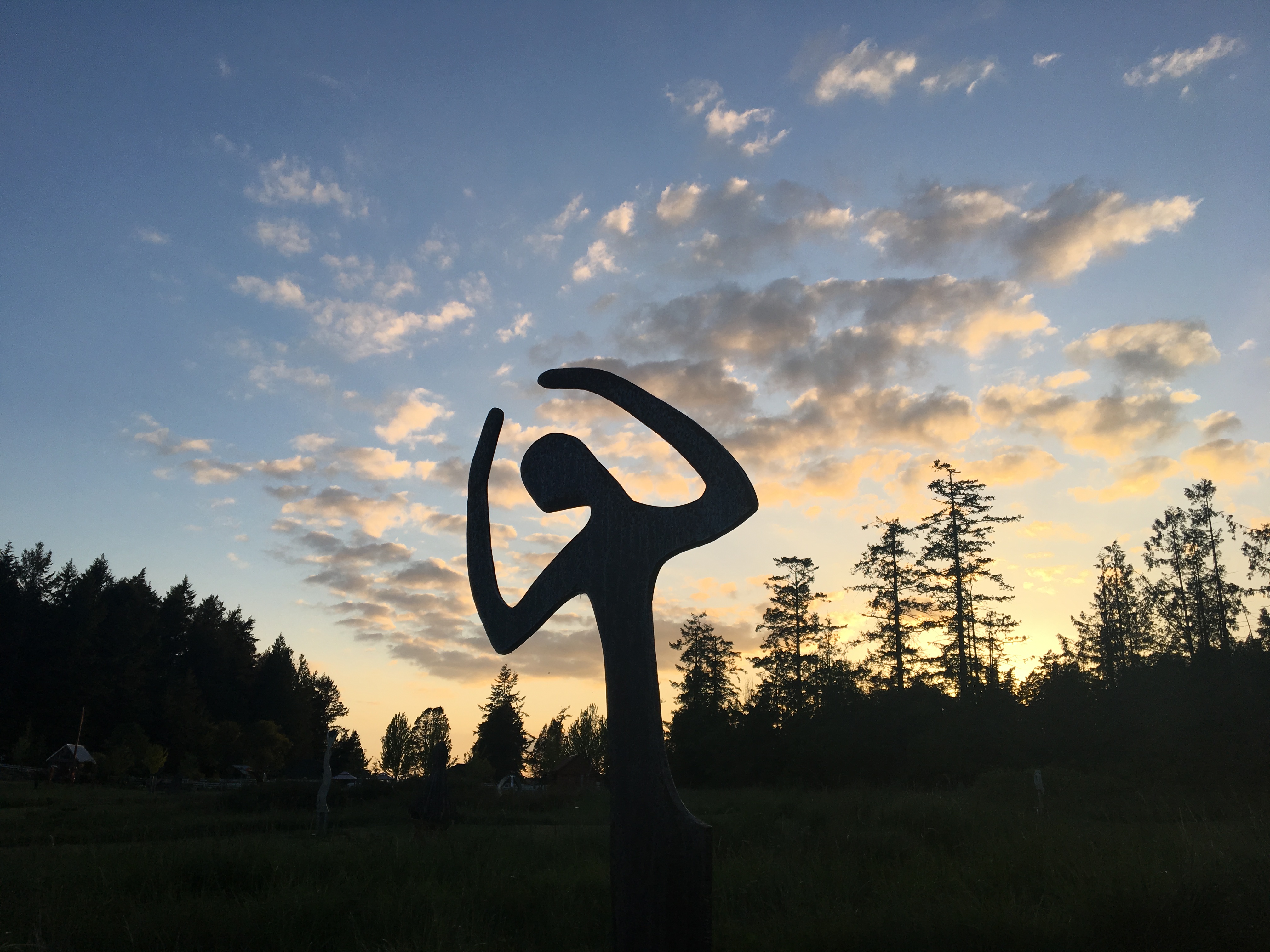
Touring the 20-acre park in his Gator I thought of the fruit orchard farm the land had been at one time, prior to the park. Today, paths tell multiple narratives as they wind over meadows, around a pond, through woods, and down by the saltwater mud flat on Westcott Bay. Visitors come to walk, to meditate, to observe birds, wildlife, and art. Approximately 150 sculptures are there at any given time, predominantly from the Pacific Northwest. Works of art are on commission, Roche Harbor owns the land, and with 65,000 visitors a year the Sculpture Park is self-supporting. And a non-profit, did I mention that? 

David points out new Coast Redwoods and Giant Sequoias planted for future shade and privacy in the park. He’s planted Butterfly Bush, and pussy willows to grow into shrubs in a ditch that will fill in with run off from the private little airport nearby. Each year 1,000 daffodil bulbs are planted by hand, now totaling 12,000.

We circle the poetry contest for locals, and I know it’s David who brought poetry to the park. At the installation of one of my favorite exhibits, three Orcas in cedar by Jim Burgess, David mentions how much he enjoys it when synergy happens, and sure enough there’s a nearby sculpture, “Forged Boundaries” in steel and glass by James Mcluen revealing 20 salmon, or what one orca can eat in a day. “I believe any installation should be information,” David tells me.

Some exhibits defy information, however. The Starfish Project where children and visitors can build their own sculptures with natural beach finds in a large starfish-shaped sand area. The Prayer Wheels by Chris Moebch.  And what will be the Sculpture Park’s last project for this year: a Wind Phone, in which a visitor, any one of us, can sit and talk to someone who has passed. There are no words for that.

Originally published September 9, 2026 in the Journal of the San Juan Islands

Leave a comment

Filed under San Juan Island

Arrr!

The booty

BY KIMBERLY MAYER

The truth is far too much fun. –Captain Hook

All of this happened in the month of June 2026, when our house on island became a pirate ship. A ship that ran aground and got stuck in the mud of a pirate cove, otherwise known as Westcott Bay, San Juan Island, Washington.

“Heave away!” our two young grandsons cried when they came to stay. Suddenly the two- story house was all about decks, the upper deck and a lower deck, depending on a shipmate’s rank. The captain generally tried to stay aloft. Between the interior set of stairs and an outdoor staircase they chased each other ‘round and ‘round all day, as pirates do on gangways.

“Let’s explore,” they cried, binoculars in hand like telescopes. Indeed everything was an adventure from the moment they sprang from their captain’s bunks fully dressed for the morrow. And what do pirates want for grub? A hot bowl of oatmeal heaped with local berries like rubies, garnets, and sapphires. Treasures!

Oyster shells stashed under the lower deck, pinecones pillaged on the ground or swept up on the upper deck, all these got tossed overboard with glee. Everything in excess, I noticed. When my pirates sauntered off to a nearby quarry for what-was-to-be a simple lesson in skipping stones, they promptly turned it into a duel of who could throw the most rocks and the biggest rocks, sending juvenile bass fish scurrying.

“Weigh anchor and hoist the mizzen! Loose the topsails!” one of them wailed when back on board, and suddenly white paper unraveled like sails from the paper roll of their easel out on the deck.

As Blackbeard said, “Time and tide waits for none.”

Author Dave Eggers knew something about pirates’ ability to capture children’s imagination when, in 2002, he opened 826 Valencia in the Mission District, San Francisco as a writing and tutoring non-profit center for children in under-resourced communities. To comply with a city ordinance for a retail establishment he opened The Pirate Supply Store on the street frontage. In the backroom, the writing lab, plenty of creative space with long tables and chairs, paper, pens, markers, whiteboards, and books. But up front, pirate supplies like nobody had ever assembled before: clothing, eye patches, compasses, spyglasses, skull flags, treasures and chests, bottled fog, and peg leg polish.

There isn’t a child on earth who would walk by that.

Originally published July 8, 2026 in the Journal of the San Juan Islands

1 Comment

Filed under grandchildren,, Island Life, San Juan Island, story telling

The Wildflower Cure 

By Kimberly Mayer                

How can one help but not fall into a funk when the world is off its axis? What have we here?  A war no one wants, a president no one wants, everything imploding and harkening  back  to a darker time in civil rights, voting rights, environmental policy, medicine and health care, disregard of law, disregard of international law,… I could go on.

“Go and see the wildflowers. That’ll cheer you up,” my good neighbor suggested. We knew where to go. It was the time of year to hike the trails up Young Hill in English Camp on San Juan Island, and none too late for blooms.

“My first spring on San Juan Island,” wrote Susan Vernon in Rainshadow World: A Naturalist’s Year in the San Juan Islands, “a neighbor told me about walking up Young Hill to see the shooting stars. It took me a moment to realize she was talking about wildflowers and not a celestial event.” 

Walking through Miners Lettuce near the base it wasn’t long before we came upon the Shooting Stars (Dodecatheon hendersonii) in fushia pink and purple, their petals swept backwards like the tail end of a shooting star. Such optimism and verve! Wildflowers spread themselves in clusters or drifts, pretty much one type at a time.  In yellows, we passed Oregon grape (Berberis aquifolum) and abounding amounts of Western Buttercup (Ranunculus occidentalis). Before long the blue- violet Small Camas, also known as Camassia quamash, appeared on grassy slopes. The bulb of this plant, which when cooked tastes like sweet potatoes, was an important nutrient for First Peoples, and the islands provided a great source of the bulb as European settlements grew on the mainland. 

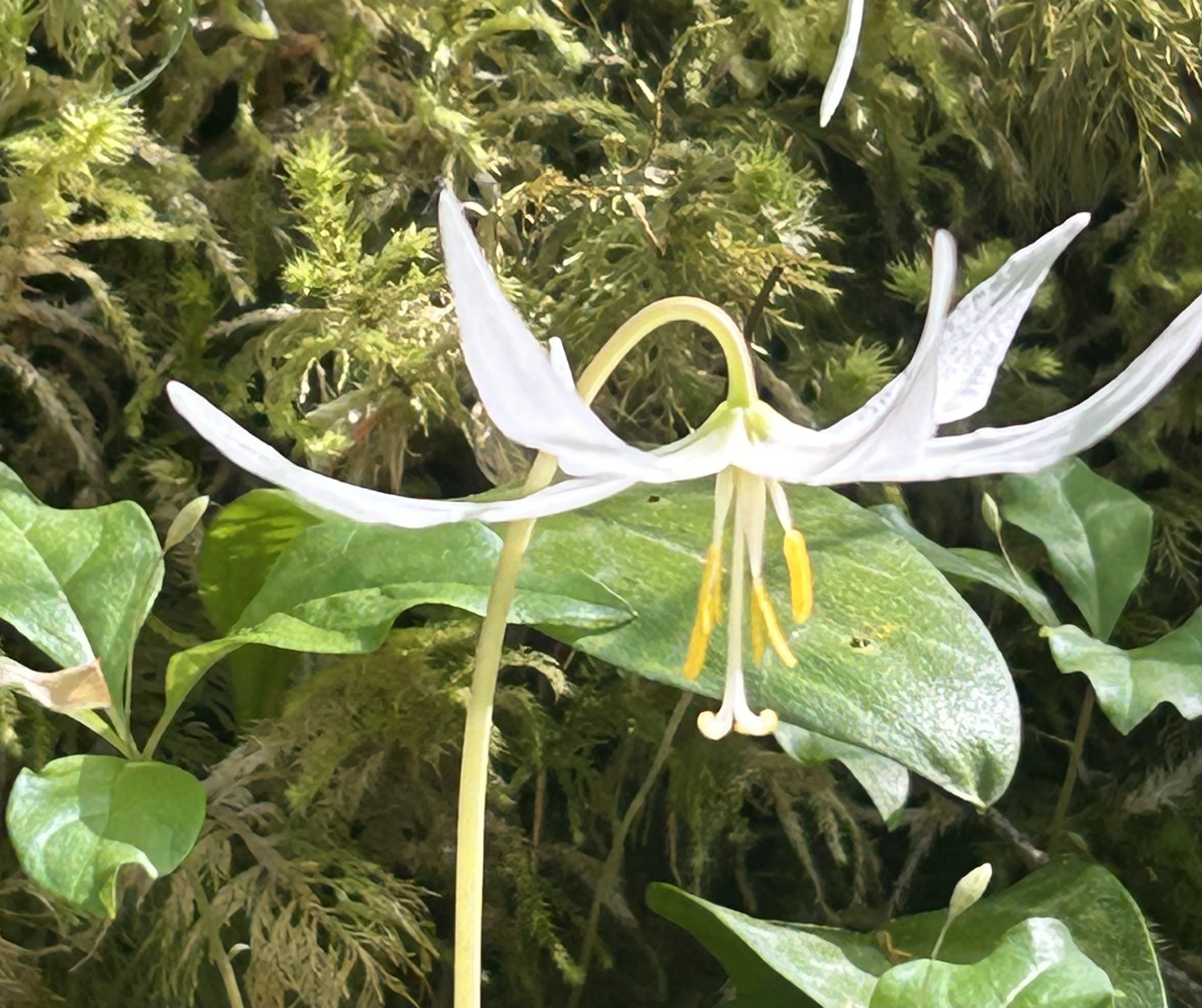
Then I saw it, The White Fawn Lily (Erythronium oregonum). Sometimes it all comes down to a single flower. A creamy white bell-shaped flower with recurved petals. Also known as Oregon Fawn Lily, it only grows on the Pacific Coast Ranges from southwestern British Columbia to northern California. An obscure beauty, here for only a fleeting moment in early spring. Blooming its head off, upside down! Just like us. 

Then back down it goes as a long living bulb. And that too is our world, underground.

Originally published Wednesday May 13, 2026 in The Journal of the San Juan Islands

1 Comment

Filed under nature, opinion, San Juan Island

What Brings Me Back

BY KIMBERLY MAYER

What drove me away from the islands in December was the darkness. Now, three months later in San Diego, I am almost ruined. All that light! Even in the historic rainfall this winter, bomb cyclones or atmospheric rivers–call it what you will–there was light. And I got used to that.

Now we leave SoCal, the land of shiny white cars, and drive up the coast, traverse Oregon, the land of trucks, and all of Washington, the land of gray SUV’s. Enormous states all. Finally, ferrying out to what our five-year old grandson refers to as “going to that other country…” 

I think that’s what breaks my heart.

I had thought we’d be returning to the island with the rufous hummingbirds, coming up from southern US and Mexico at the same time as them. In my mind’s eye salmonberry and red flowering current would be abloom for our feisty little friends, and we would start being their handmaidens, crazily filling their feeders. Bags of sugar flying off the grocer’s shelf like it was days before Thanksgiving. Kayaks and paddle boards coming and going, revolving doors of houseguests, and every meal on the deck. I saw all this, with spring accelerating into summer.

But there’s more winter to get through apparently. Our route will be more coastal, but still, a Monster Blizzard in the Sierras. Snowfall on island. We’re packing snow chains for the road trip. But it was never about snow; it was the lack of light. Snow is beautiful. And it’s bright. 

If there’s one thing we can’t predict, it’s nature. Winter or spring, we’re coming home. To the woods by the sea where Douglas firs and cedars stand and greet us, and madrone trees bend and beckon with open arms. 

Originally published 3/21/2024 in The Journal of The San Juan Islands

3 Comments

Filed under absence of light, San Juan Island, Solana Beach CA, West Coast