Author Archives: a little elbow room

a little elbow room's avatar

About a little elbow room

Kimberly Mayer received a B.A. from Emerson College, Boston, and an M.F.A from Goddard College. Her memoir, "The Making of a Master Gardener" was awarded first place in the Pacific Northwest Writing Association Literary Contest. She recently completed her first novel, "Black Angels," and is currently at work on a sequel to it. Kimberly lives, writes, and revises in Seattle, Washington. Currently, Kimberly is a Contributing Blogger at "Pyragraph," the online magazine for the arts. http://www.pyragraph.com/?s=Kimberly+Mayer

The New Year’s Resolution that Silenced the Room

It was a small and informal gathering on New Years Eve at the home of a friend we’ll call Teri as that’s her name. Teri is an uncommon person, filled to the brim with inner peace. In the hope that some of it might spill over, I always try to sit next to her.

We dined on roasted turkey and grilled salmon with a blackberry and ginger sauce. We wined and clicked champagne glasses a few times. Three dogs played around the room. Most of us were all of an age where our children have grown and gone. Dogs stick around.

Teri looked stunning. One guest presented her with a scarf which she tied on and wore with aplomb. Next she came out with a beautifully proportioned chocolate hazelnut torte atop a vintage glass cake stand. I noted how much more exquisite baked goods look with a little elevation. Something that bakeries have known for ages, and we have only just now adopted.

With a couple hours still to go to midnight, our hostess was trying to keep the party going. She suggested we share our resolutions for the new year, and since no one spoke up, Teri began. Glasses were filled once again, and we were all seated around the living room and around the storyteller.

She began. Her story climbed like a trek with windings, switches, and sidetracks, and then unfolded, articulating a new years resolution that brought silence to the room. Her story was of elephants and I will do my best to retell.

Many years ago Teri felt the urge to go to Nepal, alone, and signed up for an eco tour. The group would study the Gangetic river dolphin in the remote western region of Nepal. Requiring deep pools of water, the dolphin were endangered by plans to build a dam. But before departing on the expedition, Teri discovered a lump in her breast.

“Medical professionals kept assuring me that in 90% of the cases, the lump meant nothing,” she recalls. “But in test after test, I kept falling into that 10%.”

Suddenly it was time to operate.

The Nepal trip was only two weeks out, and Teri held onto it. In the process, “I became known as the woman going to Nepal, rather than a woman with breast cancer.” She readied herself with packing, got all the required immunizations, and put everything in order in hope that she could go. Most remarkably, she determined that anyone signed up for an eco tour such as this would be either a naturalist or a biologist, and in all likelihood she would find someone to help administer her follow up care. Indeed, her tent mate in Nepal turned out to be an oncology nurse.

From camp, they rode elephants into the jungle. Passengers sat facing out, two riders per elephant, with one driver behind the elephant’s head directing him with a stick. There was no road, no path, just into the jungle they stepped.

“And every time he hit the giant beast,” Teri recalled, “the elephant would reach up with his trunk and pull down massive branches, demonstrating incredible power and strength. It was terrifying.”

But then one of the passengers dropped a lens cover, and by giving a different type of poke the guide  somehow communicated the problem to the elephant. As gentle as can be, the elephant fished around the ground with his trunk, found the lens cap, picked it up and handed it the guide. From that moment on, Teri had a new respect for the massive beast.

photo-145

Out of the jungle and down by the river, the elephants demonstrated a playful, gentle, side. The trek continued peacefully following a path alongside the river. At night in the camp while sleeping in her hut, Teri drew comfort from the sound of elephants trumpeting in the distance.

Such was her elephant experience, then came her recent dream.

“In my dream, my husband and I had moved from our house into a smaller apartment. It wasn’t adequate,” she noted, “but I kept insisting everything was alright, it would only be for one year. That’s what I kept saying.”

However everything was not alright.

“I went back to our house to check on my elephants, and they were gone. ‘Where are they?’ I cried.”

“I had to send them off to the butcher,” was the reply.” The butcher!

Teri shuddered and explained her dream as if just awakening, right there on her living room sofa on New Years Eve.

“I believe that the dream was telling me we cannot justify wasting our time, in this case a year. And that I need to think big. I had made my world too small, and elephants don’t breed in captivity.”

“Elephants are all about fragility and gentleness, as well as strength and power. I know what I have to do,” our hostess smiled, “I have to tend to my elephants.”

Then she asked if anyone else would care to share their resolution, and the room was silent. We all knew what we had to do: tend to our elephants too.

Teri Clifford has a Masters Degree in Developmental Psychology. She holds principal’s, administrator’s and special education certificates. Teri is a Reiki Master, a hypnotist, as well as a minister in the Universal Life Church. She advocates for children and their families towards success in life as well as educational settings. Teri also has a healing practice. She lives in Seattle, Washington and can be reached at tericlifford@comcast.net

5 Comments

Filed under breast cancer, elephant, new year's resolution

My Early Retirement Plan

San Francisco has long felt like a missed chapter in my life. In an effort to make it up, we have celebrated Christmas there the past couple of years. And now, all I want for Christmas is San Francisco.

Where else in your own country do you land and find that the billboards speak a language of their own, intelligible only to natives? And where else do cabs come and pick you up without any apparent call, and deliver you without any sign of payment? I know my daughters have something to do with this. They know the workings of this city. They are enmeshed in it, while it baffles me. But then, I am easily baffled by technology and enchanted by magic, so San Francisco is for me too. I don’t know how it works but it does, remarkably so.

Where else would you dine on sushi at a restaurant named Tsunami? And find stocking stuffers in a toy store named Tantrum?

With two daughters living there we have a place to stay. Their flat is in Buena Vista alongside the park. It’s the best of both worlds: a rather posh area on the edge of Haight Ashbury.

In The Haight I meet many Tibetans minding their stores. I delight in their colorful goods, listen to their stories, and purchase a strand of prayer beads to drape around a Santo in my writing room in Seattle. The beads are in honor of a friend I grew up with in Connecticut, only to learn decades later that she has become a Buddhist. Janie, if you are reading this, it is one more example of you “walking the walk” in life, while all I do is write about it. How I love and admire you, Jane.

Contradictions co-exist in all cities, but seem more extreme in San Francisco. The Wall Street of the West, the birthplace of so many start-ups, and surely one of the “establishments” of bohemian lifestyle. Oh, the splendor and the squalor of it all!

And just when you thought that everyone in this fair city is young, up on the 19th floor of The Mark Hopkins Hotel at 1 Nob Hill, an older generation is enjoying cocktails and dancing after dark at The Top of the Mark. Men in jackets and ties, women dressed to the nines. A Tony Bennett kind of place where the male vocalists sound like him, and all the women, like Etta James or Nina Simone.

Honey, if we live in San Francisco oneday, that is where we will go if we grow old and can afford it. They’ll be playing The Beatles songs by then, and our appetite will have finally shrunk, and we could make a dinner of appetizers and just keep dancing….

But how in the world will we ever get up that hill?

6 Comments

Filed under Christmas, San Francisco

Days That Never Go Away

For days now I have had an unshakeable identity I hadn’t felt for a long time, and that is that I am a Connecticut girl born and bred. However much I ventured off and adopted other regions, it all came back to Connecticut for me this week with the shootings at Sandy Hook Elementary School. I think everyone felt this way. We all became Connecticut citizens at that moment.

I thought I could see my old neighborhood in the images. It looked familiar enough, all the parents and children, houses and trees. I saw my bucolic childhood. A time when no one locked doors. When no one other than hunters owned guns, and they took them away to wherever it was they went to hunt. While we were growing up the only guns we saw were in television shows, cop dramas and westerns, Dragnet and 77 Sunset Strip, Rawhide and Bonanza. In other words, when you saw a gun, you knew it was a toy.

And that is where I reached the end of the road in resemblance. No home then would have possessed assault weapons as this one did in Newtown, Connecticut. The Right to Bear Arms has become unbearable. Our children deserve the right to be safe. The British aren’t coming, and hunters can hunt in designated reserves where their arms are checked in, just as we leave our boats in marinas.

Gun control has long been an issue in my house. Twenty years ago when I was despairing over all the guns that were already out there, even if we could stop the sales tomorrow, my seven year old at the time said, “That’s easy, mom. They just have to stop making bullets.”

I knew she was right; if we wrap our heads around it, we can do anything. Now a woman of twenty-seven, nothing has happened in our nation in this regard. Nothing with the exception of more casualties. But just this week in the intro to her blog she wrote, “It seems like there is enough momentum to create some real change in the coming years.”(http://amadcity.com/2012/12/14/hope-take-two/).

Let’s topple the gun lobbyists who have held this country hostage for far too long. Let’s put our technology to the task. And let’s see that our country runs more like a National Park, realizing that we are at once both the caretakers and the precious wildlife.

4 Comments

Filed under assault weapons, childhood, gun control, gun lobbyists

Post Office Bay

Every year at this time I throw myself into doing Christmas cards with a devotion that astounds even me. The reason why, of course, is that some of us have moved more than we ever would have imagined, or have seen so many others off, that Christmas cards, when it comes down to it, are often the last link. So I hold onto the tradition in an effort not to let people slip through the crack.

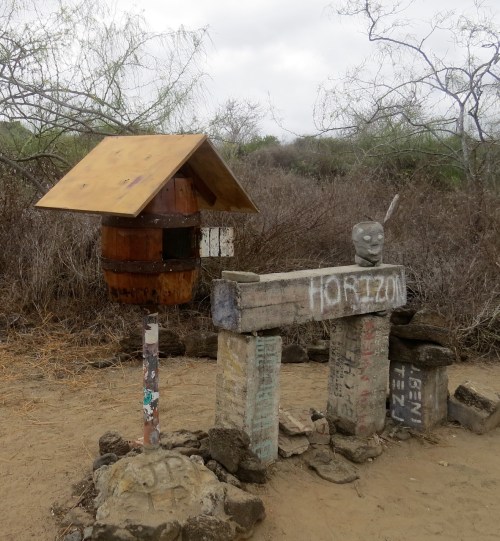
A few weeks ago I wrote about the birdhouse-like constructions of Little Free Libraries. (https://alittleelbowroom.com/2012/11/14/shrines-in-the-hood/). Then, in the midst of the Pacific Ocean on Floreana Island in the archipelago of Galapagos, I encountered an old wooden barrel with a door carved into its side and a belly full of mail, serving as a post office. Easily the earliest mailing system in the East Tropical Pacific and possibly the only free one in the world, the post office barrel is remarkably similar to Little Free Libraries in its simplicity, intent, and reliance on the kindness of strangers.

IMG_1766-4

In the late 1700’s the Galapagos was a frequent stop for whalers. On an island with a landing beach of volcanic origin and sea lions lying in the sun, a British naval captain by the name of James Colvett placed the barrel and declared, “Everyone can drop off his letters, but he must also take the mail having his same destination and deliver it to its addressee.” Thus outbound ships rounding the cape dropped mail off, and returning ships delivered it.

Post Office Bay works much the same way today. As visitors we are encouraged to leave postcards and take home any that we could deliver. I sat down and read through them all except those in other languages. Over and over, people expressed their astonishment with a place nearly perfect ecologically. Yellow Warblers, Lava Herons, Great Blue Herons, Marine Iguanas, Lava Lizards ran around us while we wrote, and we were as comfortable with them as they were with us. Such was the joy people tried in every way to express in their postcards: “nothing runs away from us here!”

Galapagos illustrates an important lesson, and that is that fear can be unlearned. It was not until 1959 that Ecuador designated 97% of the Galapagos Islands’ land area a National Park. Up until then, in the days of buccaneers, pirates, convicts and colonists, there was all manner of pillage and plunder of wildlife. Now no one treads but eco-touring visitors, walking around the nests and not disturbing anything. I want to read all kinds of hopefulness in this, for wildlife, for humans, for earth.

Something tells me I will never forget, but if the postcard I addressed to myself on Post Office Bay ever shows up, I asked the carrier to “remind me how happy I am here.”

2 Comments

Filed under christmas cards, eco-touring, Galapagos Sea Lion, Great Blue Heron, Lava Heron, Lava Lizard, Marine Iguana, postal system, Yellow Warbler

Miracles Come Up Where They May

I spent a fair amount of Sundays at church in my life, and one of the things I came away with is a fondness for benedictions. Perhaps in part because the benediction was always at the end of each service, but one particular minister’s parting words, “Now go, and take on the day!” inspire me still. First thing in the morning I summon these words to sit down and write, and today is no exception.

Last week I was hiking with an esteemed naturalist in the Galapagos, crossing over an uninhabited island to a particular beach. I believe we were on Isla Espanola that day. Here’s the problem: my journal got lost somewhere on the long route home to Seattle by way of Quito, Ecuador, Lima, Peru, and Los Angeles, and all the days and islands of Galapagos are running together. I’ve filled out lost & found forms with every airport, every airline, and each day hope to hear from one of them. And yet I know, I should let it go. As Mark Twain put it, “If you tell the truth, you don’t have to remember anything.”

Billy, the naturalist, wanted to show us where an extraordinary number of sea turtles make their nests. When we reached the beach the only imprints were turtle tracks, running perpendicular between the water and the shore. High up on the shore—hours of trekking for a turtle—a honeycomb pattern of multiple nests were dug in the sand between grasses. Once eggs are laid, mother sea turtles crawl out to sea, never to return to the nest. Upon hatching, baby sea turtles make their own trek to the water.

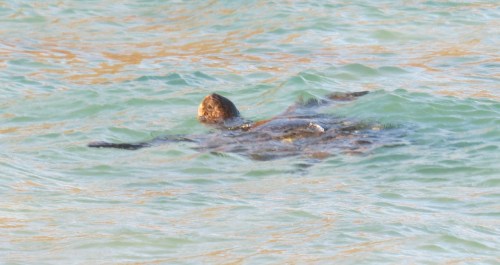
Looking out to sea, we could see numerous sea turtles treading water by the edge. Billy explained that they were awaiting sunset—mind you, we are on the equator here—to start their journey toward the nesting spot. Half a night climbing up onto the beach, and half a night making it back. No predators around, it looked perfect but for one thing: two large sea turtles hadn’t quite made it back to the water. They lay on the beach, their heads buried deep in sand. Heartbreaking.

I questioned whether the three of us could possibly lift each turtle and help it back to sea, but Billy explained that they were dead. Most likely they had started their trek back to sea too close to sunrise, and got caught in the heat of the day. And besides, we are not to interfere with nature in the Galapagos Islands. I knew that, of course, but I had to ask.

At that point the three of us went off and took a little time to ourselves. I sat down on a piece of driftwood facing the two mother sea turtles and sort of praying. I’m not sure what I mean exactly by praying, but all my thoughts went out to those two magnificent turtles whose last act on earth was to lay eggs.

Suddenly–no not suddenly, for nothing is sudden with sea turtles on land–I noticed that one of them had repositioned her body. What had been a parallel position to the water’s edge was now perpendicular, with her tail end toward me. Running down there I could see she was moving.

IMG_1817-1

“Billy, Billy,” I screamed, then I ran up the beach to get him. Billy ran back with me and the two of us were dancing around and jumping for joy—by now all the sand was marked up with human imprints. We saw the sea turtle reach the waves, and the waves wash over her, and we knew that with each laborious step she was finally cooling off after a long, hot, beached day.

Billy and I then went to inspect the other one. The body unmoved, head still buried in the sand, and once again Billy pronounced her dead. But we stayed with her, and in a sense that is what I think prayer must be: paying total attention. Sitting on the driftwood or standing by their side, I had no other thoughts but for these turtles.

She responded by blowing bubbles. At first we weren’t sure what we were seeing. But her head slowly came up, eyelids lifted, and this one too was alive! Slowly she swung herself around, orienting herself to the water. And we saw her off as well.

IMG_1828_3

Call me crazy, but I felt we had witnessed two miracles that day. More than witness, I was certain that it was our thoughts, our prayers, and our love that made them rise. And that without our presence, it may not have happened. I still feel that way.

I may have lost my journal on the expedition, but the stories of Galapagos are etched in my heart. A place so perfectly environmentally balanced, it felt wrong to ever leave. And especially wrong to step on exhaust-spewing planes to go home…. except to spread the word.

6 Comments

Filed under benediction, miracles, sea turtles

Shrines in the Hood

I don’t know why I log onto news some mornings. A woman in Arizona ran over her husband with a car because he had not voted in the presidential election. An elderly man in New Zealand is under court orders to keep 550 yards from the visiting Prince Charles and Camilla. Apparently in 1994 he sprayed Prince Charles with air fresheners “to remove the stink of royalty.” This time what he had in mind was more like horse manure. And back in this country, the CIA/FBI/Pentagon sex & email scandal implodes like a house of cards in high school.

I don’t know about you, but I’m going for a walk.

Just a few steps from home, I found it: a little civility. It looked, at first glance, like a birdhouse. Little Free Libraries, standing on posts alongside sidewalks in residential neighborhoods. Each hutch hosts a remarkably full, ever-changing variety of books, protected from the weather.

Little Free Libraries is the brainchild of a couple of men from Wisconsin, Rick Brooks and Todd Bol. When Bol’s mother, a school teacher, died, he built a memorial for her in his front yard. Shaped like a little red schoolhouse, it offered free books to passersby. People loved the idea and hired him to make more. When he met up with Brooks, an outreach program manager at the University of Wisconsin-Madison, a social enterprise was launched.

Today Little Free Libraries have popped up in over forty states and are going international–more than 40 in Ghana alone. And I’m lucky enough to have one on my walk to town. I regard it as a shrine. Today I lent a book of poetry and borrowed Willa Cather’s O Pioneer!

Using no start-up capital, Todd Bol and Rick Brooks founded a chain of micro lending libraries that help build community, much like bookgroups. Donations and volunteerism keep it all going. “(Neighbors) would tell me they had met more people than in the last 10 years, 20 years, 30 years,” noted Bol. Brooks concurs, “This is obviously about more than just books. Something is going on.”

Something is going on. Some people are thinking of ways to make the world a better place. And the more we all read, the better behaved we all are, and the more we stay out of trouble. It’s a start anyway.

Visit their site, http://www.littlefreelibrary.org/

7 Comments

Filed under free books

Falling Leaves and First Ladies

Tuesday was the longest day. I don’t think many of us knew what to do with ourselves. Of course, some people were simply standing in lines to vote. Unbelievable images when you take into consideration that we are not a new democracy, and when you appreciate all our advanced technology. Still, people stood patiently in lines long past polling hours.

When I was at home in the day, I made calls. When I was out, I went for long walks amongst the trees. The sun was out and I took that as a sign. And I needed the air. Finally, I settled into raking leaves around my house. Bright yellows, golds, red and orange leaves that were lovely and falling at the same rate I could gather them. Nevertheless, it seemed important that I try to make things tidy. It was an impossibly long day, waiting for the results to roll in. And when I was done raking, I did it again.

Keep America Beautiful came to mind, the nonprofit organization Lady Bird Johnson embraced. I have heard that before her campaign, it was quite common for Americans to throw trash out their car windows. Our highways were littered, and in the course of inspiring people to clean up the trash she went a step further and proposed roadside wildflowers, a program that would sustain itself. (And the idea being that people would be less inclined to litter when the landscape was lovely). Lady Bird worked tirelessly to restore natural beauty to America’s public spaces. This was before we even had the word for environmentalism, but she understood it. She knew the impact it would have on the quality of our lives and communities.

While twice filling the yard waste bin it occurred to me that Lady Bird may be one of our most underappreciated First Ladies. I was also thinking it may be safe to come in now. It was dark and in the street lights the leaves in trees looked like blossoms. Another sign?

I’d enough air, I could breathe. I can make it.

And indeed, it’s over. The center is holding and we were not derailed. We can all go forward with what we do in this beautiful country of ours.

Now, where was I?

3 Comments

Filed under election

Hair of the Dog

Seattle is, as they say, a city of neighborhoods, and when we first moved to Queen Anne, the local 5 Spot restaurant was particularly welcoming. We liked to sit and eat at the bar, watch a UW game or the Mariners, and befriend the bartender. Hank may have been the first person in town to remember our names every time, and so the 5 Spot became for us, the local Cheers bar.

Every now and then we feel in need of that again. Earlier this week, at a time of high election angst, we returned. (It is important to note here that this was before Hurricane Sandy made landfall). The intensity of the election was, at that time, Category 4, all consuming and draining. As Anne Lamott put it, “This is no way to live–rooting around the internet and twitter sites like a truffle hound, looking for better polls.” We had to get out of the house.

Once again, the 5 Spot was just the ticket. For those who are unfamiliar, the 5 Spot continually celebrates an “American Food Festival” by changing its theme every three months.  Sometimes it’s Texas, New Orleans or New York. Currently the theme was Washington D.C. Of course it would be.

Customers entered via a red or blue door to a restaurant decorated with every red, white and blue cliché: stars & stripes, beads, hats and streamers. It felt like one enormous rally. It felt like election night. And it occurred to us that maybe this was one way to deflect from the election, by just stepping right into it. Soon it would all be over, in other words.

“Vote with Your Liver” screamed the cocktails menu. Although I knew we would be ordering our usual iced teas, it was a good read:

Let Me Be Clear Martini, “no details, perfectly clear”

Bain Baubles & Bubbles, “silly, what recession?”

Joe’s Scranton Manhattan

Private Sector Sunrise, “we build, you drink, no interference”

Hair of the Dog, “for those mornings when you feel like you were tied to the roof of your car”

One of my goals this campaign season was to change my mother’s mind, to get her “to vote like a woman.” I wrote a blog post on the subject, “Don’t Call Me During the Debates,” and told mom that I had written it for her. And in every conversation I tried in some way to convince her. Then one day she informed me that it was too late.

“Your father and I have already voted,” she said.

“So there’s no sense talking to you anymore?” I quipped.

Mom laughed, I laughed.

Well, maybe I will try a Hair of the Dog cocktail afterall.

The specialty menu at 5 Spot offered Congressional House Hash, Marion Barry Cakes, White House Standoff, Koch Bros. Memorial Super Pac Porkity Pork Wich, and Initiative 502 “Herb” Salad (in reference to Washington state’s marijuana legalization initiative). I went with my usual, Cobb Salad.

There was no room for dessert. We had so much on our plates. Slurping to the bottom of my Hair of the Dog I was thinking, we can’t go back and protest for women’s rights again, not twice in one lifetime! I want to pray, please let Obama win so I can get on with my work!

Meanwhile, over on the Eastern seaboard, global warming was at our door. And she didn’t knock, and she didn’t just huff and puff, but blew our house down. How many times do we have to be reminded? Nature rules.

Vote, and vote intelligently.

6 Comments

Filed under Category 4

All Aboard!

As a child traveling Pullman cars with my family through the south and on trips out west, I had a romance with the railroads.  Smiling porters, seemingly as happy as I. Gleaming brass and wood, the freshest of linens, service whenever we wanted it, and always with that smile. I had no idea at the time what a moment in history we were caught in.

The first Pullman porters were recruited from the first generation of black men to be freed. It had to be considered a desirable occupation at the time. Porters were trained in schools and wore their uniform proudly, but their working conditions were horrendous. Meager wages, hurried meals, 400 hours of work per month, catering to rich white passengers, some of whom felt free to buzz all night and call any porter “George,” after George Pullman.

And yet the Pullman porters’ contribution to the Civil Rights Movement was immense. Forming the Brotherhood of Sleeping Car Porters in 1937, it was the first organized black labor union and wages finally  improved. Porters were couriers for “The Chicago Defender,” an African American newspaper that advertised job and living opportunities in the urban north, helping to encourage the migration of African Americans from the rural south.

I learned all this while enjoying the “Pullman Porter Blues” theatrical production at Seattle Repertory Theatre. The year is 1937, on the eve of the first black heavyweight championship, and hopes are high for Joe Lewis among porters aboard the Panama Limited, bound from Chicago to New Orleans. Three generations of men serve as porters. Musicians and singer Sister Juba are along for the ride, wailing blues, spirituals and slave era work songs. The set is designed like a fast moving train and moves seamlessly between luxury Pullman cars to coach, cargo, and caboose, and I’m in heaven….

And this ride isn’t over. Next stop is Arena Stage in Washington D.C. (opening November 23). We are casting our ballots out here and sending local playwright Cheryl L. West’s “Pullman Porter Blues” to “the other Washington,” as we call it. Consider them both, our vote and this production, from Seattle with love.

3 Comments

Filed under ballots

View from the Rafters

I haven’t been this nervous since seventh grade, when as captain of my debating team, I had to go before the school. I’m sure I feigned a sore throat that morning in an effort to stay home, and I’m sure my mother made me go. It was too important, something like “The Cuban Missile Crisis,” and I know I felt the weight of the world riding on my performance.

Now here I am, hours before the second presidential debate, beside myself again. And I have every confidence in my candidate. It’s not that. It’s that with so much at stake, the content of this debate is going to be shaped by people who cannot make up their minds.

Really? As a nation with one of the most critically important decisions to make, we fill the hall with undecideds? When was the last time you had an important decision to make? Did you call upon undecided people for help?

That’s what it’s like out there right now. All the emphasis is on the undecided or mixed-up states. What if you are not in a mixed up state? What if you are not a mixed up voter? We hardly matter anymore. Many of us have a pretty good idea of what we envision for our country, and suddenly, this election is no longer in our hands.

I have to get going…. the stage is all set at Hofstra University in Hempstead, New York. I can feel my old familiar bellyache, or was it a sore throat? The candidates tonight will be playing to a selected group of eighty-two uncommitted voters seated on stage, while the “general audience” sits up on rafters, in the cheap seats, in the dark. The candidates have been coached not to make eye contact with the general audience. It’s much like a microcosm of society right now. So many of us with little to do for the next three weeks but hang here in the dark, and check the daily tracking polls morning, noon and night.

8 Comments

Filed under tracking polls