Author Archives: a little elbow room

a little elbow room's avatar

About a little elbow room

Kimberly Mayer received a B.A. from Emerson College, Boston, and an M.F.A from Goddard College. Her memoir, "The Making of a Master Gardener" was awarded first place in the Pacific Northwest Writing Association Literary Contest. She recently completed her first novel, "Black Angels," and is currently at work on a sequel to it. Kimberly lives, writes, and revises in Seattle, Washington. Currently, Kimberly is a Contributing Blogger at "Pyragraph," the online magazine for the arts. http://www.pyragraph.com/?s=Kimberly+Mayer

Trouble in Paradise

IMG_0585

photo credit: Paul Mayer

BY KIMBERLY MAYER

You have to know, the island is my peaceful place, and Roche Harbor, my happy place on island. We found it first by boat, and later, we picked up our lives in the city and moved there.

Waiters informed us Roche Harbor had a microclimate of its own where the sun shines nearly every day, and now we know that to be true. It’s where everyone looks good in that light. Where children don’t whine, and babies don’t cry. Where children are capable kayakers or driving around in dinghies. And young ones are entertained with a net and a bucket on the docks until bedtime. A life jacket over their pajamas, rather than a computer in hand.

Where the Our Lady of Good Voyage chapel rings out beloved songs in bells. It’s where a parade of pets goes by daily: Goldens and Golden Doodles, Spaniels, Pugs and Poodles. A dog on nearly every boat, and the dogs look good in the light too. Hell, it looks like a Ralph Lauren ad.

We purchased a home to be near that light. And every day we circle through Roche Harbor in the course of our walks to pick up our mail, get groceries, stroll through the gardens, and generally enjoy the facilities, a cup of coffee or a bite to eat.

All that shattered for us last week at the dog park in Roche Harbor. How often it’s empty, I notice every time I cut through the woods. Normally we’d have no use for it, but our daughter was visiting and her Brittany pup needs to run and knows no bounds—so we chose the safety of a dog park. In we went accompanied with our other daughter’s Yellow Lab and our dog “Coco,” a small American Eskimo/poodle mix. The Brittany and Yellow Lab were fetching balls while Coco stood around not knowing what to do with herself, when the gate swung open and in walked a woman with a 90lb steel gray pit bull, off-leash. Her dog didn’t hesitate to lunge toward Coco. It was clearly in kill mode.

It is difficult to recount all that happened in the space of 15 or 20 endless seconds. The pit bull lunging, singularly focused. Coco yelping and leaping about to save herself, finally landing in my husband’s arms. Him covered with her blood. It took two people to hold back the pit bull. The mouthful of Coco’s fur in his jaws. Meanwhile in the woman’s automobile, another large aggressive dog, going nuts.

“Coco’s a lucky dog,” our vet said, pointing out punctures near her lungs. Any deeper… Incisor marks all over her left foreleg, right rear leg, belly, and rear end. They are called “weeping wounds.” Bandaged initially, uncovered now for better healing.  Coco sat still all day, with little thirst or hunger, having to be carried outside to a patch of grass for the first few days. Attended day and night by four people and two gentle, caring dogs, the Yellow Lab and Brittany who watched over her.

My question is: why would anyone have such aggressive animals? And why do they bring them around? It’s hard to believe this woman lives here, on island, near Roche Harbor as do I. She obviously doesn’t see things in the same light. The light that looks good on everyone and everything, the waiters, the food, children, babies, kayaks, dinghies, boats, and dogs. She can’t possibly see it.

17 Comments

Filed under aggressive animals

Of Trees and Seas

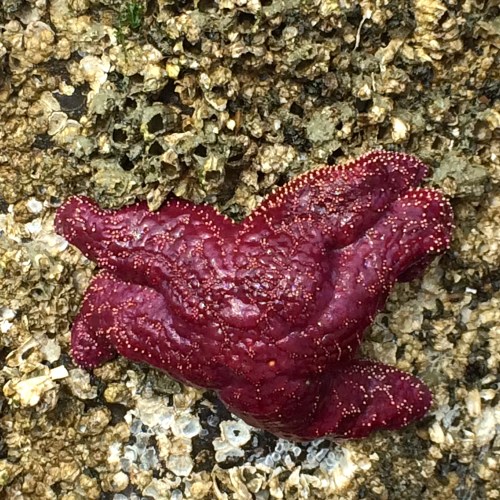
Starfish

BY KIMBERLY MAYER

When Susan Orlean asked John Laroche in her book The Orchid Thief why he loved plants, “He said he admired how adaptable and mutable they are, how they have figured out how to survive in the world.”

But I wonder… we may outfox them yet.

I recently picked up and devoured Hope Jahren’s Lab Girl, a memoir of a woman in the natural sciences. But whereas I might come at nature from the I think that I shall never see a poem as lovely as a tree brain hemisphere, Jahren, recipient of three Fulbright Awards in geobiology and tenured professor at the University of Hawai’i in Honolulu, sounded alarms good and loud from the science department.

“Planet Earth is nearly a Dr. Seuss book made real: every year since 1990 we have created more than 8 billion new stumps,” she states. “If we continue to fell healthy trees at this rate, less than 600 years from now, every tree on this planet will have been reduced to a stump.”

Some disappearances happen almost without notice in the course of one’s lifetime. Some in a matter of decades—like the colorful coral reefs in the Caribbean, now bleached. And some practically before one’s eyes, such as the magnificently large orange, red, and purple sea stars that lit up our boating trips to marinas in the Puget Sound just a few short years ago.

You know it’s a good book when what you are reading puts you in the author’s mindset. Lab Girl had me seeing like a scientist. While she examined seeds, soil, and trees, I hopped on a dock at Ganges Marina on Salt Springs Island, British Columbia and spotted starfish—something whose disappearance we have witnessed. The West Coast starfish Plague. First they go clear, and then they are gone.

You can’t imagine my delight in finding one.

Like sea life, “plants have more enemies than can be counted,” notes Jahren.

At the end of her memoir she requests that each reader plant a tree, nurture, and protect it. And “to try to see the world from its perspective.” For we are all in this together, the trees, sea stars, and us.

Here’s hoping Lab Girl sells, and sells well.

3 Comments

Filed under starfish, the environment, trees

Peace Where We Find It

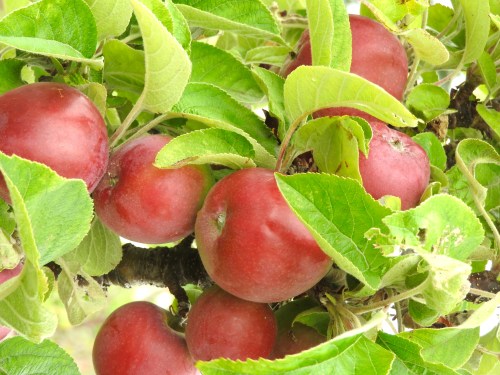
apple picNorth Pole Columnar Apples. Photo by Paul Mayer

BY KIMBERLY MAYER

Not since the 60’s has this country seen so many demonstrations. Now I am in my sixties and standing in a Demonstration Garden. What’s a Demonstration Garden, you ask? Well it’s the Master Gardeners’ way of inviting you into their space to see what grows well in a particular area and to share their gardening practices.

This place, I have decided, is my personal act of resistance. Against all the violence, hatred and bigotry in the world, this is my personal act of resistance because it is a working model. I am planting myself here as much as possible.

The first scent to hit me is fish fertilizer, and I rather like it. I’ve got dirt under my fingernails before I remember to wear my gloves, and I don’t mind that either.

Tomatoes are growing under plastic tarps for heat. In the temperate summers of the Pacific Northwest, tomatoes often need a little help. Patty pan squash, zucchini, peppers, and Bush beans aplenty. Little eggplants, dangling like amethyst earrings.

A new crop of chard is coming along, whereas my first crop is still in the process of coming up at home. Potatoes, garlic, kale. Herbs of all description. Tomatio, looking like pretty little Japanese lanterns. Grape vines gone berserk.

“And peas that are beginning to say goodnight,” as one Master Gardener put it.

Arugula that wintered-over, a skinnier leafed variety than what we are growing at home, with a more pungent peppery taste. Rhubarb, which could be grown outside the fence, as deer don’t care for it.

It’s all about food here—indeed the only blossoms are flowering food plants, artichokes, squash, and such. Despite the small plot, The Master Gardener Demonstration Garden on San Juan Island donates over 1,000 lbs. of produce annually to the Friday Harbor Food Bank, and no wonder. As we stood in the garden, Master Gardeners showed up to work carrying excess produce from their home gardens to contribute as well. Everything is organic, weighed and delivered to the Food Bank, on Wednesdays and Saturdays, just steps away.

I hopped over there to have a look and found a sweet little store, clean as can be, meticulously organized and stocked, where everything is free—all it asks of customers is island residency. Fresh produce, of course. Eggs, meat, milk, canned goods, pasta, dried beans, soups, frozen chickens, frozen sausage, and ice cream treats for kids while shopping. Some signs say take one item per shelf, or two items per shelf. Large families, of course, get extra.

Like so many things on island, the Friday Harbor Food Bank is run by volunteers. But then, this is an island where drivers in cars wave as they pass. Where there are more people walking or running or biking than driving. Where there are no traffic lights. Where the wildlife is harmless and the people are kind. Where the town of Friday Harbor looks like Main Street, Disneyland.

It isn’t fair, I get to live here.

The more I think about it, the island itself may be my personal act of resistance as well.

14 Comments

Filed under food gardening, personal act of resistance

Notes from an Old Volvo Driving South to Tahoe for the 4th of July

Tahoe Blog

BY KIMBERLY MAYER

It’s a country of alfalfa, potato, and cattle around Merrill, Oregon. Western storefronts still standing. The Wild Goose Lodge. Here Mexican food gets good. Lost River and Lava Beds National Monument, who knew?

Over the border and in California without knowing it. No wonder the green turned gray, Sage Brush and Scrub Pines. All the many Jeffrey Pine with edible leaves and a bark that smells like vanilla.

Bee farms, and rivers running dry. Barns, and farm house architecture inspired by barns. Butte Creek.

Mt. Lassen, site of my husband’s first camping trip with his parents. Their first and last time camping.

Rusted incinerators once used for burning at old saw mills. Now we repurpose the bark and chips in a multitude of ways.

We’re doing something right.

Cactus appears like roadside daisies in the North country where I come from. Ranches with acreage too vast to fence. Cattle crossing signs on the road. I think of the difference between watching for leaping deer versus a big old, going nowhere, bull.

Easy.

Transformation to an apocalyptic terrain. Looking like Death Valley.

Pit stop: we need to get out. We need to get back in the car and go. Too hot–even the dogs say so.

Eagle Lake. Susanville. Nearing Reno, more ranch country. Nothing like a city do we see. Instead John Steinbeck and The Grapes of Wrath come to mind. “Dust devils” kicking up like little cyclones.

What is that light on the dash?

Bordertown, Nevada. A white salt lake that’s been browned by dirt dust. Boomtown. Truckee River, and I know we’re getting there. Gold Ranch Road. Having grown up on the east coast, how I love these western names.

Tahoe Nat’l Forest. Squaw Valley. We’re in the Sierras here.

All the rafting on the Truckee River alongside us, as we bumper-to-bumper our way in to Tahoe City. Rafts tied up like traffic, laughing all the way. Summer break happens here & now. I’m thinking I could live here.

Freedom of movement. Haven’t I always loved that about this country?


2 Comments

Filed under roadtrip

Ode to a Flower

DSCN0480

Photo by Paul Mayer

BY KIMBERLY MAYER

Orlando. Congress. This has been a tough time in our country, what poet Beatrix Gates called “the thousand day week.” I am writing an ode to a flower because it’s the only thing pulling me through.

A year ago I planted numerous wallflower, salvia, coneflower, Iceland poppy, lavender, lupine, and Shasta Daisy—practically every perennial I could get my hands on from the drought-resistant, deer-resistant tables at our island nursery. I wanted to see what would thrive on a sunny hillside in our piece of old-growth-forest-on-the-bay.

All that I planted, and all that remains today: a trace of wallflower, a little lavender, and Shasta Daisy.

I should have taken a clue from all the roadside daisies on island. Unless you have something you have to prove to yourself, my theory in gardening is to go with what thrives. And daisy may be this island’s flower. The deer have gifted it to us.

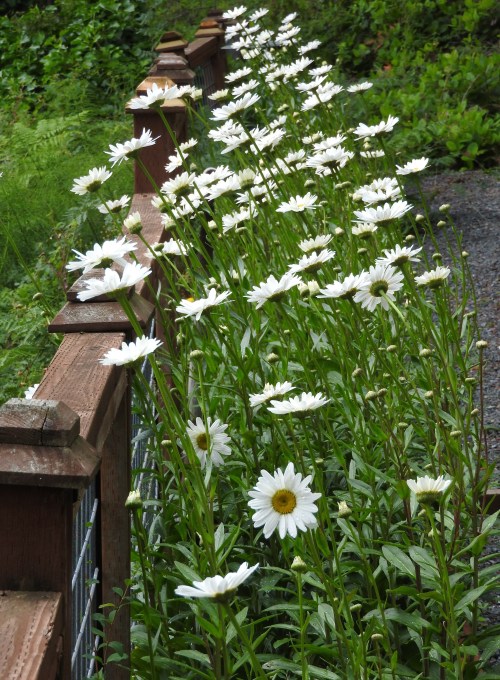
This year the variety of Shasta Daisy I have planted is Leucanthemum ‘Becky,” all along a hundred foot fence on the bank to the water, since that’s another sunny spot. Larger and more robust than the roadside daisy, growing up to 4ft tall and blooming early summer through early fall, they are all I need.

The funny thing is, they’re facing away toward the water and toward the sun. South is south, and there’s nothing we can do about it. It’s all good. Another reminder that we are not the center of the world. If Trump ever tried to garden with his tiny hands he would know that.

4 Comments

Filed under deer-resistant, drought-resistant, perennial, planting

My Next Dinner Party

1511029_10100884484707365_7520856888575245068_n

photo credit: Ashley Mayer

BY KIMBERLY MAYER

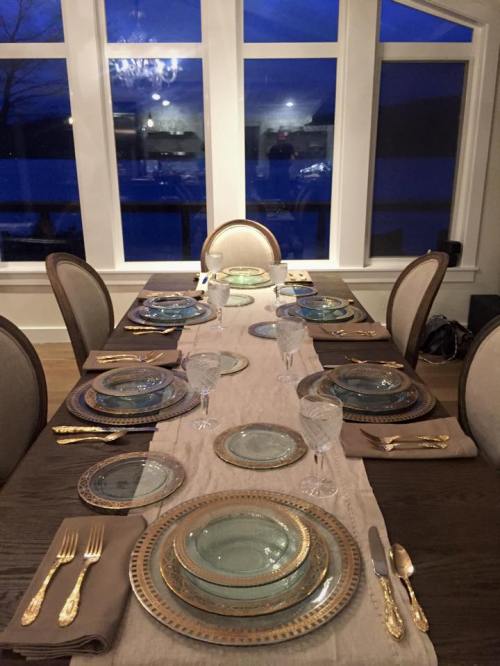
As for table decorating, it is hard to beat a simple, large plate whose design and color don’t compete with the food, a simple glass that makes the wine seems to float in air, a great big soft napkin of any color that strikes your fancy, and pots of field flowers (or weeds), or a few poppies. Lee Bailey 

Here’s an idea: assuming we only invite people whom we like to dinner, why not tell them just how much? This idea came to me when my husband returned home from a Rotary meeting one morning last week.

Our life in a nutshell: Paul seems to wake up dressed and push off like Superman. That’s what I called him back in the days he wore a three-piece suit to work. I hardly saw him. Whereas I rise slowly, brew a pot of coffee and write my Morning Pages–three pages longhand—followed by my gratitude journal entries, every day, before I even talk to anyone. So I knew something about what Paul was talking about when he said they were visited at Rotary by David Brooke, aka That Gratitude Guy.

A former Nordstrom store manager, for the past 7 years David “The Brooker” Brooke has been speaker, life coach, author, and teacher on the transformative power of gratitude, a self-described “social entrepreneur.” His message: “… no matter how stressful or tragic, (any situation in life) can be reframed and refocused into a fulfilling journey, by using the simple principles of gratefulness.”

Now I’ve probably been keeping gratitude journals longer than David’s been running workshops, so I know firsthand what he’s saying. To put it simply, starting each and every day with a gratitude list—five things for which I am grateful—has me looking up, not down. Getting off on the right foot, so to speak. Lord knows it’s way too easy to start off on the wrong one, and spend the rest of the day catching your fall.

At the breakfast meeting of The Rotary Club of San Juan Island, David passed out cards and asked each member to select a partner and write down attributes he or she appreciates about that person, then give the card to him or her. I read my husband’s card, written by a very new friend, and saw that he nailed it. All my husband’s best qualities on one card, which I have put away in a dresser drawer—to be taken out whenever I need to be reminded.

So at my next dinner party, I am going to borrow a page from David Brooke. We’ll each pick a partner and write down as many attributes as we can about the other for one minute. Then share it with him or her.

This I know before any consideration of food, wine, and what I love most, the linens and dishes and table setting—so much so that I dream of my late grandmother’s butler pantry. It’s a recurring dream of mine in which the pantry figures as prominently as any other room in the Connecticut manse.  Gram had more glasses and dishes than Crate & Barrel, and in the dead space above the mile-high cupboards, rolls and rolls of paper towels. She could house whatever she wanted to store in that pantry.

Gram would have loved Costco. And I would have loved parlor games.

4 Comments

Filed under dinner party, gratitude, table setting

Flamboyant

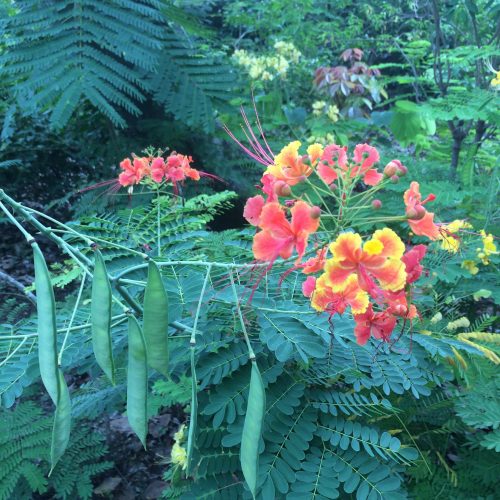
Flamboyant flower

BY KIMBERLY MAYER


I make too much of houses, I know that. I always have. So on a recent visit to the Virgin Islands to try to locate four homes I had lived in nearly forty years ago, I ran into a wall. Four walls, to be precise.

We hired a driver for a couple hours to help scout out the homes. But what I remembered were the names of the bays, not the roads. The views, not the directions. Mostly what I remembered was every little detail about the homes.

Well none of them were there, or none of them could be found. Hurricanes, developers, or my faulty memory had conspired to remove them all. We were free to pursue other interests. Such as the flora.

And for the first time—mind you, I had lived there for two full years—I took note of the tropical plants and trees. I can say that while I had always appreciated the natural beauty around me, I’d never studied the vegetation or learned many names. And as every gardener knows, knowledge of plants only increases one’s pleasure in the garden.

Years later in moving east to Philadelphia from California, I brought with me a comprehensive knowledge of Mediterranean plants. I could walk through the conservatories at Longwood Gardens identifying, and feeling at home with, my Mediterranean friends. I carried nothing like this back with me from The Virgin Islands.

The fact is, I hadn’t started gardening yet. I was in my twenties in St. Thomas, starting a shop, running a shop, and had nothing in common with Tilly-hatted, kahki-clad women kneeling on kneepads with tool bags by their side. In my free time I was literally and figuratively at the beach.

Interest in gardening is an age thing perhaps. I took it up when I had children so they might inherit it, and I took it up with fever. Later still, I wrote a manuscript around it. A couple weeks ago in Boston I found a literary agent for that gardening memoir at GrubStreet’s The Muse and the Marketplace writer’s conference. From Boston I flew directly to the Caribbean. I thought a fresh take on the houses would refreshen my book, but it’s the flora and foliage that did it.

Nature is what survives somehow, I should have known that. Nature is all that matters.


6 Comments

Filed under gardening, tropical plants and trees

What’s Pretty to Me Now

FullSizeRender-37

BY KIMBERLY MAYER

I must be living in man’s country. Just this week we met two more intelligent, good men who share my husband’s love of woodworking. Paul Bunyans of the Pacific Northwest, all of them. One by one, every house is giving up the garage or building a shed for a workshop. My Paul Bunyan’s intention is to sculpt with logs, but I’m putting in an order for a long organically-shaped “live” table as well.

Going rural changes things.

I have gone from browsing Nordstrom’s flagship store in downtown Seattle to leafing through Orvis catalogs in the mail. From loving linens to admiring homespun weaves. From manicured box hedges to an old growth forest. From a Pennsylvania bluestone patio to gravel rock. From candle light to bonfires. From dining out every week to eating in.

What is aesthetically pleasing to me now has changed. I can find beauty in firewood neatly stacked. In driftwood washed up on the shore at random. And hay, when it’s rolled in the fields later in the summer. I nearly go ecstatic; it’s like living in a French Impressionist landscape.

People with so much love in their hearts they plant daffodil bulbs in the wilderness, and make signs for art’s sake.

Euphorbia on a white fence, and English daisy in the grass. Mossy paths to anywhere. And anytime I come upon a cairn, it is magical to me.

At home: a deck that’s swept, a floor that’s swept. And the way cedar needles blend into the colors of my foyer rug so I may go awhile without vacuuming.

Rock and wood in the house. An antler wreath. Antique paddles made by my father-in-law as a young man. The ceramic Raku Fish by Tomfoolery Artworks on the wall swimming toward the sea. Our view from every room, every day.

It’s the things that were here, and are here, that we had nothing to do with. Our part, it seems to me, is to stand back and be in awe of it all.

7 Comments

Filed under aesthetics, going rural, moving to the country, woodworking

Walking in the World

White Point sign

BY KIMBERLY MAYER

There are people in our lives who have an influence they’d never know. My parents instilled a love for Cape Cod that we find in many ways living here on San Juan Island in Washington. The friend in California who suggested a year or so ago that I rein in this blog to a remodeling theme: remodeling a house, remodeling a life—the same thing, in my book. Our daughter, now living in Argentina, who upon visiting before her departure grew my daily walk by a beautiful mile or two. And in sending me a video of the works of sculptor Anthony Howe on neighboring Orcas Island, my cousin in Atlanta reminding me to stay with art every day. And to try not to stray.

They are all part and parcel of who I am, why I’m here, and how I see it.

“Walking the loop” began as a tradition while living on upper Queen Anne in Seattle and continues out here today. That first loop took me around the perimeter of the hill, overlooking the Space Needle and downtown Seattle, Lake Union, and Puget Sound. Today’s loop takes me alongside Westcott Bay, and through the red, white and blue nostalgic quality of Roche Harbor Resort where everyone looks good in the light. Finally, the road meanders through an old growth forest of cedar, fir, and pine where everything grows dark and green, and back to my home on the bay.

Where the road dips down to the shoreline I experience what I call a Cape Cod moment, framed by flatlands, grasses, marshes, and horizon. In the course of this walk I may pass only one or two cars on the road, a few more in summer, on an island where every driver waves.

This is the walk my daughter grew, taking it out on a point to new terrain, the posh end of White Point Road. Here I pass tennis courts where nobody’s playing, a pond with a dock establishing someone’s swimming hole, and a private golf course back in there somewhere, for I’ve seen it from the water. Horse fencing and regally high pampas grasses standing like sentry guide the way. Crushed white shells underfoot line the one-lane road at sea level. It’s as private as private can be, except for me, out on this point.

Here I gape at houses, something that seems to be my lot in life: the desire to see myself in other spaces, other places. On walks I finish unfinished houses in my mind, or tear them down and start again. As anyone in the field knows, design is never done. When the bones are good, I may mentally repaint it, or envision it clad in cedar shingles, dark, red, natural or a weathered gray.

At home, the short video on the kinetic sculpture of Anthony Howe awaits me. It’s mesmerizing. How did my cousin know to send this now? I needed it. Isn’t art what ultimately pulls us through? All the arts, always. And art as balm, particularly in troubling times. Which is where we are today.

“After reading the newspaper on Sunday, I sit quietly and simply look at art books.” Michael Graves

10 Comments

Filed under art, design, remodeling, walking

Finding Bigfoot

Bigfoot4_p01

BY KIMBERLY MAYER

I don’t know that I’ve ever stayed in one of the WPA era National Park Service Rustic Lodges, but I’ve been there in my dreams. Where guests rock in rocking chairs with wool throws over their laps and steaming mugs in hand before a great stone fireplace, knowing they are safe from bears.

The look and feel of a lodge is what I long for in winter, and I continually ask how can I bring a little of that to my home on the water in an old growth forest in the Pacific Northwest?

Nature provides all the drama here. Wind storms come off the sea in winter and everything keels over but the house and the strongest trees. A forest so dense, it regularly thins itself out. After each storm, the ground is carpeted with cedar needles, softening and quieting the outdoor world.

Our dog’s bed lies at the foot of the fireplace, where she always faces the fire. “It brings out the wolf in her,” we note. In the  summer, we move to sitting around a bonfire in the evenings. We may not have wolves but on full moon nights fox congregate on the beach to yip at the moon.

Back in the house in winter, candles stand in lanterns posed for a power outage that rarely comes–it’s almost disappointing. Soup’s in the slow cooker, one recipe after the other. We all agree the second day is tastier than the first. This far north a mud room is called “the Alaska room,” where a third of the contents are rain gear, boots and waders.

We walk everywhere. Over to the marina to check on things daily. There’s the mail to pick up, and a little market that never disappoints me, no matter what I need. Everything conspires against taking the car, and not to ferry off island–for as long as possible.

Nature is a gentle giant here. Short of a tree falling on one’s head, I can’t think of any real danger. Besides the people who are few and friendly, the island is populated with deer, little foxes, raccoon, rabbits, comfortable cows, horses, goats, sheep, alpaca, and a camel. Plenty of birds overhead, though the eagles think they own the airspace.

You can see where I’m going, there is nothing to fear here. And creating a lodge is not all about weathered or salvaged wood, rock, leather, burlap, Native American blankets, wrought iron, rusted iron, sliding barn doors and antler chandeliers. There ought to be an element of adventure, if not danger, to it.

So I invent something while walking in the woods. I invent Sasquatch, or Big Foot, for myself. Though no one sees her, I am certain she’s here. Big and hairy, perhaps 10ft tall, yet gentle and shy. Maybe.

Assuming they are nocturnal, I look for her sleeping by day. I look between the trunks of giant cedars for an outstretched arm or leg, a 24” foot protruding out. I look over moss covered rocks for her enormous head at rest. I figure she’s gone brown and green with the forest over the years. Lichen probably grows on her. She is hard to spot.

It makes for a more welcoming homecoming. Knowing she’s out there and shutting the door behind me, helps this house become a lodge.

6 Comments

Filed under fear