At the end of every summer season residents of Cape Cod, Massachusetts gather on overpasses to wave farewell to visitors on the bridges that connect Cape Cod to the mainland. Year after year, that’s the tradition. But whenever I heard my mother tell the story, she had them “dancing on the bridges.” Having retired to Cape Cod with my father, I think she was always so exhausted after hosting everyone all summer long she imagined a celebratory dance.
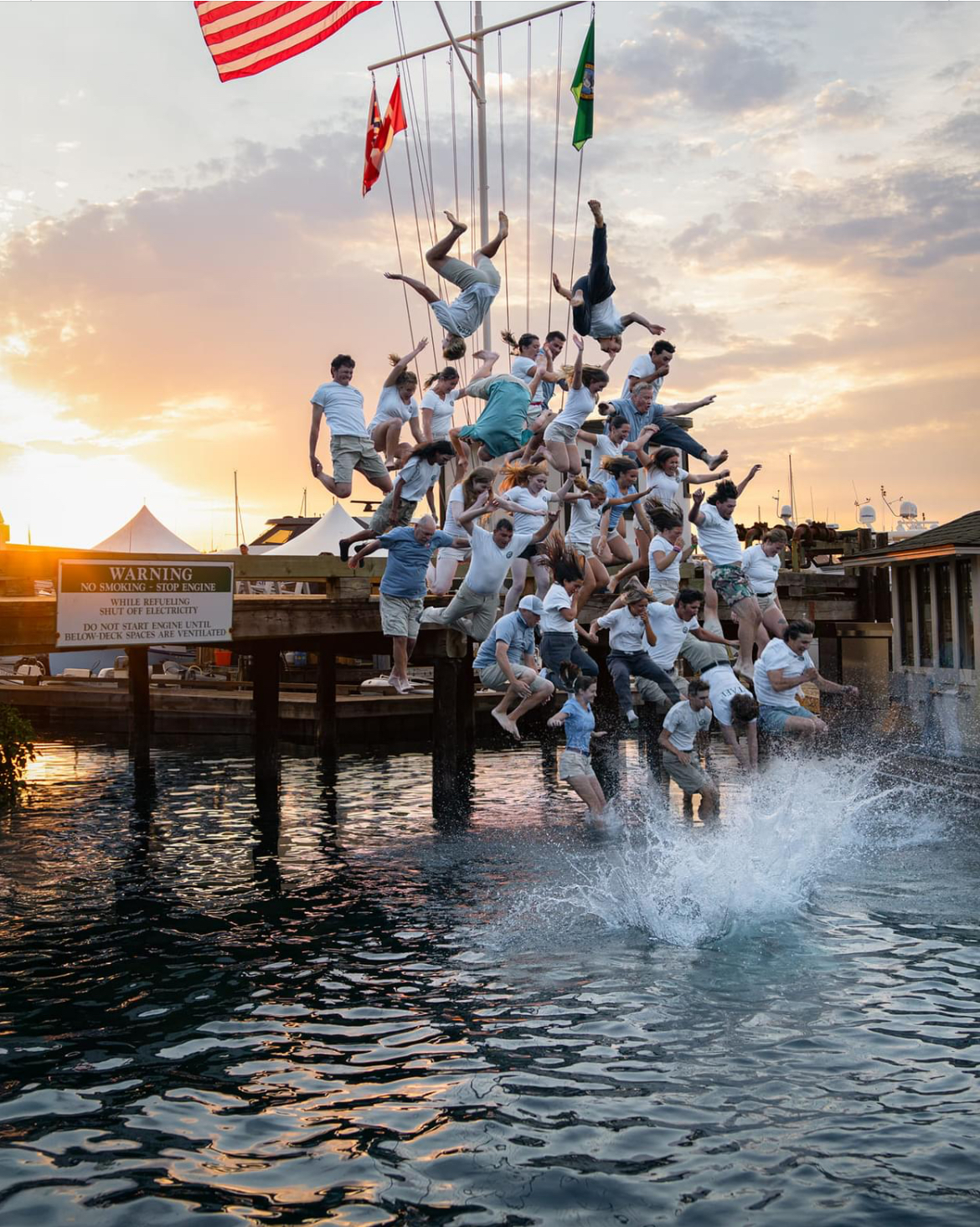
Here too, the visitors, for the most part, have vanished. Short of throwing yourself off the dock on Labor Day like the staff at Roche Harbor Marina, I’m not sure what end of season traditions we have on island. One might say being able to walk the sidewalks with ease in town, and not having to stand in any lines. Our friend Adam Eltinge adds, “and turning left in town,” if you’re a car.
As soon as the tents at the San Juan County Fair are folded up, a seasonal tide is set to turn and autumnal equinox is almost upon us. Big leaf maples start to turn, and summer birds get the memo and head south. We can renew our garden activity with fall planting, although rains will relieve us of all the summer watering. As Susan Vernon wrote in Rainshadow World, “As the days progress, the morning fog drifts in and out gently nudging summer away.”
That nudge may be a little less gentle each year, I’d say. Each time around it becomes increasingly apparent that we’re not here for very long and that our time is going faster. In Late Migrations Margaret Renkl describes this phenomena of time and place as a reminder “… that the world is turning, that the world is only a great blue ball rolling down a great glass hill, gaining speed with each rotation.”
My favorite time of year on island without exception is when hay has been rolled, and round bales dot the fields. This is my “South of France moment” each year. And every year I have every intention to set up an easel and paint it, or sketch it, and as it is I barely catch it with my camera before the bales are gone from the fields. Ten years ago, it seemed I had weeks in which to set up. This year, I must have blinked. Great blue ball, indeed.
Originally published in The Journal of the San Juan Islands 9/18/24
Nine years ago, when my father was ninety-one years old and recovering from quadruple bypass heart surgery, he spent some time in a rehabilitation center near the retirement village where he lived with my mother in Duxbury, Massachusetts. I remember being startled at first by how frequently the word “rehab” was bandied about by their crowd. It took me awhile to appreciate that these stays had nothing to do with drugs or alcohol. My father’s stay, it turned out, had everything to do with gardens.
The month was September and the weather was mild. Mom and I visited dad in turns daily, and when it was my turn I knew I was giving her much needed time alone or with her friends. So I spent some time. Every day I wheeled dad out to a courtyard in the center of the complex, where I pulled up a chair and, with a navy blue lambswool throw over his lap and a gray herringbone wool cap on his head, we settled in for a good bit of the afternoon. We spent no time whatsoever in his room, and I can’t even tell you whether or not he had a roommate. But our time in the courtyard is as clear as can be.
Memory, it turns out, has a far stronger relationship to place than it does to time. I know this to be true because in order to write this, I had to rely on my sisters to recall the month and year for this particular rehab stay. Toward the end there were so many.
Surrounded by a brick building on all four sides, the courtyard was concrete underfoot with a couple patches of soil. A rhododendron shrub grew in each patch. So Dad and I started with that. Our job, the one we gave ourselves each day, was to dream up a courtyard garden. Just the two of us. There were other patients scattered about but as we didn’t know them, we enjoyed an anonymity, and of course, reported to no one. In this way we took ownership of the lot.
“Look at how the rhodies thrive here, let’s do more of that,” I don’t know which one of us said it. We were thinking like one from the start.
And so we began in that concrete courtyard, designing a garden in our heads. Creative play, day after day. Neither touching a hoe nor getting dirt in our fingernails, just thinking like a gardener together. No boots, no gloves, no kneeling pad—or knee pads, as my father would have worn. No deer here, no rabbits to devour everything green. But the sun on our faces and fresh air in our hair, for gardening is also about being in a garden, albeit in our minds’ eye.
Each day we took our place and picked up where we’d left off. Dreaming it, improving it, growing it, we made the courtyard garden ours. Did dad share this with mom in her visits? Probably not. I never heard a word about it from anyone.
What dad and I felt in our hearts was that a garden at the rehabilitation center would do more than all the staff, more than all the meds, more than anything, for the patients. We just knew it at the time, and I have since learned this to be true. In 1984 the pioneering environmental psychologist Roger Ulrich conducted the first such study, View Through a Window May Influence Recovery from Surgery. In a suburban hospital in Pennsylvania two groups of patients recovering from the same surgery were studied. The windows in the rooms of one group looked to a brick wall, the other, to leafy trees. “The patients with a view of trees fared better; they had lower levels of stress, more positive mood, required fewer doses of pain medication, and were discharged on average a day sooner.” (The Well Gardened Mind: The Restorative Power of Nature, by Sue Stuart-Smith). And that was simply given a view.
Consider the recovery with an outdoor space, such as a courtyard, to bring the outdoors in. Architecture could be doing this, but it isn’t, not enough. Gardening-wise, it can be as simple as planting trees, vines, or broadcasting seeds. In her book, Growing Myself, Judith Handelsman reminds us, “In the not too distant past, the healing power of gardens was a matter of course. European sanitoriums incorporated time in their gardens as an essential part of the cure. It is only with modern medicine’s dependence on taking a pill that we have lost the belief in healing through osmosis by basking in the presence of nature.”
If indeed dad and I had been “basking in the presence of nature,”all of this would be more understandable. But in our case the courtyard at the rehabilitation center was all but barren. Similarly, E.B. White described his wife Katharine S. White “laying out of the spring bulb garden” in the Introduction to her book, Onward and Upward in the Garden:
Armed with a diagram and a clipboard, Katharine would get into a shabby old Brooks raincoat much too long for her, put on a little round wool hat, pull on a pair of overshoes, and proceed to the director’s chair—a folding canvas thing—that has been placed for her at the edge of the plot. There she would sit, hour after hour, in the wind and weather, … sitting there with her detailed chart under those dark skies in the dying October, calmly plotting the resurrection.
I don’t want to overstate it, but gardens have always been about both the real and the imagined. Ask any gardener. And an imagined garden, it turns out, can be healing too.
My father was soon released from the rehabilitation center, moving back into the retirement village in Duxbury with my mother, and then to a more assisted care facility near Boston. There he contracted Covid 19 and died, nearly five years after our time together in the rehab courtyard. I consider that imagined garden dad’s last garden because his plot of land in life kept shrinking. In the end it was the 11 x 6 inch birdfeeder mounted on his bedroom window that came the closest to being a garden. Blue jays, sparrows, cardinals, and chickadees, his joy in them immeasurable.
Following a visit to New England this winter, my daughter mentioned how dry her hands were there. How well I know, I thought. I remember living in a railroad flat apartment in NYC where the radiator heat dried my hands such that they would crack and bleed. I treated it by applying Vaseline to my hands at night and wearing little white gloves to bed. The gloves must have been left over from the days of my dreaded ballroom dancing lessons in a large formal hall in Longmeadow, Massachusetts, where girls were made to dance with boys, and boys with girls–before we wanted to. Round and round the ballroom we’d go, and when one of the boys stepped all over a girl’s feet, the instructor, Mr. Ryder, would single him out to the center of the dance floor and make the boy dance with him. Oh, the look of devastation on the boy’s face–and the look of delight on Mr. Ryder’s.
The ballroom dancing lessons were scheduled on friday nights, the same time “The Twilight Zone” and “The Alfred Hitchcock Hour” aired on television. T.V.’s best night bar none, and there was no taping then. The only redeeming thing about the evening was the requisite stop at a Friendly’s Ice Cream shop following the lessons, which whatever mother was driving the carpool that week had to make. There, having missed our favorite television programs, we felt entitled to gorge on Friendly’s Big Beef hamburger and fries with a Friendly Cola, or their milkshake, the Fribble.
My bedroom at home was papered in a bright yellow with green leaves and stems and white flowers flying around on it, as if tossed into the air. It was always spring in that room. Not so in New England. Maybe I was meant for more temperate climates, as I insisted on open windows and fresh air no matter what time of year.
Our house was a big old colonial in which every room was heated by a radiator. An oil furnace the size of a Model T automobile churned away in the basement to keep it all going. I liked my corner bedroom for the cross currant of air I could create in it. At night I’d burrow under layers of blankets and read into early hours with a flashlight: Gone with the Wind, On the Beach, Bring Me a Unicorn, and all the journals of Anne Morrow Lindbergh, falling in love not so much with Charles Lindbergh, as with Anne. I loved the way she wrote.
One night–it must have been a Nor’easter outside–wind was whipping through my room so hard the radiator went into overdrive. Hissing its head off and spraying hot steaming water all around the room, I had more reason than ever to stay buried under blankets, head and all. What could I do but scream for help? It was my father that heard my cries and came in and shut it all off (how’d he do that without getting burned?), closing my windows too most likely. An old camper at heart, he understood my craving for fresh air and had no harsh words for me, not that I remember.
Years later, in that railroad flat apartment in NYC, the radiator heat was even worse. Well, everything was. I was trying to recover from a broken marriage and deal with a divorce at the time, and not doing particularly well with either. That might have had something to do with it. So I moved West, choosing California, to put my life into some sort of sunshine. And to get out of those damn white gloves.



 a little elbow room
 a little elbow room