Under the Tuscan Umbrella

I had the good fortune this month to attend the Travel, Food and Wine Writing Workshop in Tuscany with Nick O’Connell. A group of writers drove and flew in from France, Australia and The States to wine and dine and concoct stories as varied and honest as a Tuscan stew or ragu.

Landing in Rome I would have know exactly where in the world I was, if I had been transported there in my sleep–which of course I was. The villas, the landscape. The planted trees atop hills spaced like musical notes….

We considered ourselves fortunate for the verdant green landscape. Deep forests, gray-green olive groves, promising vineyards, and fields of bright yellow Scottish Broom punctuated with orange-red poppies. At this time of year, we were told, the hillsides are typically gold.

I should have known, for we had flown atop a mattress of cloud all the way.

In Siena my friend and I sat under café awnings in the shell shaped piazza, the Campo, watching monsoon rains wash the stones and run down Roman aqueducts. But for the most part, it was a soft rain with sunbreaks.

Our group walked the vineyards, and strolled among monks in the abbeys. Hiked La Madonna, the path along the perimeter of the hilltop town of Montalcino, where the park drops off into the view like an infinity pool.

When we weren’t eating, drinking or writing, we were walking….

Tuscany is rose country. Roses grow over walls, roofs, and over all, like bougainvillaea along the Riviera.

I fell in love with bells in Siena. Bouquets of bells, from every church and cathedral. But before the bells, an owl woke us each morning. Carried through the narrow canyons of city streets, the three same notes, then silence. Three notes, and silence….

People in Tuscany are very present. The people of Tuscany are not on cell phones.

2 Comments

Filed under writing workshop

Rosemary for Remembrance

If I could live my life over again, I’d start gardening at an earlier age.

My first mentor in the gardening world was a woman we called “Mere.”  (My grandfather loved to work the land and grow things, but Mere was there when I was ready). And for all her horticultural knowledge and experience, she could not be accused of being a garden snob. I like to think I inherited that too.

Mere, or Marge Potter, was my grandmother’s friend, having grown up together in Connecticut. Marge recalled the day grandma’s father surprised his little girl with a pony in the kitchen on her birthday, as she was coming downstairs to breakfast. My grandmother lived her entire life in that enormous house, whereas Marge moved with her husband to Cleveland, and later, retired in San Diego. And that is where I was living at the time with my husband and our two young daughters. As a courtesy to my grandmother I went to call on her old friend, never guessing I would become so enamored with her too.

Marge is the one who threw me out of the house and down the garden path. She believed in herbs the way a witch or an old medicine man believes in them. Herbs had meaning and health benefits and a prominent place in her garden always. We spent many a late afternoon and early evening sitting on her terrace where a weathered, wooden St. Francis sculpture held court in the herb garden, my daughters tumbled about on the lawn, and the sun set over purple hills.

Today in Seattle, and everywhere we have lived since knowing her, I have made an herb garden of my own. My herbs grow in pots that have become wonderfully mossy and white, and perch upon a black wrought iron etegere that looks decidedly French. A St. Francis stands on my terrace as well. We use the herbs in cooking, enjoy the scent, and as much as an herb garden is a part of our lives now, it is also a memorial to Marge. I think of that every day I water.

Many of the herbs, such as the vigorous mint and oregano, hop around and seed themselves between pavers on the terrace. Marge would approve and say something like, “They know where they want to go.”

So I water them too.

2 Comments

Filed under remembrance

Having Babies

Everyone remembers their first time. Where they were. The time of day. The anticipation…. I remember my first time. Where I was: at home. Who was home: no one, I had the house to myself. How I had waited! Holding it, loving it, and finally, just content to have it in my arms.

It was some time before I even considered opening the envelope.

I am talking about the first time I received a manuscript to read. Deliveries such as this usually come Fed Ex. Chances are you requested it, or the writer asked you to be an early reader. Either way, it’s flattering. To be that trusted and to know that your opinion is valued. To be afforded a look before all the world can see it.

The first friend who sent me a manuscript—it was also her first novel—had to know what a thrill it was. As an aspiring writer myself, I studied her words and the way she put them together. I studied how the manuscript was printed and bound, the illustration she had found for the cover, and the care with which she had selected her title. I read passages over and over, and made notes on the double-spaced, single-sided pages, as she requested. I felt I was part of a book launch. And I was deeply jealous.…

She is the one who spurred me on in writing. I was between coasts and between arts at the time, and she prescribed Julia Cameron’s “The Artists Way,” a course I have been practicing now for fourteen years and counting. Writing grounded me. I found I loved it more than anything. Whatever else I may do, I know now that I will write my way through.

Then I lost her. Her life went into flux. A name change, a move…. and now I am trying to find her. She needs to know that I still believe in her novel and am always keeping an eye out for it. More than anything, I hope to hear that she is writing. And I want to thank her for changing the course of my life.

The most recent manuscript to land on my lap came electronically, of course, but I printed it up nevertheless. This baby weighed in at a healthy 9 lbs. I say “baby” because a book may be the closest thing to having a baby that a man can have. This one is a memoir. A memoir that moved me to places no one would ever want to go, places we didn’t know existed. And took me inside what it must be to be a nine, thirteen, and fourteen year old boy, a dear boy at that. I wanted to rescue him at every turn.

In the end, at 3 am, I sat there stunned, in my house so quiet, his manuscript upon my lap. Finding it incredulous that my friend had lived through it once, and then again in the writing. A writer lives twice.

4 Comments

Filed under memoir

Assisted Living

Life and art collided for me in one simple gesture of going to the theatre on Friday evening. Don’t you love moments like that when what you do, and what you know to be true, are in complete sync?

Maybe I don’t mean “collide” so much as commingle. But it can be startling when it happens.

Or as writer Sarah Bird notes, “It’s gratifying when you’re in a world, and you see that the author gets that world right.”

Startling, humbling, gratifying….

This week I attended the preview at ACT Theatre in Seattle for the world premier of “Assisted Living.” Written by Katie Forgette, Assisted Living imagines a scenario in the not-too-distant-future in which an overwhelming number of elderly baby boomers–a “tsunami,” the playwright calls it–are housed in prisons. Prisoners having been outsourced to make room for them.

Or rather, for us.

It’s bleak, it’s debilitating, and it could be what’s coming. But for one thing: a band of residents with a love for theatre find each other and form a troupe. Together they give readings, write plays, perform, and save their own souls, during permissible social hours, of course.

Artistic Director of ACT, Kurt Beattie, refers to this as “…the survival instincts hard-wired in the human spirit, and the essential elements of a life worth living; community, hope, and love.”

Playwright Katie Forgette works in a retirement home. “We have a theatre group and we’ve read everything from Hedda  to, yes, Glengarry. What can I say? They’re a game bunch.”

And I see this every week in the writing workshop that I run in a retirement home in Queen Anne. What started as a six- week, I believe, teaching practicum requirement for my MFA, is still going two years after completing the degree. But with writers and individuals and relationships blooming, how could I ever leave?

And I know we’re next. In such a residence, I for one, would be despondent if a MFA student, or a writer, wasn’t coming in to offer something of this sort. I would consider it my saving grace.

It’s all about finding your tribe, at any age, anywhere.

“Assisted Living” runs through May 12 at ACT Theatre, Seattle.

1 Comment

Filed under assisted living

Save the Rail

2456somewhere_west01-1After her divorce, my sister moved closer to the center of town. I like that it’s more pedestrian, a walk to everything. Her street is a cul de sac primarily of duplexes, inhabited by highly-educated, multi-ethnic, mixed-aged residents, both married and divorced. This is where she now rents, and where she has found a real neighborhood.

Here neighbors know each other, walk with each other, and say good day and good night. As my sister describes it, “The houses and yards are close and run from one into the next. We support each other with advice and chores. There is always someone around who will listen or talk. We get together for wine, coffee, game nights, celebrate birthdays together, and Seder dinner for Passover.”

My sister formed a tutoring company with two other teachers in the neighborhood. The couple she shares a duplex with are an attorney and a grant writer. Her neighbor in the next house over is a child and adolescent psychologist. Asian, Russian, Indian, multi-religions.

“In the summer,” she continues, “we sit around fire pits under the stars. Sometimes it reminds me of a campground because in warm weather you can smell smoke and food from cook- outs, hear laughter and conversation.”

Not everyone’s experience of a neighborhood anymore.

A small creek runs behind her house, visible from her kitchen sink. And just beyond the homes at the end of the cul de sac: train tracks, where a commuter railroad goes whistling through, connecting ‘burbs such as hers to downtown Boston. The sound of the train gives me comfort. I like to sleep to it and wake to it when I am visiting. During the day, it’s a type of clockwork. Everything seems to be working as it should, as on a model train.

I know I derive more pleasure from this than my sister, for train trips filled many of my early vacations. But by the time she was born, our family was flying.

Back out west now, driving  the highways and freeways and sharing the road with monster trucks, I float back and forth between model trains on a table, my sister’s neighborhood, and the big picture. This works with trains; up and down in scale, they don’t really change. In my mind I “lift” all the containers off the road, all across the land, and set them down on railway cars. All the long hauls to be done by rail, enabling us to drive freely about in smaller, more fuel- efficient cars. A safer and prettier world I should think, where the towns are green and peopled, and trains run around them or through, whistling now and then.

6 Comments

Filed under trains, trucks

They Call Us Mossbacks

For years I wondered: where on earth do I feel most at home? We would move and I’d try various places, waiting to see if I could grow roots. Finally I took up gardening. In the garden I can make myself at home anywhere, but nowhere as easily as here, in the Pacific Northwest. Where everything grows on its own accord.

Moss_Covered_Old_Stone_Bridge_HD_Wallpaper-Vvallpaper.Net

Back in San Diego I used to paint my flowerpots with buttermilk, then roll them in dirt before potting. With regular watering over a course of time, the pots would whiten and grow the mossy green patina found on garden antiquity. All around me the homes were too new. Too many developments with roofs of clean bright orange terra cotta tile. Whereas the pots on my terrace gave the appearance of old. While developers were busy putting up “Mediterranean style” for the masses, I was looking for Old Spain, something evacuated from say, Seville.

Here in the Pacific Northwest we can save the buttermilk for baking. Moss grows up our steps, over walls, on all sides of trees, and onto rooftops. I have to laugh.

We love our moss. A friend told me the story of a time she hired a man to pressure-wash the brick patio, as it can get slippery, and stepped out of the house to find that he had gone on and taken care of the back wall as well “which was a treasure trove of happy lichens in yellow, orange and gold, plus fabulous swaths of moss.” She was heartbroken.

Not too long ago a neighbor from those days in San Diego, now living in Houston, came through Seattle on book tour. I had come into the kitchen in the morning, turned on KUOW, our local NPR, in the middle of an interview and recognized her voice immediately. That night I attended her reading at Third Place Books in Lake Forest. Harriet Halkyard is her name. One doesn’t forget a name like that. She and her husband, John, wrote 99 Days to Panama based on their travels there. After the reading I bought their book and we sat down for lattes and to get caught up.

I will admit I was surprised to hear how much they love living in Houston (“It’s the people; we’ve never been so socially engaged!”), but nothing could have prepared me for her next comment.

“I don’t know how you live here,” she cried.

“I mean,” Harriet went on, “when you’ve seen seen one pine tree you’ve seen them all.”

I smiled and realized it could be plants and trees and climates that determine where one feels most at home. In San Diego we both had the warmth, the sun, the desert landscape, the occasional palm tree and arid climate, and she chose to go get more of it in Texas. Whereas I sought to come home, if not to New England, to the Pacific Northwest. A place more exaggerated than New England ever dreamed.

6 Comments

Filed under antiquity, lichen

The Loop

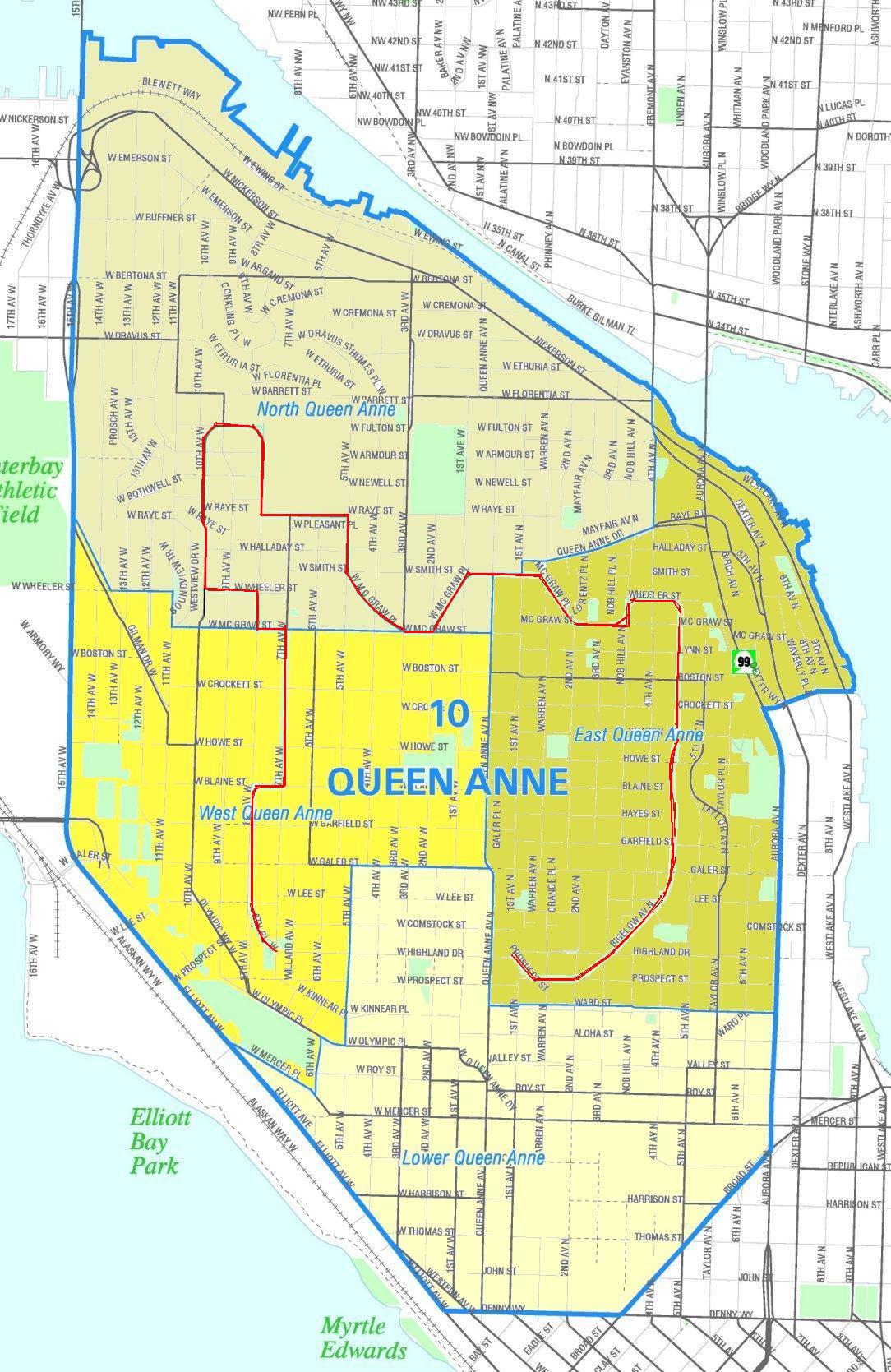
Seattle_-_Queen_Anne_Boulevard_mapI walk because a little flower can bring me to my senses, turn the world right side up, and give balance. Just that, the perfect, or imperfect, little plant. With nature one just has to be there, to be very present.

Nature is my religion and walking pulls me along like prayer. Particularly in spring when the set changes so fast. The orchestration of bulbs pushing up, magnolia tree blossoms on high opening like a stretch and a yawn, and wild roses scrambling to position themselves alongside a fence. Whether we garden or not, spring is reward time. Daffodils double on their own, birds carry seeds, and things hop around by wind.

I live on a hilltop in the city of Seattle ringed by a historic four mile loop. “The loop,” as it’s called, is well treed, well tred, and many of us walk or run it faithfully. To walk the loop is to indulge in everything from close-up (plants and wildlife), to midrange (architecture), and most distant: spectacular views of the city skyline, Mt. Rainier, The Sound and Olympic Mountains on one side, Lake Union and The Cascades on the other. A painter’s paradise, as all of the waterscapes are backed by mountains, and from the vantage point of Queen Anne, Mt. Rainier looms like a backdrop over downtown. This was the view in the television series, “Frasier.”

Walking clears the head. What you can leave at home is immense. On this day: concern about my father’s lingering cough, discouragement that our efforts for gun control seem to be backfiring, fear of N. Korea’s blustery “state of war” declaration, and a blog to write—as if that is going to help anything.

Anyway, it’s a start. For I am walking away from all that and toward…. Well, we’ll see.

“As artists, we are like beachcombers,” Julia Cameron observes, “walking the tide line, pocketing the oddments washed ashore—some small stray thing will tell us a story to tell the world.” And story, as we know, is what moves life along and gives it meaning.

My walking companion, the young friend I’ve hired as a personal trainer, shared stories of her eight year old daughter, Eleanor. I don’t need to tell you that for parents, these were some of the best years of our lives. And out of the blue, as her stories evolved, there came an explosion of wonderfully old fashioned names for girls, all friends of Eleanor’s, an old fashioned name as well. A world of classmates and girlfriends by the names of Penelope, Hazel, Clementine, Scarlett, Beatrice, Isabella and Madeline!

Don’t tell me I’m alone in finding this delightful?

You have to know, the older I get the more I feel I belong to that world, and it is of course eroding under my feet…. In many ways I am but a polar bear on an ice floe. But if there are three things I can do they are: to worship nature, to walk, and to write.

Forget the NRA. Forget Kim Jong Un. Today’s walk was suddenly worth it for this, the pleasure of these wonderfully old fashioned names. There’s a story there and I will write it.

4 Comments

Filed under old fashioned names

Learning by Guess and by Gosh

From the perspective of the writing life I now live, it’s easy to look back and see that what I was doing before was all a matter of gathering material. Falling in and out of love, moving around the country, having children, raising children, working in one art form after another before landing on writing. Writing being the biggest catch basin of them all.

Now here comes Easter and all I can think of is how much I miss building my daughters’ baskets. Two little girls, a blond and a brunette, who played along with the Easter bunny story for years because it made me happy. And because they love chocolate, games and treasures too. Somewhere I still have their first baskets. I treasured them and was sorry they ever outgrew them. How enormous they looked, like bassinets! Pale yellow and pale blue, one had a bunny carved on the wooden handle and the other, a duck. The baskets were handmade and I had found them in a gallery in Scottsdale, Arizona. Into these I went out of my way every year to find natural grass, not the cellophane stuff, but more like straw or shredded paper, dyed in pale shades like the baskets.

soap bubble

OK, good grass in the baskets, now what? I put a lot of thought into the contents in an effort to go sparingly on candy. A fine chocolate bunny—they initially preferred white chocolate but over the years I steered them to dark. And then I looked for little gifts that would fit in the baskets: pocket-sized jigsaw puzzles, bracelets, bath salts, lovely soaps, that sort of thing. Topped with a smattering of jelly beans and all tied up with a pretty bow.

Baskets built, girls sleeping, I set to work with an Easter scavenger hunt of sorts. Having cut scores of bunny paw prints out of paper, I lay the prints down starting at their bedroom door then “hopping” all over the house in circles, loops and crazy figure-eights. In the end the paw prints always led to the baskets–whereas if the girls had only “looked up” they most likely would have found their baskets sooner. For years the girls indulged me in this too.

Indulged me more than I ever knew, as I recently overheard one remark to the other that all their Easter candies tasted a bit like soap every year.

I feel bad about that.

Leave a comment

Filed under soap

Notes from a Tree Hugger

I was sure something was up when my neighbor first moved in. First of all, it’s a strange house architecturally. On a hill of period Craftsman, Colonial, Victorian and Tudor, up pops this stucco box, cold and contemporary. It looks positively clinical.

The first thing my neighbor wanted to do was take out the grand old maple tree out front. Bereft of leaves, I believe she thought it dead.

“You can’t do that!” we cried. “These trees belong to the city.”

We love our trees for softening and quieting the street–and what we couldn’t say is that it helps to hide her house when full of leaf.

Her hair was colored a Raggedy Ann red then. She came and went in a dark red car. Her outfits at the time were primarily red, black or perhaps purple. These things I noticed.

When she first moved in the shades on her house were drawn, night and day. I noticed that too.

My new neighbor hammered wreaths in that tree out front for decoration before I could stop her. As a Master Gardener, I have to believe that hammering anything into a tree compromises its integrity. Still, I should have spoken up because she has since then only hammered in more ornamentation. The lady collects stuff, or let’s just say, stuff finds her.

But what I found most curious and what led me to my suspicions, were the assorted little dried gourds and pods she placed on the ground wherever she planted anything. I was sure they must mean something….

I think she’s a witch.

There ought to be some way to ask, but I haven’t found it. And here I am, totally amiable to the idea of an earth-based pagan religion. Especially one that honors both Goddess and God, the changing seasons and cycles of the moon. To me there’s a natural balance to natural law.  The law of return, “What you put out, comes back to thee,” is  simply karma to me. Healing with herbs, I don’t have a problem with that. And I would never, ever, hammer ornamental items onto trunks of trees.

Hey, maybe I’m the witch?

4 Comments

Filed under witch

When Life Imitates Art

The first time I visited Santa Fe, New Mexico, I approached the city by driving up from Albuquerque. “Land of Enchantment” passed me by on every license plate, as I was fixed to all the landscape in my field of vision. Face glued to the window, fogging up the glass with my breath and smudging it with my fingers, I was having one of those ecstatic moments–there really ought to be a word for it–when life imitates art.

life-imitates-art-thus-paint-your-dreams-brightly2

I was seeing a place where I had never been through the eyes and handiwork of Georgia O’Keeffe. This woman whose life story I knew so well and whose art I had loved for many years. She was out there still, everywhere, in the desert and sagebrush, red rocks and purple hills, on the mesas, trails, and in the enormous clear blue skies, painting it all. I could taste the dryness in the air and smell mesquite burning in the distance. Like the child in Walt Whitman’s poem, “There Was a Child Went Forth,” everything I saw was familiar to me, and I knew a part of me had always been, and would always be, there.

Oh, how I wish I had the word for it, when life and art collide. Paintings, poetry or prose, these are the moments most worth living for, in my experience.

Recently I was handed another one. Again, I was in a moving car, this time through a snow covered landscape, making our way like a sleigh to Logan Airport in Boston. I had been visiting my parents’ in their retirement village on the South Shore and my mind was elsewhere.

Turning to me, the driver said, “Nice place there. Every morning I pick up a Mrs. Blessington and take her to visit her sister in Plymouth.”

“Lulie!” I cried, before I could catch myself.

You need to know that I had recently written a novel, Black Angels, in the course of completing my MFA, and had named one of my main characters Lulie Blessington based on two of my parents’ friends: one named Lulie and the other by the last name of Blessington. I had never met Mrs. Blessington, but I loved the sound of the names together and thought it worked for the feisty up-from-the-South character that was my Lulie. You need to know I had been living in that novel for years, and in that instant, she was practically before me. Well, not exactly before me, but let’s just say the seat was warm with her presence.

There was a young child went forth every day;

And the first object he look’d upon, that object he became;

And that object became part of him for the day, or a certain part of the day, or for many

years, or stretching cycles of years.

….

These became part of that child who went forth every day, and who now goes, and will

always go forth every day.

Walt Whitman

4 Comments

Filed under art