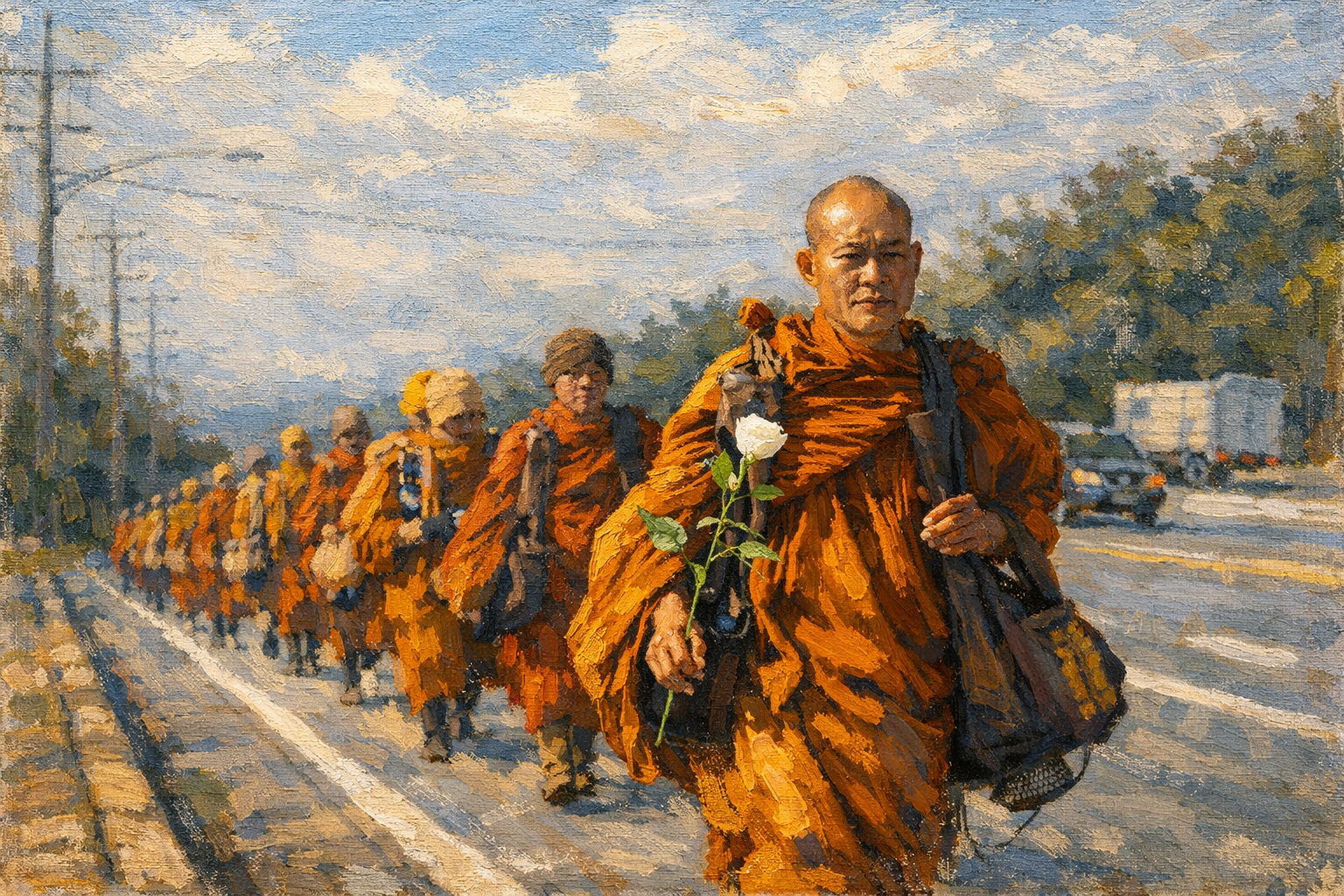
I don’t know about you, but I am missing the band of Buddhist monks who walked for more than three months across nine states to Washington D.C. in the Walk for Peace. In single file with shaved heads and flowing robes of saffron, orange and maroon, barefoot and in running shoes, through frigid temps and winter storms of snow, sleet, and freezing rains, they captured the attention and imagination of millions around the world.
The monks began their long journey October 26, 2025 at the Huong Dao Vipassana Bhavana Center, a Buddhist temple in Fort Worth, Texas. Their pilgrimage, the Walk for Peace, often appeared to me the only good news every day. And while many of us protested in the face of an authoritarian regime, the way of the monks was quite different.
“We walk not to protest, but to awaken the peace that already lives within each of us,” said Bhikkhu Pannakara, spiritual leader of the Walk for Peace. I’ve heard this before, I thought, remembering the practice of TM (Transcendental Meditation). Shut the world out and meditate. Each of us is but a flower in the garden. We must change the world in this way, one flower at a time.
The real journey, of course, was inside the monks. We could see it in their elation, their glow. The Walk for Peace pilgrimage was a form of prayer. For many of us, their yearning for the impossible felt reassuring and healing somehow. “In dreams begin responsibility,” said William Butler Yeats.
“Genius on the part of these monks to recognize how hungry people were for the opposite of the selfish greed and violence around us now, for something more spiritual, idealistic, altruistic. Genius also that they are so obviously non-Christian, non-white, nonwestern at exactly the time these things are under attack but are here being celebrated and loved. They are following the route to the capitol and leading people toward openheartedness,” noted Rebecca Solnit.
But not everyone heeded the call. Indeed, the Defense (War) Department was building up a fleet of warships in the Middle East even as the monks walked. And less than three weeks after the pilgrimage concluded in Washington D.C., the U.S. went to war with Iran. Still, even as some plan to destroy it, the monks pray for the world. One step at a time.
October 18th marked the largest single day of protest in U.S. history. Comprising a network of progressive organizations, No Kings’s organized 2,600 peaceful protests in nearly all states–people exercising their constitutional rights, reminding the world our country was founded in opposition to monarchy.
More than 7 million people participated in No Kings Day nationally. And on a little island in the middle of nowhere with a year-round population of 7,500, an astonishing 1,000 people of all ages assembled. It seemed everyone on San Juan Island was there, assembling at noon on the courthouse lawn then parading through town. Any passerby would note the flag on our side, creativity in homemade signs, and delightful frivolity in costumes, a far cry from House Speaker Mike Johnson’s characterization of our protests as “hate America rallies.”
Parading alongside an inflated dinosaur, a pair of chipmunks, unicorns, an eagle, orcas, and a furry fox, it’s no wonder I heard Dr. Seuss’s Horton Hears a Who in my head! For anyone not acquainted with the beloved children’s book, the story is of an elephant named Horton who, because of his enormous ears, is capable of hearing what no one else could: a small voice in a speck of dust. Which turned out to be all the Who’s in Who-ville where every voice counts.
He looked and he looked. He could see nothing there
But a small speck of dust blowing past through the air.
“I say!” murmured Horton. “I’ve never heard tell
Of a small speck of dust that is able to yell.”
“And, all over Who-ville, they whooped up a racket.
“We are here! We are here! We are here!” they cried.
“You mean…” Horton gasped
“You have buildings there, too?”
“Oh yes,” piped the voice. “We most certainly do….
I know,” called the voice, “I’m too small to be seen
But I’m the Mayor of a town that is friendly and clean.
Our buildings, to you, would seem terribly small
But to us, who aren’t big, they are wonderfully tall.
My town is called Who-ville, for I am a Who
And we Whos are all thankful and grateful to you.”
“Mr. Mayor! Mr. Mayor!” Horton called.
“You’ve got to prove now that you really are there!
So call a big meeting. Get everyone out.
Make every Who holler! Make every Who shout!”
“We are here! We are here! We are here!”
Originally published November 19, 2025 in The Journal of the San Juan Islands
Years ago I read that shortly after a telephone conversation with Katherine Hepburn, who was at her seaside home in Old Saybrook, Connecticut at the time, Spencer Tracy became aware of a hurricane barreling up the Eastern seaboard, heading right for Old Saybrook. “But she never even mentioned it!” he exclaimed.
I am much the same way. I didn’t bring up our recent storms either. Long distance people had to ask, and I downplayed it. “We’re accustomed to winds,” I said, “and our trees are accustomed to winds.” But between us, it really was something. And not all trees stood.
One storm was a bomb cyclone, and the other, an atmospheric river. Unlike hurricanes, they have no names—we save names for earthquakes and wildfires out west. In any case, last month we experienced one right after the other. Everything all at once it seemed. Nearby Vancouver Island tracked gusts of 101 mph–the speed of a Catagory 2 hurricane. In Seattle the National Weather Station was damaged by high winds, while falling trees struck homes, a homeless encampment in Lynnwood, a King County Metro bus, and pulled down power lines all around the metropolitan area.
I rode the storms out in my home on San Juan Island, wifi down, flashlights and candles at the ready. For what seemed like weeks I stood at the windows and witnessed the world whited out and erased. Wind and rain, wind and rain. Normally we can determine wind direction by the waves, but we couldn’t even see the bay. Everything vanished.
And yet we never lost power on San Juan Island. Be it the number of underground wires or the confluence of surrounding mountains, we were spared any outages through the two monster storms. I’m thinking we’re in a protected bubble here.
Pinecones can slam against glass windows and batter the decks all they want—it’s just a lot of noise.
Hold that thought. Keep it in mind as we look to the next four years. While trying to console me after the election, my daughter suggested “You’re in a good place, mom. Trump doesn’t even know about the San Juan Islands. He has no idea any of you are there.”
Originally published January 1, 2025 in The Journal of the San Juan Islands
At the end of every summer season residents of Cape Cod, Massachusetts gather on overpasses to wave farewell to visitors on the bridges that connect Cape Cod to the mainland. Year after year, that’s the tradition. But whenever I heard my mother tell the story, she had them “dancing on the bridges.” Having retired to Cape Cod with my father, I think she was always so exhausted after hosting everyone all summer long she imagined a celebratory dance.
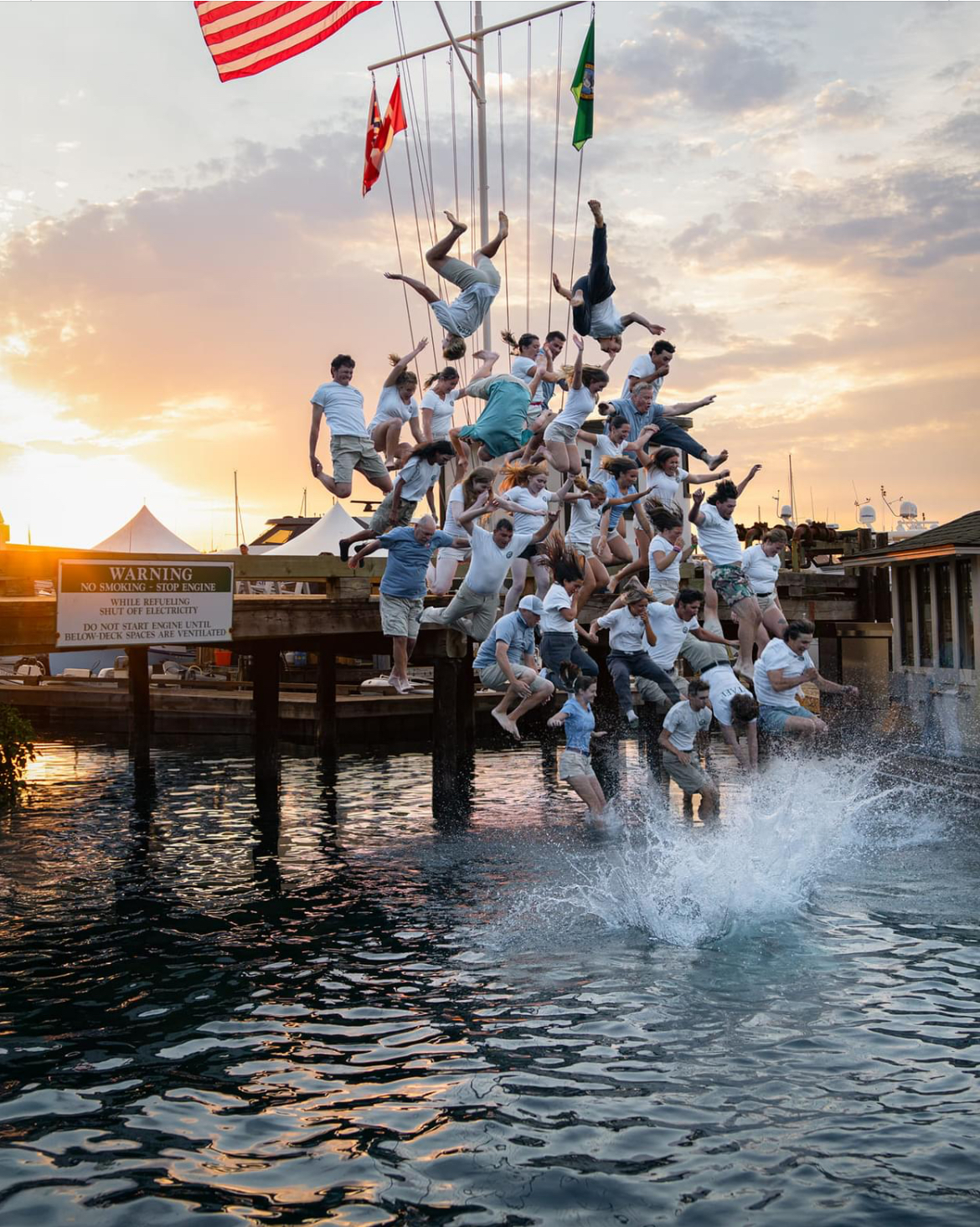
Here too, the visitors, for the most part, have vanished. Short of throwing yourself off the dock on Labor Day like the staff at Roche Harbor Marina, I’m not sure what end of season traditions we have on island. One might say being able to walk the sidewalks with ease in town, and not having to stand in any lines. Our friend Adam Eltinge adds, “and turning left in town,” if you’re a car.
As soon as the tents at the San Juan County Fair are folded up, a seasonal tide is set to turn and autumnal equinox is almost upon us. Big leaf maples start to turn, and summer birds get the memo and head south. We can renew our garden activity with fall planting, although rains will relieve us of all the summer watering. As Susan Vernon wrote in Rainshadow World, “As the days progress, the morning fog drifts in and out gently nudging summer away.”
That nudge may be a little less gentle each year, I’d say. Each time around it becomes increasingly apparent that we’re not here for very long and that our time is going faster. In Late Migrations Margaret Renkl describes this phenomena of time and place as a reminder “… that the world is turning, that the world is only a great blue ball rolling down a great glass hill, gaining speed with each rotation.”
My favorite time of year on island without exception is when hay has been rolled, and round bales dot the fields. This is my “South of France moment” each year. And every year I have every intention to set up an easel and paint it, or sketch it, and as it is I barely catch it with my camera before the bales are gone from the fields. Ten years ago, it seemed I had weeks in which to set up. This year, I must have blinked. Great blue ball, indeed.
Originally published in The Journal of the San Juan Islands 9/18/24
The last time I went to the library I returned a couple overdue books and picked up a packet of seeds. Who knew? While seed saving has been done for 10,000 years, it has only recently become available at many public libraries, including ours. Started and maintained by Jessa Madosky and Nancy Best at San Juan Island Grange, the seed library was moved to the public library this spring. Housed in small manilla and craft paper envelopes in a wooden card catalog many of us will recall, not much space is taken. The whole thing is wonderfully old fashioned.
Vegetables, fruit, herbs, flower, and wildflower. No sign out is necessary, and it’s free.
There’s a natural economy in seed saving. Here, packed in quantities suitable for a row in a home garden, are seeds from organic, open-pollinated gardens, already proven successful in our area. Preserving heirloom varieties ensures better flavor, encourages disease resistance, and helps combat seed monocultures where four giant companies control more than 60% of the world’s seeds, threatening our global food supply.
The seeds I “borrowed” are Heritage Waldron Kale. After coming home from the library I planted them in a tray, and in a couple weeks three or four showed their heads and I cheered. Today as I write, the tray is populated with more seedlings than I can count, looking like a Lilliputian field of four-leaf clover. This is what happens when you stare at a tray or a small plot for a period of time: it becomes your world. As any gardener will tell you, when you raise them you begin to refer to them as your “babies.”
Seeds, as Thor Hanson remarks in his book The Triumph of Seeds, “… are quite literally the stuff and staff of life.” These seeds were so small they were but mere specks. Yet in each one, an embryo plant with a supply of food (starch, protein, oils) to get it on its way. “A baby in a box,” Hanson calls it. It’s not time yet to transplant my seedlings.
Having come of age in a small rural town without a bookstore, the library meant everything to us. Today with services expanding into realms librarians of old never dreamed of, the library means everything once again. Along with the community-based collections of seeds, Assistant Director of San Juan Island Library, Anthony Morris showed me some of what else the library has been lending lately: birdwatching equipment, a State Park Pass, a pass for two to the art museum, gardening tools, culinary tools, and a telescope.
Who knew that too?
Originally published in The Journal of the San Juan Islands 6/19/24
You might drop by the San Juan Islands Sculpture Park for the art, you might stroll it for the plantings and nature preserve, or you might do as we are doing, and go for the birds. It is warm in the sun and cold in the shade in May. Dressed in drab colored field clothes, vests and jackets with plenty of pockets, hats on our heads, and sensible shoes underfoot, a group of birdwatchers winds its way through the park with bird guide Tyler Davis. Around everyone’s neck, binoculars.
Before binoculars, birds were killed for study. “I shot the first kingfisher I met,” John James Audubon wrote in his journal, “pierced the body with wire, fixed it to a board, another wire held the head, smaller ones the feet… there stood before me the real kingfisher. I outlined the bird, colored it. This was my first drawing actually from nature.” (The Birding Life: A Passion for Birds at Home and Afield by Sheehan Stites).
Originally called “field glasses” in England, binoculars made all the difference. The first real pair of handheld binoculars were introduced in 1825 and by the end of the century, birdwatching had become a recreational activity. “Binoculars don’t bring the birds closer to you,” states Simon Barnes in The Meaning of Birds, “they bring you closer to the birds, taking you into the tree, across the sea to the ledges of the cliff, out to the middle of the lake, and above all, they take you into the sky to fly with the birds.”
At a time when birds themselves are on a decline, birdwatching or birding is ever-growing. We are drawn to it for a host of reasons:
~ “I feel a much deeper connection to the natural world…. Birding has tripled the time I spend outdoors and proved more meditative than meditation… My senses focus resolutely on the present, and the usual hubbub in my head becomes quiet.” (Ed Yong, “When I Became a Birder, Almost Everything Else Fell in Place,” The New York Times 3/30/2024).
~ Improving observation and memory.
~ Listening to birdsong is calming.
~ Birding is an inexpensive hobby, and our archipelago, a bird rich location with 291 species of birds recorded. (Birding in the San Juan Islands, Lewis and Sharpe).
We stand in an open field as bald eagles soar on high, riding the thermals. Such is the wilderness in our backyard. No one says a word.
From mud flats to freshwater lake and marsh pond, field and pasture, dry grasslands, open woodland, forest, and shrubby thicket, there’s a variety of habitats in The Sculpture Park. It’s a breeding ground for numerous species, and on our recent morning, the act of bird copulation called a cloacal kiss.
Birders often speak of their “spark bird,” meaning that first bird love, the bird that got them seriously into birding. Tyler shared his spark bird moment with us, recalling Rainbow Lorikeets in downtown Cairns, Australia. He was twelve years old at the time and thrilled to find this brilliantly colored parrot flying wild. His mother gifted him a guide book, Birds of Australia, by Simpson and Day–one senses that he still has the book–and “this is what ultimately got me hooked on all things avian,” he says with a grin.
You could say we are coastal people. North or south, it’s the ocean that pulls us. Our northern home is on a bay where the trees meet the water, logs rest in mud, buoys bob, ducks float by, rafts of otter play along the shoreline, and solitary heron tiptoe knee deep in water tiptoe over rocks. Except for the call of gulls and eagles from their treetop lookouts, it’s quiet. Sometimes a voice will carry across the water, but not many people live in the San Juan Islands.
In Solana Beach, California, where we’re wintering, the surf pounds. Day and night the perpetual pounding and crashing becomes one with our breath, our pulse, our being. Surfers seize the surf all year long, but we give it a wide berth and walk the long sandy beaches in winter. Then at the end of every day, high on a bluff at Seascape Shores, a handful of people seat themselves upon a couple rows of benches, like pews, to witness the setting sun.
All ages, all neighbors, living aside, across from, and on top of each other in a cubist configuration of condos that forms a village, that’s Seascape Shores. Here the communal ritual of seeing the sundown has been going on since I-don’t-know-when. I just know that for the final leg of the sun’s long arc across the sky every day, we arrive in the golden light in which everyone looks good, and bid goodbye in darkness.
At the same time on the beach below, dozens or hundreds of birds line up near the water’s edge and face the sun every day at sunset too. Like us they are all in a line, very still, and facing forward. Thrilled to be sharing our sun worshipping moments with another species, I thought, I really must ask my friend, Tyler Davis, about it. Naturalist and bird guide on San Juan Island, he would know.
Tyler guessed, rightly, they are Western Gulls who have “found a place to roost for the night, or perhaps stage before continuing on to a communal roost nearby.”
“Is there anything particularly spellbinding about the setting sun to them?” I asked.
“Not that I can think of,” he replied.
Tyler must have sensed my disappointment, for he then inquired whether the wind would be coming from that direction.
“Oh yes, the wind is coming off The Pacific Ocean alright,” I assured him.
“Roosting gulls often point themselves into the wind,” Tyler explained. Then added, “Doesn’t mean they can’t also be sun-worshippers!”
This piece was recently published in my monthly column, The Nature of Things, in The Journal of the San Juan Islands.
One month ago I began to plunge. The sun was at such a low arc in the San Juan Islands the days grew darker, and the darkness got me. It was at that time I made the acquaintance of a man who, having lived many years in Alaska, found winter on island to be darker. He explained that because Alaska is without all the cloud cover, moonlight is reflected in the snow and winters seem brighter. Night after night I was watching HGTV “Bahamas Life” in bed. No wonder.
Trading rain shadow for Ray Bans and missing our grandchildren, we packed up the car and headed to sunny Southern California. Tree branches waved like arms in the wind as we steamed off on the ferry. Goodbye beautiful snowy mountains and islands, there is no place like you anywhere in the world, I know. But sometimes there is just not enough light.
Wet and cold, dark and muddy, it was all much the same through Washington and Oregon. Then something happens the moment one goes over the line into California, and it happens every time. Rolling down the Siskiyou Mountains and coming into all that light and dryness—the landscape looks like the location of Westerns in my childhood. Signs like Sunny Valley, Rogue River, Little Muddy Creek, Elk Creek, and Wolf Creek seem to bear witness.
It turns out that “the real west,” as I call it, was always unreal.
Everything is indeed looking better in the light and I can’t help but be happy. A four year old in San Diego charted our road trip on his placemat map at breakfast every morning and we made it. But here’s what I forgot: “The darkness is not an end point, nor is the daylight. They live in a continually unfolding, mutually dependent cycle,” explains Rick Rubin in The Creative Act: A Way of Being. The process is as old as time, and every six months it starts all over again.
I never saw us as snowbirds. I had lost the continuity of seasons. Winter Solstice was but days away, and instead of waiting it out, we jumped the gun. The skies here may not be Bahama blue but they’re powder blue. Light is coming for us all, and with it, color. Hang in.
Nine years ago, when my father was ninety-one years old and recovering from quadruple bypass heart surgery, he spent some time in a rehabilitation center near the retirement village where he lived with my mother in Duxbury, Massachusetts. I remember being startled at first by how frequently the word “rehab” was bandied about by their crowd. It took me awhile to appreciate that these stays had nothing to do with drugs or alcohol. My father’s stay, it turned out, had everything to do with gardens.
The month was September and the weather was mild. Mom and I visited dad in turns daily, and when it was my turn I knew I was giving her much needed time alone or with her friends. So I spent some time. Every day I wheeled dad out to a courtyard in the center of the complex, where I pulled up a chair and, with a navy blue lambswool throw over his lap and a gray herringbone wool cap on his head, we settled in for a good bit of the afternoon. We spent no time whatsoever in his room, and I can’t even tell you whether or not he had a roommate. But our time in the courtyard is as clear as can be.
Memory, it turns out, has a far stronger relationship to place than it does to time. I know this to be true because in order to write this, I had to rely on my sisters to recall the month and year for this particular rehab stay. Toward the end there were so many.
Surrounded by a brick building on all four sides, the courtyard was concrete underfoot with a couple patches of soil. A rhododendron shrub grew in each patch. So Dad and I started with that. Our job, the one we gave ourselves each day, was to dream up a courtyard garden. Just the two of us. There were other patients scattered about but as we didn’t know them, we enjoyed an anonymity, and of course, reported to no one. In this way we took ownership of the lot.
“Look at how the rhodies thrive here, let’s do more of that,” I don’t know which one of us said it. We were thinking like one from the start.
And so we began in that concrete courtyard, designing a garden in our heads. Creative play, day after day. Neither touching a hoe nor getting dirt in our fingernails, just thinking like a gardener together. No boots, no gloves, no kneeling pad—or knee pads, as my father would have worn. No deer here, no rabbits to devour everything green. But the sun on our faces and fresh air in our hair, for gardening is also about being in a garden, albeit in our minds’ eye.
Each day we took our place and picked up where we’d left off. Dreaming it, improving it, growing it, we made the courtyard garden ours. Did dad share this with mom in her visits? Probably not. I never heard a word about it from anyone.
What dad and I felt in our hearts was that a garden at the rehabilitation center would do more than all the staff, more than all the meds, more than anything, for the patients. We just knew it at the time, and I have since learned this to be true. In 1984 the pioneering environmental psychologist Roger Ulrich conducted the first such study, View Through a Window May Influence Recovery from Surgery. In a suburban hospital in Pennsylvania two groups of patients recovering from the same surgery were studied. The windows in the rooms of one group looked to a brick wall, the other, to leafy trees. “The patients with a view of trees fared better; they had lower levels of stress, more positive mood, required fewer doses of pain medication, and were discharged on average a day sooner.” (The Well Gardened Mind: The Restorative Power of Nature, by Sue Stuart-Smith). And that was simply given a view.
Consider the recovery with an outdoor space, such as a courtyard, to bring the outdoors in. Architecture could be doing this, but it isn’t, not enough. Gardening-wise, it can be as simple as planting trees, vines, or broadcasting seeds. In her book, Growing Myself, Judith Handelsman reminds us, “In the not too distant past, the healing power of gardens was a matter of course. European sanitoriums incorporated time in their gardens as an essential part of the cure. It is only with modern medicine’s dependence on taking a pill that we have lost the belief in healing through osmosis by basking in the presence of nature.”
If indeed dad and I had been “basking in the presence of nature,”all of this would be more understandable. But in our case the courtyard at the rehabilitation center was all but barren. Similarly, E.B. White described his wife Katharine S. White “laying out of the spring bulb garden” in the Introduction to her book, Onward and Upward in the Garden:
Armed with a diagram and a clipboard, Katharine would get into a shabby old Brooks raincoat much too long for her, put on a little round wool hat, pull on a pair of overshoes, and proceed to the director’s chair—a folding canvas thing—that has been placed for her at the edge of the plot. There she would sit, hour after hour, in the wind and weather, … sitting there with her detailed chart under those dark skies in the dying October, calmly plotting the resurrection.
I don’t want to overstate it, but gardens have always been about both the real and the imagined. Ask any gardener. And an imagined garden, it turns out, can be healing too.
My father was soon released from the rehabilitation center, moving back into the retirement village in Duxbury with my mother, and then to a more assisted care facility near Boston. There he contracted Covid 19 and died, nearly five years after our time together in the rehab courtyard. I consider that imagined garden dad’s last garden because his plot of land in life kept shrinking. In the end it was the 11 x 6 inch birdfeeder mounted on his bedroom window that came the closest to being a garden. Blue jays, sparrows, cardinals, and chickadees, his joy in them immeasurable.
I am on a bird walk. Comfortable shoes and binoculars are all that’s required, and I carry in my pocket a small notebook and pen. As our guide, Tyler Davis, says, “there’s just so much happening up there.” There’s a lot happening down here too, as participants in his bird walk in the San Juan Islands Sculpture Park seem to double, triple, and quadruple each month this summer.
We stand in a circle and it’s easy to feel dizzy as swallows perform in flight around us.
We learn there are six species of swallows on San Juan Island, five in the Sculpture Park and one out by the ferry landing. Our guide knows all the birds, their appetites, and who’s returning every week. We learn that robins move around, that winter robins and summer robins may not be the same. There are 11 or 12 species of gull on island in the wintertime, and bluebirds are being reintroduced. That quail live in brambles to protect themselves from foxes. Ducks nest in trees. Cowbirds historically follow cows and the buffalo out west. That bird bones are honeycombed to keep them light in flight, and that birds migrate by using celestial cues and following the stars.
We walk on.
Like a conductor Tyler hears everything around him, sometimes cupping his ears to hear even better. “So much of birding is by ear,” he states.
The busiest time of day for song is sunrise, but before sunrise there’s also what birders call a dawn chorus. Some birds sing when seated, some only in flight. The goldfinch cries, “potato chip.” The white crown sparrow, “me me pretty me.” Tyler’s favorite is the flute-like sound of a Swainson’s thrush, which he describes as “a summertime song, ethereal.”
“Like a spiral staircase,” he adds, twirling an index finger in the air.
Spotting and listening to birds not only enhances our time outdoors, but paying attention to birds may be beneficial to our well-being. “Everyday encounters with the bird kind are associated with better mental health,” writes Richard Sima in “Why Birds and their Songs are Good for our Mental Health” Washington Post, May 18. Known as attention restoration theory, “natural stimuli, such as birdsong,” he explains, “may allow us to engage in soft fascination which holds our attention but also allows it to replenish.”
“The special thing about birdsong,” writes Emil Stobbe, an environmental neuroscience grad student at the Max Planck Institute for Human Development in Berlin, “is that even if people live in very urban environments and do not have a lot of contact with nature, they link the songs of birds to vital and intact natural environments.”
We continue walking. I’m thinking we are learning to listen with our eyes as well as our ears.
Twenty acres of naturalized gardens, fields, meadows, a pond, woods, and shoreline. The San Juan Islands Sculpture Park is indeed a wildlife sanctuary. Numerous birds live and alight here, and according to park president David Jenkins, “Turns out birds love art.”
We are all in a reciprocal relationship. Protecting and preserving natural environments has everything to do with sustaining bird life, and in turn, our own mental well-being. The more in tune with birds we are, the more in tune with ourselves.





 a little elbow room
 a little elbow room