Kimberly Mayer received a B.A. from Emerson College, Boston, and an M.F.A from Goddard College. Her memoir, "The Making of a Master Gardener" was awarded first place in the Pacific Northwest Writing Association Literary Contest. She recently completed her first novel, "Black Angels," and is currently at work on a sequel to it.
Kimberly lives, writes, and revises in Seattle, Washington. Currently, Kimberly is a Contributing Blogger at "Pyragraph," the online magazine for the arts. http://www.pyragraph.com/?s=Kimberly+Mayer
Some weeks back, when a visitor asked for recommendations of things to do in Friday Harbor, I was a bit surprised by my friend Kat Rose’s response, “Be sure to visit our consignment shops.” Kat explained, “People move to the island and soon adopt the rural style and we sell our city clothes.” She then listed various local consignment and thrift shops for clothing, housewares, and furniture for the visitor.
Now I don’t know why I was surprised by Kat’s response, as unloading in these venues is what I do all the time lately. Basically, the longer I’m on island—ten years now—the less I seem to need. One day I may just float off and become a bhikkhuni, a Buddhist nun. Seriously, I am trying to lighten my footprint.
I find my clothes go rather fast at Girlfriends, though handbags tend to hang around. I recently brought a console table into Treasure Hounds (where proceeds go to the animal shelter), followed by a pair of antique French chairs. They’re just not me anymore, not our lifestyle—if they ever were. The Thrift House (benefitting the fire department) always receives my linens. Books go to Serendipity and Little Free Libraries whenever they’re not full. Any finer objects I once collected and loved are at Funk & Junk. Finally, Community Treasures is what I drive through to donate everything from garden hoses to box springs when the others are closed.
Nobody gave it much thought, but all the boomers would be unloading at once.
Some of the best things show up second-hand, I know that. Indeed some of the items I’m giving away were consignment shop finds in the first place. When we moved into this house we filled a crawl space—whatever were we thinking in storing things there? Whatever is there, we obviously don’t need it. And our kids don’t want our stuff. Aren’t all millennials minimalists? Likewise I don’t bemoan anything I have given away. Gone is gone, and there is so much joy in giving and gifting, and experiencing a little monetary compensation in the case of consigning. But the real reward is experiencing lightness.
Today there is so much more I don’t want, than that I do. I am happier with less.
When we came up with “The Nature of Things” as a title for this column, I liked it for the reason that I could write on any subject I chose. But sometimes it’s about the things you can do without, and the nature of that. That’s the space I’m writing into today.
The last time I went to the library I returned a couple overdue books and picked up a packet of seeds. Who knew? While seed saving has been done for 10,000 years, it has only recently become available at many public libraries, including ours. Started and maintained by Jessa Madosky and Nancy Best at San Juan Island Grange, the seed library was moved to the public library this spring. Housed in small manilla and craft paper envelopes in a wooden card catalog many of us will recall, not much space is taken. The whole thing is wonderfully old fashioned.
Vegetables, fruit, herbs, flower, and wildflower. No sign out is necessary, and it’s free.
There’s a natural economy in seed saving. Here, packed in quantities suitable for a row in a home garden, are seeds from organic, open-pollinated gardens, already proven successful in our area. Preserving heirloom varieties ensures better flavor, encourages disease resistance, and helps combat seed monocultures where four giant companies control more than 60% of the world’s seeds, threatening our global food supply.
The seeds I “borrowed” are Heritage Waldron Kale. After coming home from the library I planted them in a tray, and in a couple weeks three or four showed their heads and I cheered. Today as I write, the tray is populated with more seedlings than I can count, looking like a Lilliputian field of four-leaf clover. This is what happens when you stare at a tray or a small plot for a period of time: it becomes your world. As any gardener will tell you, when you raise them you begin to refer to them as your “babies.”
Seeds, as Thor Hanson remarks in his book The Triumph of Seeds, “… are quite literally the stuff and staff of life.” These seeds were so small they were but mere specks. Yet in each one, an embryo plant with a supply of food (starch, protein, oils) to get it on its way. “A baby in a box,” Hanson calls it. It’s not time yet to transplant my seedlings.
Having come of age in a small rural town without a bookstore, the library meant everything to us. Today with services expanding into realms librarians of old never dreamed of, the library means everything once again. Along with the community-based collections of seeds, Assistant Director of San Juan Island Library, Anthony Morris showed me some of what else the library has been lending lately: birdwatching equipment, a State Park Pass, a pass for two to the art museum, gardening tools, culinary tools, and a telescope.
Who knew that too?
Originally published in The Journal of the San Juan Islands 6/19/24
You might drop by the San Juan Islands Sculpture Park for the art, you might stroll it for the plantings and nature preserve, or you might do as we are doing, and go for the birds. It is warm in the sun and cold in the shade in May. Dressed in drab colored field clothes, vests and jackets with plenty of pockets, hats on our heads, and sensible shoes underfoot, a group of birdwatchers winds its way through the park with bird guide Tyler Davis. Around everyone’s neck, binoculars.
Before binoculars, birds were killed for study. “I shot the first kingfisher I met,” John James Audubon wrote in his journal, “pierced the body with wire, fixed it to a board, another wire held the head, smaller ones the feet… there stood before me the real kingfisher. I outlined the bird, colored it. This was my first drawing actually from nature.” (The Birding Life: A Passion for Birds at Home and Afield by Sheehan Stites).
Originally called “field glasses” in England, binoculars made all the difference. The first real pair of handheld binoculars were introduced in 1825 and by the end of the century, birdwatching had become a recreational activity. “Binoculars don’t bring the birds closer to you,” states Simon Barnes in The Meaning of Birds, “they bring you closer to the birds, taking you into the tree, across the sea to the ledges of the cliff, out to the middle of the lake, and above all, they take you into the sky to fly with the birds.”
At a time when birds themselves are on a decline, birdwatching or birding is ever-growing. We are drawn to it for a host of reasons:
~ “I feel a much deeper connection to the natural world…. Birding has tripled the time I spend outdoors and proved more meditative than meditation… My senses focus resolutely on the present, and the usual hubbub in my head becomes quiet.” (Ed Yong, “When I Became a Birder, Almost Everything Else Fell in Place,” The New York Times 3/30/2024).
~ Improving observation and memory.
~ Listening to birdsong is calming.
~ Birding is an inexpensive hobby, and our archipelago, a bird rich location with 291 species of birds recorded. (Birding in the San Juan Islands, Lewis and Sharpe).
We stand in an open field as bald eagles soar on high, riding the thermals. Such is the wilderness in our backyard. No one says a word.
From mud flats to freshwater lake and marsh pond, field and pasture, dry grasslands, open woodland, forest, and shrubby thicket, there’s a variety of habitats in The Sculpture Park. It’s a breeding ground for numerous species, and on our recent morning, the act of bird copulation called a cloacal kiss.
Birders often speak of their “spark bird,” meaning that first bird love, the bird that got them seriously into birding. Tyler shared his spark bird moment with us, recalling Rainbow Lorikeets in downtown Cairns, Australia. He was twelve years old at the time and thrilled to find this brilliantly colored parrot flying wild. His mother gifted him a guide book, Birds of Australia, by Simpson and Day–one senses that he still has the book–and “this is what ultimately got me hooked on all things avian,” he says with a grin.
Spring is upon us and I know I must go headlong into it. “That’s the thing about gardening,” notes Maggie O’Farrell, “there’s always something to do, you’re only ever just catching up with yourself.” First, I had everything to clean up from winter winds. In other places people worry about break-ins. On island it’s the outdoors that gets ravaged.
I call it picking up sticks, and it’s a chore I actually enjoy. You might say I have more in common with George W. Bush today than I ever did during his presidency. Surely you remember him going off to clear brush on his horseless ranch in Central Texas. It was how he unwound, they said. Well, the same might be true with me although I’m not the president of anything, nor am I starting any wars.
I find it interesting how many U.S. presidents were brush clearers. According to presidential scholar Tim Blessing of Alvernia University in Reading, PA: Washington, Adams, Jefferson, Andrew Jackson, Teddy Roosevelt, and Ronald Reagan. But perhaps none as tenacious as George W. Bush in the canyons, rocky hillsides, and pastures of his ranch outside Crawford, Texas. “Local agronomists say brush control has been a part of rural Texas since the Dust Bowl days of the 1930’s.” (Down on the Ranch, President Wages War on the Underbrush, Lisa Rein 12/2005 Washington Post)
Unlike Bush, I am not whacking down stands of trees, making ear-splitting noise with chain saws, or burning piles.On my little wooded lot by the bay on San Juan Island, I simply put on gloves and boots and pick up Douglas Fir, Cedar and pine sticks, branches and boughs. “Calling cards” from the winds, I call them.
One thing leads to another, and I think about all the recently felled trees on Roche Harbor Road. Fallen branches, fallen trees, this is where the mind wanders when everything is falling down. While we understand OPALCO’s intent in trying to prevent a Maui-like wildfire along high-voltage power lines–those winter winds again–it is distressing to see so many trees downed. And aesthetically it’s unacceptable. On every trip to town and back I pondered, what can be done, what can we do?
And then I got it: bicycle paths!
Bicycle paths running within the powerline easement, crossing creeks, pastures, and a vineyard. Hopping over ravines, and alongside lakes. Climbing hills, and sometimes disappearing into woods. The tricky part is how often the power lines leap across Roche Harbor Road from side to side. How will cyclists do it? But I’ll leave that to others, and just say I can see it in my mind’s eye.
Now on every trip to town and back on Roche Harbor Road I find myself mentally riding the bicycle path off the road. It’s attractive in that it follows the contours of the land—mountain bikes, anyone?– and far more fun. Mr. Toad’s Wild Ride, if you will.
What drove me away from the islands in December was the darkness. Now, three months later in San Diego, I am almost ruined. All that light! Even in the historic rainfall this winter, bomb cyclones or atmospheric rivers–call it what you will–there was light. And I got used to that.
Now we leave SoCal, the land of shiny white cars, and drive up the coast, traverse Oregon, the land of trucks, and all of Washington, the land of gray SUV’s. Enormous states all. Finally, ferrying out to what our five-year old grandson refers to as “going to that other country…”
I think that’s what breaks my heart.
I had thought we’d be returning to the island with the rufous hummingbirds, coming up from southern US and Mexico at the same time as them. In my mind’s eye salmonberry and red flowering current would be abloom for our feisty little friends, and we would start being their handmaidens, crazily filling their feeders. Bags of sugar flying off the grocer’s shelf like it was days before Thanksgiving. Kayaks and paddle boards coming and going, revolving doors of houseguests, and every meal on the deck. I saw all this, with spring accelerating into summer.
But there’s more winter to get through apparently. Our route will be more coastal, but still, a Monster Blizzard in the Sierras. Snowfall on island. We’re packing snow chains for the road trip. But it was never about snow; it was the lack of light. Snow is beautiful. And it’s bright.
If there’s one thing we can’t predict, it’s nature. Winter or spring, we’re coming home. To the woods by the sea where Douglas firs and cedars stand and greet us, and madrone trees bend and beckon with open arms.
You could say we are coastal people. North or south, it’s the ocean that pulls us. Our northern home is on a bay where the trees meet the water, logs rest in mud, buoys bob, ducks float by, rafts of otter play along the shoreline, and solitary heron tiptoe knee deep in water tiptoe over rocks. Except for the call of gulls and eagles from their treetop lookouts, it’s quiet. Sometimes a voice will carry across the water, but not many people live in the San Juan Islands.
In Solana Beach, California, where we’re wintering, the surf pounds. Day and night the perpetual pounding and crashing becomes one with our breath, our pulse, our being. Surfers seize the surf all year long, but we give it a wide berth and walk the long sandy beaches in winter. Then at the end of every day, high on a bluff at Seascape Shores, a handful of people seat themselves upon a couple rows of benches, like pews, to witness the setting sun.
All ages, all neighbors, living aside, across from, and on top of each other in a cubist configuration of condos that forms a village, that’s Seascape Shores. Here the communal ritual of seeing the sundown has been going on since I-don’t-know-when. I just know that for the final leg of the sun’s long arc across the sky every day, we arrive in the golden light in which everyone looks good, and bid goodbye in darkness.
At the same time on the beach below, dozens or hundreds of birds line up near the water’s edge and face the sun every day at sunset too. Like us they are all in a line, very still, and facing forward. Thrilled to be sharing our sun worshipping moments with another species, I thought, I really must ask my friend, Tyler Davis, about it. Naturalist and bird guide on San Juan Island, he would know.
Tyler guessed, rightly, they are Western Gulls who have “found a place to roost for the night, or perhaps stage before continuing on to a communal roost nearby.”
“Is there anything particularly spellbinding about the setting sun to them?” I asked.
“Not that I can think of,” he replied.
Tyler must have sensed my disappointment, for he then inquired whether the wind would be coming from that direction.
“Oh yes, the wind is coming off The Pacific Ocean alright,” I assured him.
“Roosting gulls often point themselves into the wind,” Tyler explained. Then added, “Doesn’t mean they can’t also be sun-worshippers!”
This piece was recently published in my monthly column, The Nature of Things, in The Journal of the San Juan Islands.
One month ago I began to plunge. The sun was at such a low arc in the San Juan Islands the days grew darker, and the darkness got me. It was at that time I made the acquaintance of a man who, having lived many years in Alaska, found winter on island to be darker. He explained that because Alaska is without all the cloud cover, moonlight is reflected in the snow and winters seem brighter. Night after night I was watching HGTV “Bahamas Life” in bed. No wonder.
Trading rain shadow for Ray Bans and missing our grandchildren, we packed up the car and headed to sunny Southern California. Tree branches waved like arms in the wind as we steamed off on the ferry. Goodbye beautiful snowy mountains and islands, there is no place like you anywhere in the world, I know. But sometimes there is just not enough light.
Wet and cold, dark and muddy, it was all much the same through Washington and Oregon. Then something happens the moment one goes over the line into California, and it happens every time. Rolling down the Siskiyou Mountains and coming into all that light and dryness—the landscape looks like the location of Westerns in my childhood. Signs like Sunny Valley, Rogue River, Little Muddy Creek, Elk Creek, and Wolf Creek seem to bear witness.
It turns out that “the real west,” as I call it, was always unreal.
Everything is indeed looking better in the light and I can’t help but be happy. A four year old in San Diego charted our road trip on his placemat map at breakfast every morning and we made it. But here’s what I forgot: “The darkness is not an end point, nor is the daylight. They live in a continually unfolding, mutually dependent cycle,” explains Rick Rubin in The Creative Act: A Way of Being. The process is as old as time, and every six months it starts all over again.
I never saw us as snowbirds. I had lost the continuity of seasons. Winter Solstice was but days away, and instead of waiting it out, we jumped the gun. The skies here may not be Bahama blue but they’re powder blue. Light is coming for us all, and with it, color. Hang in.
A writer’s life is like this. She grows a set of antennae as she goes into the world, looking for material. Lately I’m wearing two sets of antennas, one for this blog and one for a new column in the Journal of the San Juan Islands. I don’t know what the difference will be in terms of what I will see and what I will write for either outlet. I do know, however, that while blogging can be irregular, I will have to be regular with the monthly newspaper column.
I’ve titled it “The Nature of Things,” to keep it broad. My new hero in life is Eleanor Roosevelt. A woman for all seasons, all reasons, and now this: her dedication as a columnist. For nearly thirty years, six days a week, Eleanor Roosevelt wrote “My Day,” a nationally syndicated column reaching millions. How did I not know this when I was young and reading only comics and “Dear Abby” in the newspaper? Why was I not guided to “My Day”? I feel I am having to make up for lost time as a child.
More liberal than her husband, Eleanor considered herself a journalist first. She wrote past FDR’s presidency, through the Truman administration, the Eisenhower administration, and into the Kennedy administration. Indeed Eleanor Roosevelt didn’t put down her pen until two months before her own death in 1962. Her column covered everything, from everyday occurrences in the White House to nature and conservation, art, labor reform, civil rights, women’s rights, anti-Semitism, and the threat of fascism.
Today we have all that plus a planet in peril. My column, “The Nature of Things” appeared for the first time in The Journal of the San Juan Islands this month, and what did I cover but runner beans, rolled hay, and Breton striped sweaters. It was a start.
Nine years ago, when my father was ninety-one years old and recovering from quadruple bypass heart surgery, he spent some time in a rehabilitation center near the retirement village where he lived with my mother in Duxbury, Massachusetts. I remember being startled at first by how frequently the word “rehab” was bandied about by their crowd. It took me awhile to appreciate that these stays had nothing to do with drugs or alcohol. My father’s stay, it turned out, had everything to do with gardens.
The month was September and the weather was mild. Mom and I visited dad in turns daily, and when it was my turn I knew I was giving her much needed time alone or with her friends. So I spent some time. Every day I wheeled dad out to a courtyard in the center of the complex, where I pulled up a chair and, with a navy blue lambswool throw over his lap and a gray herringbone wool cap on his head, we settled in for a good bit of the afternoon. We spent no time whatsoever in his room, and I can’t even tell you whether or not he had a roommate. But our time in the courtyard is as clear as can be.
Memory, it turns out, has a far stronger relationship to place than it does to time. I know this to be true because in order to write this, I had to rely on my sisters to recall the month and year for this particular rehab stay. Toward the end there were so many.
Surrounded by a brick building on all four sides, the courtyard was concrete underfoot with a couple patches of soil. A rhododendron shrub grew in each patch. So Dad and I started with that. Our job, the one we gave ourselves each day, was to dream up a courtyard garden. Just the two of us. There were other patients scattered about but as we didn’t know them, we enjoyed an anonymity, and of course, reported to no one. In this way we took ownership of the lot.
“Look at how the rhodies thrive here, let’s do more of that,” I don’t know which one of us said it. We were thinking like one from the start.
And so we began in that concrete courtyard, designing a garden in our heads. Creative play, day after day. Neither touching a hoe nor getting dirt in our fingernails, just thinking like a gardener together. No boots, no gloves, no kneeling pad—or knee pads, as my father would have worn. No deer here, no rabbits to devour everything green. But the sun on our faces and fresh air in our hair, for gardening is also about being in a garden, albeit in our minds’ eye.
Each day we took our place and picked up where we’d left off. Dreaming it, improving it, growing it, we made the courtyard garden ours. Did dad share this with mom in her visits? Probably not. I never heard a word about it from anyone.
What dad and I felt in our hearts was that a garden at the rehabilitation center would do more than all the staff, more than all the meds, more than anything, for the patients. We just knew it at the time, and I have since learned this to be true. In 1984 the pioneering environmental psychologist Roger Ulrich conducted the first such study, View Through a Window May Influence Recovery from Surgery. In a suburban hospital in Pennsylvania two groups of patients recovering from the same surgery were studied. The windows in the rooms of one group looked to a brick wall, the other, to leafy trees. “The patients with a view of trees fared better; they had lower levels of stress, more positive mood, required fewer doses of pain medication, and were discharged on average a day sooner.” (The Well Gardened Mind: The Restorative Power of Nature, by Sue Stuart-Smith). And that was simply given a view.
Consider the recovery with an outdoor space, such as a courtyard, to bring the outdoors in. Architecture could be doing this, but it isn’t, not enough. Gardening-wise, it can be as simple as planting trees, vines, or broadcasting seeds. In her book, Growing Myself, Judith Handelsman reminds us, “In the not too distant past, the healing power of gardens was a matter of course. European sanitoriums incorporated time in their gardens as an essential part of the cure. It is only with modern medicine’s dependence on taking a pill that we have lost the belief in healing through osmosis by basking in the presence of nature.”
If indeed dad and I had been “basking in the presence of nature,”all of this would be more understandable. But in our case the courtyard at the rehabilitation center was all but barren. Similarly, E.B. White described his wife Katharine S. White “laying out of the spring bulb garden” in the Introduction to her book, Onward and Upward in the Garden:
Armed with a diagram and a clipboard, Katharine would get into a shabby old Brooks raincoat much too long for her, put on a little round wool hat, pull on a pair of overshoes, and proceed to the director’s chair—a folding canvas thing—that has been placed for her at the edge of the plot. There she would sit, hour after hour, in the wind and weather, … sitting there with her detailed chart under those dark skies in the dying October, calmly plotting the resurrection.
I don’t want to overstate it, but gardens have always been about both the real and the imagined. Ask any gardener. And an imagined garden, it turns out, can be healing too.
My father was soon released from the rehabilitation center, moving back into the retirement village in Duxbury with my mother, and then to a more assisted care facility near Boston. There he contracted Covid 19 and died, nearly five years after our time together in the rehab courtyard. I consider that imagined garden dad’s last garden because his plot of land in life kept shrinking. In the end it was the 11 x 6 inch birdfeeder mounted on his bedroom window that came the closest to being a garden. Blue jays, sparrows, cardinals, and chickadees, his joy in them immeasurable.
“As you start to walk on the way, the way appears.” Rumi
BY KIMBERLY MAYER
We are thinking about selling the boat. The boat that brought us here, to the San Juan Islands. We lived in Seattle then and we were just starting to dream about living here.
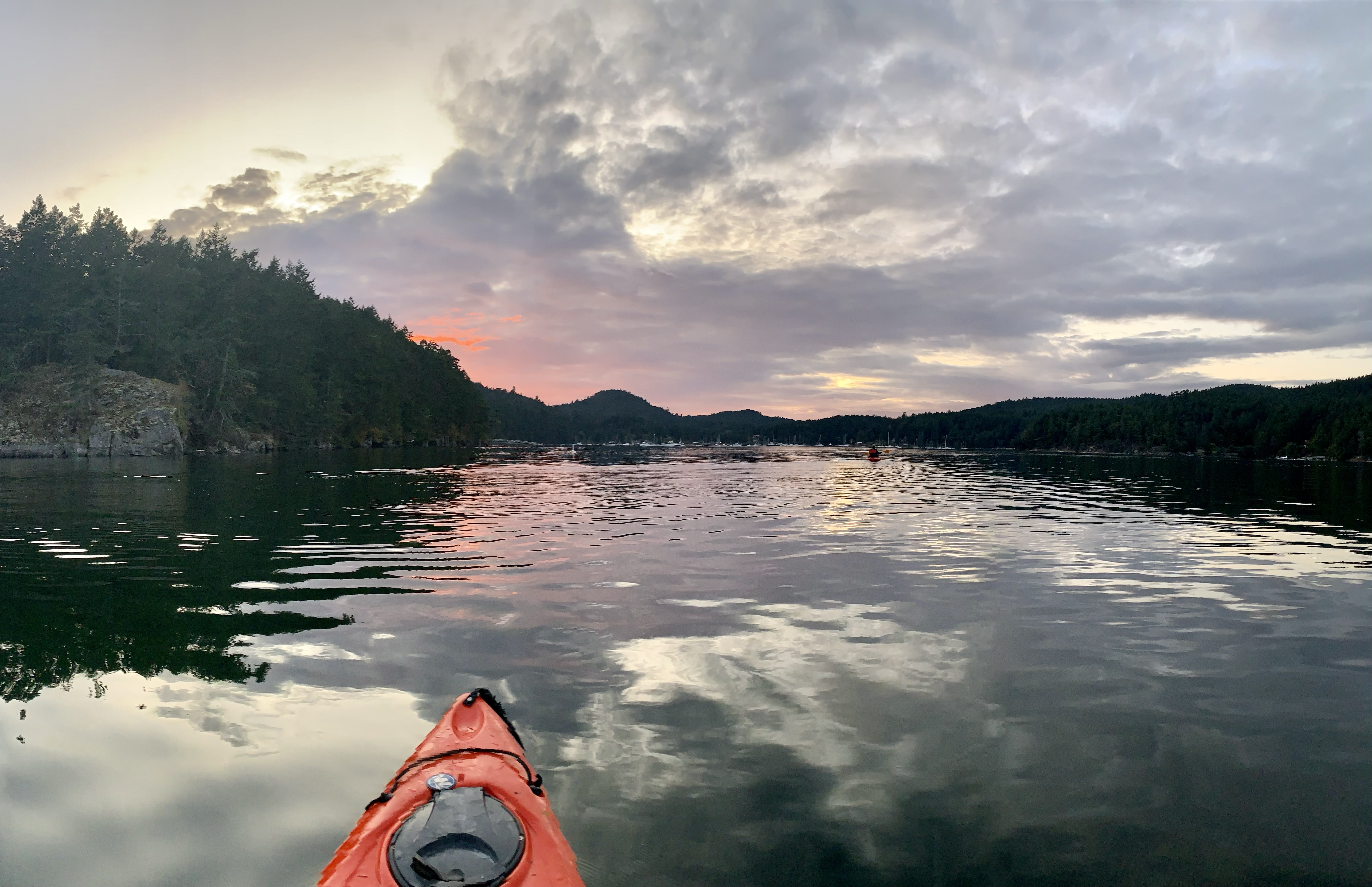
We found a waterfront house on San Juan Island and lived on the boat in the marina while our home was being remodeled. On our bay there are no ferries, no commercial boats of any kind. Only residents quietly coming and going in kayaks, canoes, and small fishing boats. We see our neighbors paddling by more often than we do on the shore.
This is where I want to live, I said way back then. At the end of the world. The archipelago reminded me of Pat Conroy’s beloved low country in South Carolina. The turning back of the clock, stuck in time, almost off the grid.
Life on an island will be made even smaller if we sell our boat.
Will we lose this connection to other islands?
When a woman I know from Houston came to Seattle on book tour she remarked, “When you’ve seen one pine tree you’ve seen them all.” I’m wondering, is it that way with islands? I think not. You can turn my husband around at sea and he can identify any island by its shape, by the contour of its hills. The islands are individuals much like trees are sentient beings.
We have talked to the kids about the boat and everyone understands. The boat is getting old, and we’re not getting younger. For one reason or another she is spending too much time in the slip. A couple of our friends recently sold their boat. Another couple were relieved when their sailboat sank. Lately a broken down expresso machine at home impacts us more than the loss of a trawler.
Haven’t I always said, the smaller the boat, the more the fun? Our time would be freed up to kayak more. Kayaks, paddleboards, a canoe, and a rowboat, such is the small fleet at home.
As my friend said on putting down her dear old ailing dog, “As much as I miss her every day, I’m thinking I may have kept her too long.”
We are living with the idea. I’ll write this up and see which way the wind blows. We’re heading out this week to the Gulf Islands, BC, and time will tell. Trawling will tell. It’s a fluid situation.







 a little elbow room
 a little elbow room