Author Archives: a little elbow room

a little elbow room's avatar

About a little elbow room

Kimberly Mayer received a B.A. from Emerson College, Boston, and an M.F.A from Goddard College. Her memoir, "The Making of a Master Gardener" was awarded first place in the Pacific Northwest Writing Association Literary Contest. She recently completed her first novel, "Black Angels," and is currently at work on a sequel to it. Kimberly lives, writes, and revises in Seattle, Washington. Currently, Kimberly is a Contributing Blogger at "Pyragraph," the online magazine for the arts. http://www.pyragraph.com/?s=Kimberly+Mayer

What’s in a Name

BY KIMBERLY MAYER

Having grown up on the East Coast, I still get a kick out of towns, hills, creeks, rivers, and roads with Western names. I don’t think a born Westerner would derive the same pleasure in the signs flying by on road trips: Sweet Briar, Tom Cat Hill, Lost Man Creek, Rogue River, Coyote Pass, Red Bluff, Crater Lake, and Whiskeytown Cavern. 

Like everyone back then I was raised on enough Westerns for it to be part of my television DNA, but it was on train trips as a child that I really fell in love with the west–lock, stock and barrel. Stretched out in a pullman berth alongside a window running the length of my bed, the landscape rolled by like bygone days—before everyone came to California. In my head Rin Tin Tin ran full speed alongside the track, and Bonanza was around every bend. The light, the stars, the far horizon. I know this land, I thought, and the land knows me. That’s where the deal was sealed, I believe, with the west. It’s the story I tell myself to this day.

The west of my childhood is still out there. Like the young girl on the train I am all eyes and note the signs that give me a sense of place: Antelope Valley, Crazy Horse Canyon, Black Butte Summit, and Jumpoff Joe Creek. Take creeks, a western word if there ever was one. Wolf Creek, Canyon Creek, Elk Horn Creek, Medicine Creek, Bean Creek, and Little Muddy Creek, to name a few. In the east it’s called a brook or a stream. Slough is another western word: Blue Slough Road, Preachers Slough Road. In the east we’d call it a marsh or tideland. The word river, of course runs all over the map. 

The summer travels of my childhood, as I recall, went as far west as the Pacific Ocean in California, and as far north as The Redwoods. But nothing prepared me for the Pacific Northwest, the place I now call home. 

I have found The Pacific Northwest to be like nowhere else, but perhaps Stephen King’s Maine. Notwithstanding geographical similarities (the rugged coastlines and countless islands, forested and mountainous regions), it’s the names of places in the Pacific Northwest that ring not of happy-go-lucky cowboy jargon as in California, but rather, the eeriness of Stephen King’s novels.  

Desolation Sound, Deception Pass, Obstruction Island, Phantom Lake, Dismal Nitch—I could go on and on. And Dead Mans Bay on San Juan Island.

Originally published February 12, 2025 in The Journal of the San Juan Islands

4 Comments

Filed under The West, The Pacific Northwest

Ode to the Dinosaur-like Bird

BY KIMBERLY MAYER

My book group on island takes a hiatus of a couple months in winter with a great classic as our read. This year it’s Tolstoy’s Anna Karenina. At an age where we all have more time than ever, we’ll whistle through it much like we devoured Dicken’s David Copperfield last winter. New literature will simply have to wait; it’s become a tradition to start each new year with a thick classic. This may or may not be as bizarre as other New Year traditions, my favorite of which is Las doce uvas de la suerte, the Spanish custom of eating twelve grapes under the table on New Years Eve.

In birding circles, the first bird one spots on January 1 is considered a sign for the rest of the year. A sparrow promises better days ahead, a goldfinch brings happiness and prosperity, a grosbeak heals old wounds, etc. Did I even remember to look for birds on Jan 1? I think not. I am spending the holidays in San Diego, and unless I’m in a park or the beach, I’m not sure to even see a bird here. Shocking to say when birds are overhead and all around us on island. There, time stands still when I notice the heron, and I always do. 

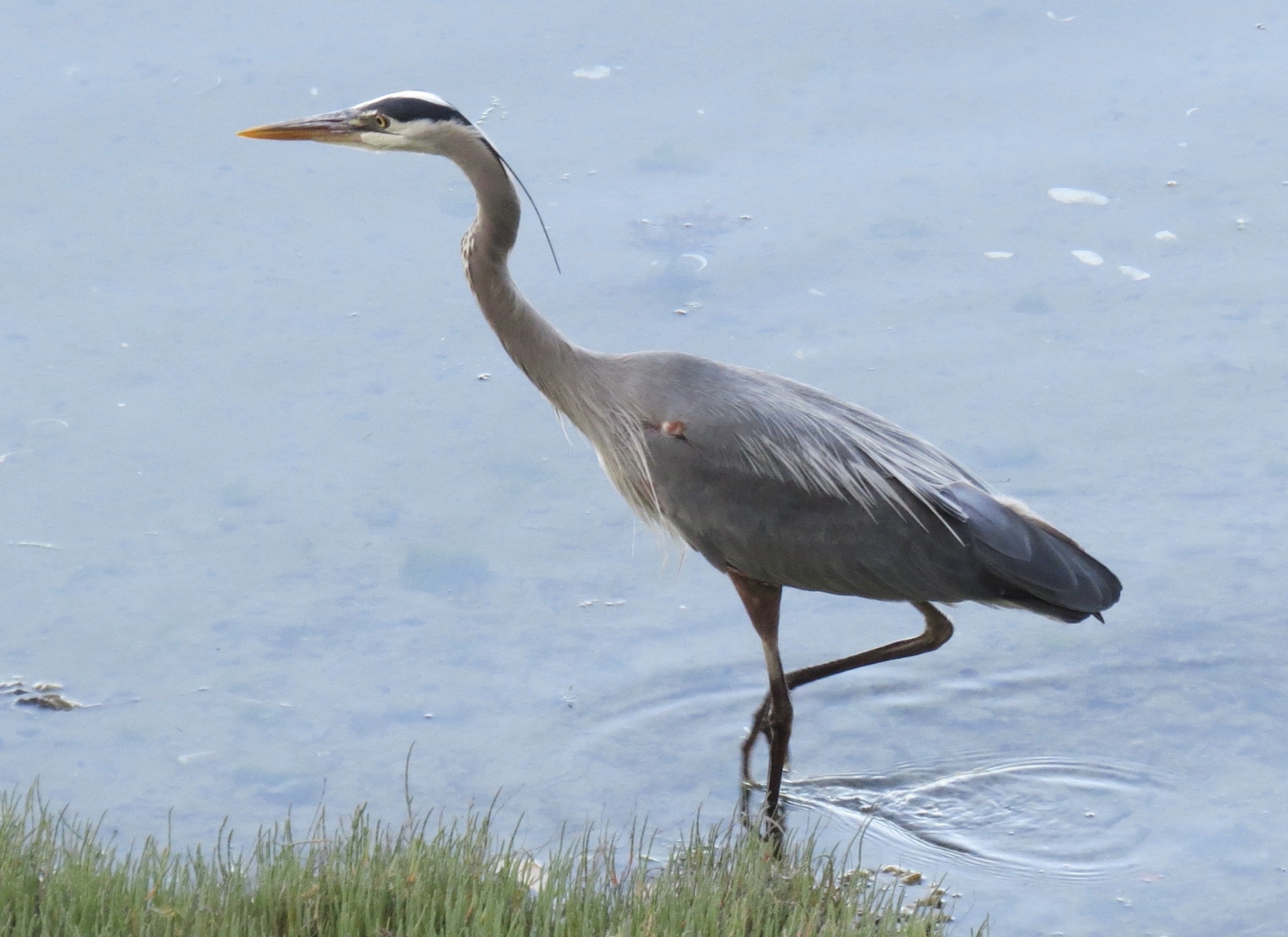
The heron surely represents patience. Poised like sculpture, wading in water–both freshwater and coastal–scanning for small fish, the great blue heron stands four foot tall on long skinny legs which possibly look like reeds in the water. Extending exceptionally long necks they strike their prey with lightning speed, spearing with razor-sharp bills.

Nesting high in trees and with outstretched wings of 6 feet, the great blue heron is a common sight in Western Washington where we are fortunate to have them as year-round residents. Consider the Pacific Northwest a sanctuary for the great blue heron. A refuge for all of us who, like birds, want to be left alone. 

Originally published January 15, 2025 in The Journal of the San Juan Islands

5 Comments

Filed under Birds

One Storm or Another

BY KIMBERLY MAYER

Years ago I read that shortly after a telephone conversation with Katherine Hepburn, who was at her seaside home in Old Saybrook, Connecticut at the time, Spencer Tracy became aware of a hurricane barreling up the Eastern seaboard, heading right for Old Saybrook. “But she never even mentioned it!” he exclaimed.

I am much the same way. I didn’t bring up our recent storms either. Long distance people had to ask, and I downplayed it. “We’re accustomed to winds,” I said, “and our trees are accustomed to winds.” But between us, it really was something. And not all trees stood.

One storm was a bomb cyclone, and the other, an atmospheric river. Unlike hurricanes, they have no names—we save names for earthquakes and wildfires out west. In any case, last month we experienced one right after the other. Everything all at once it seemed. Nearby Vancouver Island tracked gusts of 101 mph–the speed of a Catagory 2 hurricane. In Seattle the National Weather Station was damaged by high winds, while falling trees struck homes, a homeless encampment in Lynnwood, a King County Metro bus, and pulled down power lines all around the metropolitan area. 

I rode the storms out in my home on San Juan Island, wifi down, flashlights and candles at the ready. For what seemed like weeks I stood at the windows and witnessed the world whited out and erased. Wind and rain, wind and rain. Normally we can determine wind direction by the waves, but we couldn’t even see the bay. Everything vanished.

And yet we never lost power on San Juan Island. Be it the number of underground wires or the confluence of surrounding mountains, we were spared any outages through the two monster storms. I’m thinking we’re in a protected bubble here. 

Pinecones can slam against glass windows and batter the decks all they want—it’s just a lot of noise. 

Hold that thought. Keep it in mind as we look to the next four years. While trying to console me after the election, my daughter suggested “You’re in a good place, mom. Trump doesn’t even know about the San Juan Islands. He has no idea any of you are there.”

Originally published January 1, 2025 in The Journal of the San Juan Islands

5 Comments

Filed under nature, Uncategorized

Book Women

BY KIMBERLY MAYER

A dozen women sit high and dry reading in our living rooms month after month on an island in the Salish Sea. As a bookgroup we travel together by way of our book selections, be it fiction, nonfiction, or historical fiction—and lately an armload of them were set in the Appalachian Mountains: Demon Copperhead, by Barbara Kingsolver, The Last Castle, by Denise Kiernan, and The Book Woman of Troublesome Creek, by Kim Michele Richardson.

So when Hurricane Helene made landfall in Florida and then rolled up to the southern Appalachian mountains, hitting there the hardest, 2,500 miles northwest the bookgroup was hit too. Land that we had come to know was washed out. The hallows and canyons in Demon Copperhead. The healing properties of the cool forests in Asheville, N.C. when George W. Vanderbilt first arrived. Creeks now turned to rivers, and rivers overflowing. Trees giving way in the saturated soil and winds. Bridges tumbling down like Tinker Toys, and roads destroyed. 

When we travel by way of literature our consciousness aligns with that of the book. Indeed, art and life came together like a thunderclap when I saw coverage of an organization called Mountain Mule Packers delivering food, water, etc. to remote areas in North Carolina. Such was the method of delivery in The Book Woman of Troublesome Creek, over mudpacked trails on steep mountainous terrain, bringing books to remote hill people in counties that had no library during Roosevelt’s Kentucky Pack Horse Library Project, 1935-43, a part of The Works Progress Administration (WPA) program. 

“Since the historic storm swept through the southeastern United States,” reported Citizen Times, a daily newspaper in Asheville, “a train of mules and their riders has trekked through the chaos from dawn to dusk, delivering essential supplies to people in hard-to-reach-areas… From cleaning supplies to hygiene products, blankets, clothing—and even a teddy bear with a note of support from a young donor—the mules have tirelessly carried load after load, shouldering the burdens that people of Appalachia can no longer bear.”

Empathetically bookgroups help carry some of that burden too.

Originally published November 20, 2024 in The Journal of the San Juan Islands

Leave a comment

Filed under Bookgroups, Hurricane Helene

Patrons of Husbandry

By Kimberly Mayer

I may be the last person on island to get to know the Grange. In the rural town in Connecticut where I grew up, #199 Grange was a large colonial building in the landscape, as formidable and mysterious to me as Knights of Columbus, Elks Club, Shriners, and the Masonic Temple. I thought them all men’s clubs. Secret societies complete with handshakes, robes, hoods, and who knows what? I never entered any of them. The official name of the Grange is National Grange of the Order of Patrons of Husbandry. You can imagine the thoughts that went through the mind of a thirteen year old girl with the word “husbandry.”

Many miles and many years later, along comes my good neighbor on San Juan Island, Washington, and what does he do in moving here but join the local Grange #966. “I’m channeling my great grandfather, James William Abert Wright,” he told me at the time. In the aftermath of The Civil War, JWA Wright left a decimated Alabama for the San Joaquin Valley, the breadbasket of California. And there, as an educated man, teacher, lawyer, writer, and later editor at San Francisco Daily Evening Post, he became an early Grange organizer. The Declaration of Purposes of the National Grange, a treatise which was adopted by the St. Louis session of the National Grange in 1874 and still stands today, was penned by my neighbor’s great grandfather, JWA Wright.

As a young girl I was wrong about so many things. For one, women have always been admitted membership and held leadership roles in the Grange. Even before they had the right to vote nationally, women enjoyed full vote and voice here. Turns out the Grange was progressive. And as the most powerful farming organization in the country, it was a significant force in the national struggle for women suffrage. 

In the Connecticut town where I grew up Grange #199 no longer exists. Membership has declined nationally, but Washington, it turns out, has the largest membership of any state. 

The mission statement of San Juan Island Grange #966 is “To support a resilient community of growers, makers, and keepers; to foster social and political engagement; and to maintain our hall as a home for celebrations and programs.” Today this is expressed in gamer nights, workshops, meetings, Repair Fairs, and Monday Night Contra Dance—where my neighbor is a regular. Back in the day, the social isolation of farmers is something the Grange always addressed. In the advancement of agriculture, the Grange valued the needs of family members. Halls were designed with a stage for musicians, an open floor for dancing, and benches along the walls. Meeting, greeting, courting, socializing, and raising families. 

One doesn’t even have to be a farmer to join The Grange.

Originally published October 19, 2024 in The Journal of the San Juan Islands .

11 Comments

Filed under The Grange

Dancing on Bridges

Photo Credit: Jack Riley

BY KIMBERLY MAYER

At the end of every summer season residents of Cape Cod, Massachusetts gather on overpasses to wave farewell to visitors on the bridges that connect Cape Cod to the mainland. Year after year, that’s the tradition. But whenever I heard my mother tell the story, she had them “dancing on the bridges.” Having retired to Cape Cod with my father, I think she was always so exhausted after hosting everyone all summer long she imagined a celebratory dance. 

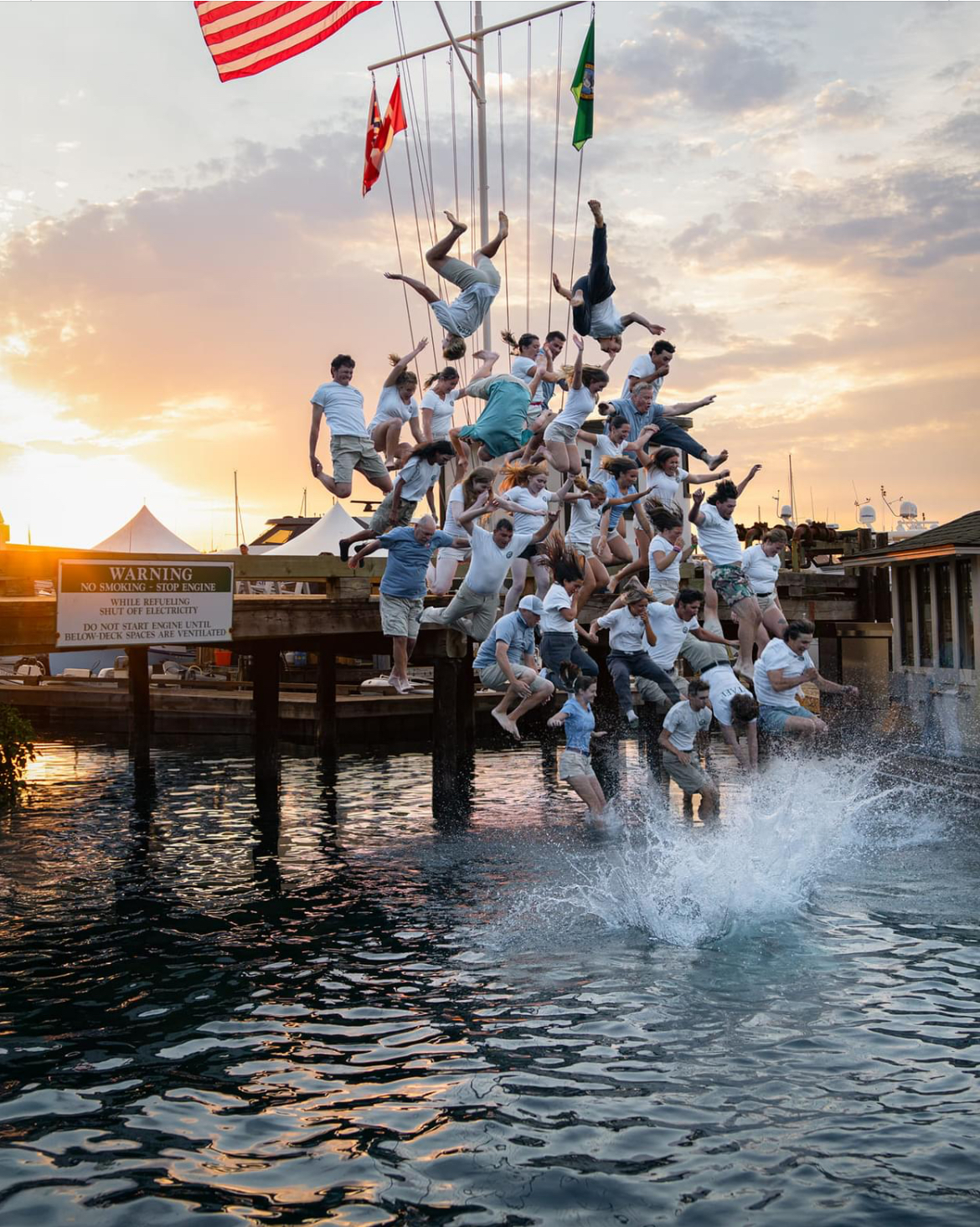
Here too, the visitors, for the most part, have vanished. Short of throwing yourself off the dock on Labor Day like the staff at Roche Harbor Marina, I’m not sure what end of season traditions we have on island. One might say being able to walk the sidewalks with ease in town, and not having to stand in any lines. Our friend Adam Eltinge adds, “and turning left in town,” if you’re a car.

As soon as the tents at the San Juan County Fair are folded up, a seasonal tide is set to turn and autumnal equinox is almost upon us. Big leaf maples start to turn, and summer birds get the memo and head south. We can renew our garden activity with fall planting, although rains will relieve us of all the summer watering. As Susan Vernon wrote in Rainshadow World, “As the days progress, the morning fog drifts in and out gently nudging summer away.” 

That nudge may be a little less gentle each year, I’d say. Each time around it becomes increasingly apparent that we’re not here for very long and that our time is going faster. In Late Migrations Margaret Renkl describes this phenomena of time and place as a reminder “… that the world is turning, that the world is only a great blue ball rolling down a great glass hill, gaining speed with each rotation.”

My favorite time of year on island without exception is when hay has been rolled, and round bales dot the fields. This is my “South of France moment” each year. And every year I have every intention to set up an easel and paint it, or sketch it, and as it is I barely catch it with my camera before the bales are gone from the fields. Ten years ago, it seemed I had weeks in which to set up. This year, I must have blinked. Great blue ball, indeed.

Originally published in The Journal of the San Juan Islands 9/18/24

6 Comments

Filed under change of seasons, Uncategorized

Resilience

BY KIMBERLY MAYER

“Hang onto your hat, hang onto your hope and wind the clock, for tomorrow is another day.”

E.B. White

One day there will be a word for what we went through recently, in this election. Suffice it to say the presidential debate on June 27 did us all in. Our president was getting on in years, and so it was gloom and doom time amongst friends on island. Nevertheless, Democrats marched in the 4th of July parade on island without a name on their signs. Marching with messages, marching through the morning. 

We were on our own, it seemed.  

Everyone I know was practicing self-care. I began asking others, “What did you do to pull yourself through?” Walking, birding, kayaking, baking. Listening to more music, seeing more films, and reading more books than ever. What more can one do? Working remotely at our home, our daughter paddle boarded off toward the horizon at the end of every day. It seemed endless. One dear friend wonders, “I am trying to think, did I cope?” 

I found my way, as I often do in times of trouble, to the labyrinth at St. David’s Episcopal Church in Friday Harbor. Labyrinths are designed for walking meditation and have been practiced for thousands of years, long before Christianity. I can’t explain why but it works. Walking a labyrinth is mindfulness that looks mindless. There is only one path to follow from the outside to the center and back out again. No decisions, no wrong turns possible. You think you’re getting there, and you’re not. Just when you are spinning further away, suddenly you are there. Much like life.

And just like that, the winds changed and the tides turned and everything flipped when Joe Biden gave his seat in the upcoming election to his second in command, Kamala Harris. And soon a Vice Presidential candidate on top of all that. Now we’re all shining brightly and experiencing a lightness of being and unbridled joy. 

Parade, anyone?!

Originally published in The Journal of the San Juan Islands 8/21/24

8 Comments

Filed under The election

Unloading

Photo by Jacqueline Blum

BY KIMBERLY MAYER

Some weeks back, when a visitor asked for recommendations of things to do in Friday Harbor, I was a bit surprised by my friend Kat Rose’s response, “Be sure to visit our consignment shops.” Kat explained, “People move to the island and soon adopt the rural style and we sell our city clothes.” She then listed various local consignment and thrift shops for clothing, housewares, and furniture for the visitor.

Now I don’t know why I was surprised by Kat’s response, as unloading in these venues is what I do all the time lately. Basically, the longer I’m on island—ten years now—the less I seem to need. One day I may just float off and become a bhikkhuni, a Buddhist nun. Seriously, I am trying to lighten my footprint. 

I find my clothes go rather fast at Girlfriends, though handbags tend to hang around. I recently brought a console table into Treasure Hounds (where proceeds go to the animal shelter), followed by a pair of antique French chairs. They’re just not me anymore, not our lifestyle—if they ever were. The Thrift House (benefitting the fire department) always receives my linens. Books go to Serendipity and Little Free Libraries whenever they’re not full. Any finer objects I once collected and loved are at Funk & Junk. Finally, Community Treasures is what I drive through to donate everything from garden hoses to box springs when the others are closed.

Nobody gave it much thought, but all the boomers would be unloading at once.

Some of the best things show up second-hand, I know that. Indeed some of the items I’m giving away were consignment shop finds in the first place. When we moved into this house we filled a crawl space—whatever were we thinking in storing things there? Whatever is there, we obviously don’t need it. And our kids don’t want our stuff. Aren’t all millennials minimalists? Likewise I don’t bemoan anything I have given away. Gone is gone, and there is so much joy in giving and gifting, and experiencing a little monetary compensation in the case of consigning. But the real reward is experiencing lightness.

Today there is so much more I don’t want, than that I do. I am happier with less.

When we came up with “The Nature of Things” as a title for this column, I liked it for the reason that I could write on any subject I chose. But sometimes it’s about the things you can do without, and the nature of that. That’s the space I’m writing into today. 

Originally published in The Journal of the San Juan Island 7/17/24

7 Comments

Filed under downsizing, Simplifying

Seed Library

The optimism of seedlings

BY KIMBERLY MAYER

The last time I went to the library I returned a couple overdue books and picked up a packet of seeds. Who knew? While seed saving has been done for 10,000 years, it has only recently become available at many public libraries, including ours. Started and maintained by Jessa Madosky and Nancy Best at San Juan Island Grange, the seed library was moved to the public library this spring. Housed in small manilla and craft paper envelopes in a wooden card catalog many of us will recall, not much space is taken. The whole thing is wonderfully old fashioned.

Vegetables, fruit, herbs, flower, and wildflower. No sign out is necessary, and it’s free.

There’s a natural economy in seed saving. Here, packed in quantities suitable for a row in a home garden, are seeds from organic, open-pollinated gardens, already proven successful in our area. Preserving heirloom varieties ensures better flavor, encourages disease resistance, and helps combat seed monocultures where four giant companies control more than 60% of the world’s seeds, threatening our global food supply.

The seeds I “borrowed” are Heritage Waldron Kale. After coming home from the library I planted them in a tray, and in a couple weeks three or four showed their heads and I cheered. Today as I write, the tray is populated with more seedlings than I can count, looking like a Lilliputian field of four-leaf clover. This is what happens when you stare at a tray or a small plot for a period of time: it becomes your world. As any gardener will tell you, when you raise them you begin to refer to them as your “babies.”

Seeds, as Thor Hanson remarks in his book The Triumph of Seeds, “… are quite literally the stuff and staff of life.” These seeds were so small they were but mere specks. Yet in each one, an embryo plant with a supply of food (starch, protein, oils) to get it on its way. “A baby in a box,” Hanson calls it. It’s not time yet to transplant my seedlings.

Having come of age in a small rural town without a bookstore, the library meant everything to us. Today with services expanding into realms librarians of old never dreamed of, the library means everything once again. Along with the community-based collections of seeds, Assistant Director of San Juan Island Library, Anthony Morris showed me some of what else the library has been lending lately: birdwatching equipment, a State Park Pass, a pass for two to the art museum, gardening tools, culinary tools, and a telescope.

Who knew that too?

Originally published in The Journal of the San Juan Islands 6/19/24

8 Comments

Filed under Uncategorized

When Bird Became a Verb

photo credit Paul Mayer

BY KIMBERLY MAYER

You might drop by the San Juan Islands Sculpture Park for the art, you might stroll it for the plantings and nature preserve, or you might do as we are doing, and go for the birds. It is warm in the sun and cold in the shade in May. Dressed in drab colored field clothes, vests and jackets with plenty of pockets, hats on our heads, and sensible shoes underfoot, a group of birdwatchers winds its way through the park with bird guide Tyler Davis. Around everyone’s neck, binoculars.

Before binoculars, birds were killed for study. “I shot the first kingfisher I met,” John James Audubon wrote in his journal, “pierced the body with wire, fixed it to a board, another wire held the head, smaller ones the feet… there stood before me the real kingfisher. I outlined the bird, colored it. This was my first drawing actually from nature.” (The Birding Life: A Passion for Birds at Home and Afield by Sheehan Stites).

Originally called “field glasses” in England, binoculars made all the difference. The first real pair of handheld binoculars were introduced in 1825 and by the end of the century, birdwatching had become a recreational activity. “Binoculars don’t bring the birds closer to you,” states Simon Barnes in The Meaning of Birds, “they bring you closer to the birds, taking you into the tree, across the sea to the ledges of the cliff, out to the middle of the lake, and above all, they take you into the sky to fly with the birds.” 

At a time when birds themselves are on a decline, birdwatching or birding is ever-growing. We are drawn to it for a host of reasons: 

~ “I feel a much deeper connection to the natural world…. Birding has tripled the time I spend outdoors and proved more meditative than meditation… My senses focus resolutely on the present, and the usual hubbub in my head becomes quiet.” (Ed Yong, “When I Became a Birder, Almost Everything Else Fell in Place,” The New York Times 3/30/2024). 

~ Improving observation and memory. 

~ Listening to birdsong is calming. 

~ Birding is an inexpensive hobby, and our archipelago, a bird rich location with 291 species of birds recorded. (Birding in the San Juan Islands, Lewis and Sharpe). 

We stand in an open field as bald eagles soar on high, riding the thermals. Such is the wilderness in our backyard. No one says a word.

From mud flats to freshwater lake and marsh pond, field and pasture, dry grasslands, open woodland, forest, and shrubby thicket, there’s a variety of habitats in The Sculpture Park. It’s a breeding ground for numerous species, and on our recent morning, the act of bird copulation called a cloacal kiss.

Birders often speak of their “spark bird,” meaning that first bird love, the bird that got them seriously into birding. Tyler shared his spark bird moment with us, recalling Rainbow Lorikeets in downtown Cairns, Australia. He was twelve years old at the time and thrilled to find this brilliantly colored parrot flying wild. His mother gifted him a guide book, Birds of Australia, by Simpson and Day–one senses that he still has the book–and “this is what ultimately got me hooked on all things avian,” he says with a grin.

So much depends upon a spark bird.

Originally published in The Journal of  the San Juan Islands, 5/15/24

9 Comments

Filed under Uncategorized