Tag Archives: Friday Harbor WA

Monster Trucks and Midsized Regrets

Drawing by Hunter Blum

BY KIMBERLY MAYER

The year-round population of San Juan Island is a little over 8,500. In summer it swells to twice that, which makes it harder to get around the town of Friday Harbor and find parking. But it wasn’t summer yet when, in a parking lot, I witnessed an accident in slow motion. A large pick-up truck, attempting to park, dented the side of a shiny new luxury SUV. The driver hopped out of the truck and looked bewildered. Are parking spaces too small? Are vehicles too large? Are we all not trained truck drivers? The answer to all that is yes. 

Years ago the tabloid website outlet TMZ broke the story of California’s First Lady Maria Shriver caught on camera holding a cellphone to her ear while driving in Brentwood. Just one year earlier her husband, Gov. Arnold Schwarzenegger, had made the use of hand-held mobile devices illegal while driving. The story was then picked up by mainstream media. (“Shriver and her cell phone,” by Meghan Daum 10/15/2009 Los Angeles Times). People were abuzz. 

 “There’s going to be swift action,” said the governor. But the big crime to me at the time was the largeness of her car, a black Cadillac Escalade. 

In the years that followed, the American appetite only grew for ever larger SUV’s, pick-up trucks, and swollen vans. Demand for the sedan dwindled. Today, nearly half of the U.S. population owns a truck, and trucks became supersized.

“The consequences of this vehicle growth trend are far from benign. Cities and infrastructures designed for smaller vehicles are now grappling with oversized vehicles,” according to The Finn Blog 2025. Parking, road congestion, and most critically, the increase in size is more dangerous to people walking, biking, wheelchair users, and children. Blind spots are created when the driver sits higher and the front of the truck is higher. And while cars with lower hoods might have struck pedestrians in the legs, the supersize truck strikes torsos and heads.“ To put it simply, pick-up trucks and SUVs are two to three times more likely than smaller vehicles to kill people in the event of a crash,” writes Steve Davis 4/12/2021 for the nonprofit organization Smart Growth America.

These giants have finally become too much vehicle for us to handle. I know, I drive one. Not as massive as Maria Shriver’s black Cadillac Escalade, but a midsized SUV, which I consider huge. Mirrors help in the back, but not in the front. As I come over a rise to our drive, for a breathless moment I see nothing at all before me until the car levels out. My heart has always been in something smaller.

At age six my grandson is obsessed with Monster Trucks. He collects them, plays with them, draws them, wears them proudly on tee shirts, and is super excited whenever he spots one. He will get over it, but will we?

Originally published July 16, 2025 in The Journal of The San Juan Islands

1 Comment

Filed under road safety, Supersized trucks, full-size SUVs, Monster trucks

When a Writing Piece Becomes a Painting

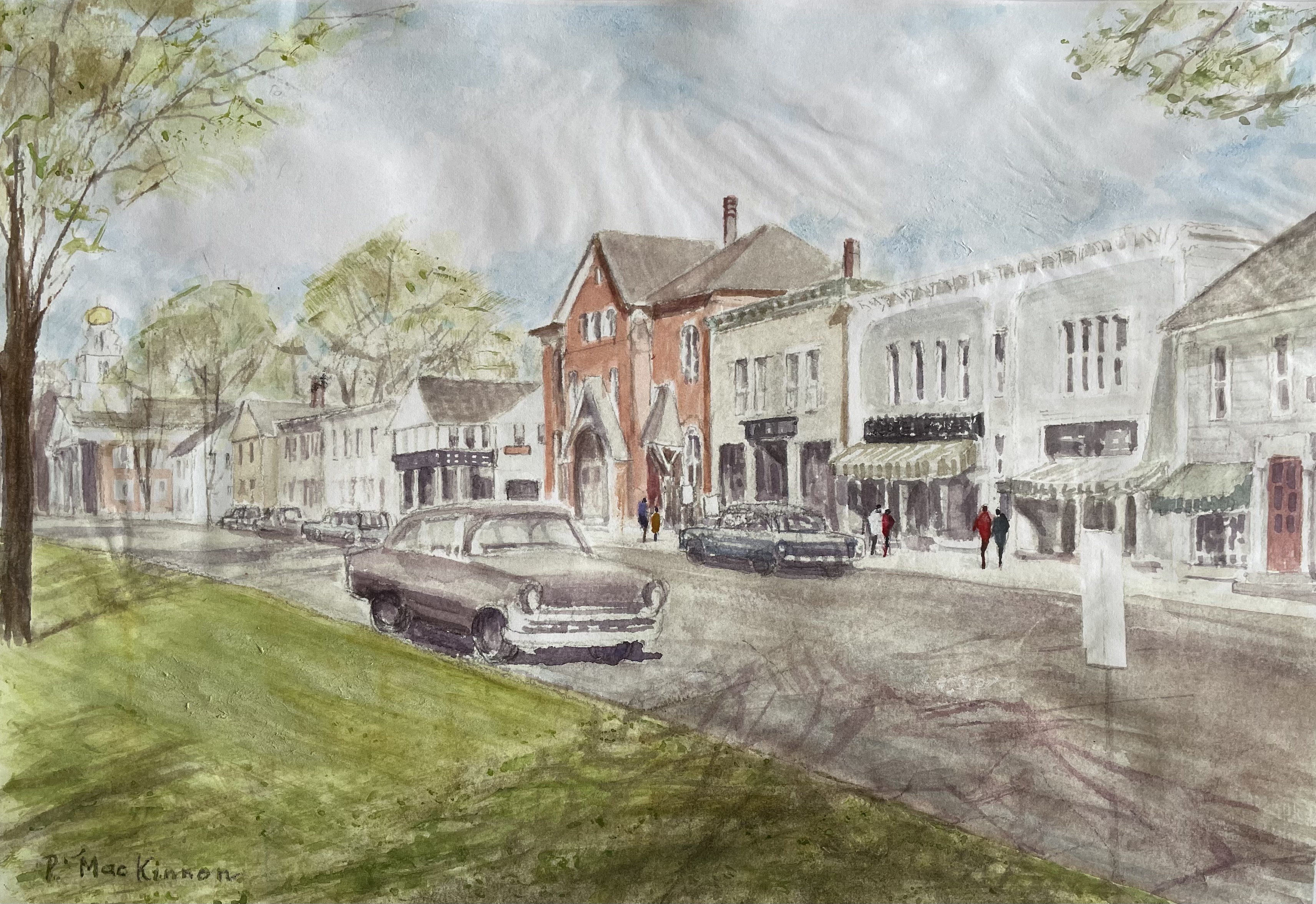
Suffield Town Center, by Peggy MacKinnon

BY KIMBERLY MAYER

One of the things I love about writing is not knowing where it’s going. Whether casting off or plunging into one’s internal well, writing is a fishing expedition. When asked what makes a great poem, W.S. Merwin replied, “Following what you don’t know.”

Writing about a recent fire in Friday Harbor, Washington led me to this piece. In the process of writing “What We Lost” (https://alittleelbowroom.com/2022/04/26/what-we-lost/ ) I fell in love all over again, with my old town center in Suffield, Connecticut. Which is like falling in love with a ghost town for the center isn’t there anymore, except in my head. And now in this watercolor painting by Peggy MacKinnon that sits upon my writing table looking out to the bay. 

Peggy MacKinnon is ninety-six years old and still resides in Suffield. At one time my cousin lived just a few doors from The MacKinnon’s home on South Main Street. Best friends with her son Ian, I asked Gil about his time there, growing up.

“Ian was the youngest of six boys, all at least 6’1, and Peggy, their mom, so little. Likewise, all the boys and her husband, Dan, had a wild sense of humor,” Gil recalls. “But Peggy, so quiet … perhaps noticing other things.” The slant of light, the saturation of color. Even as a child Gil knew to detect an artist’s mind in Peggy.  

Peggy had met Dan in high school on a tennis court in Ann Arbor, Michigan. Years later they were a family of eight living in Suffield, and as a couple, frequently played tennis with my folks. In my memory of home my mother is often in her nightgown hanging onto the kitchen wall phone in the morning, and the friend on the other end was very often Peggy. Peggy MacKinnon.

Peggy painted. She painted while Dan was the Director of Prison Industries at a state prison, and when he founded the Maverick Corporation, a work program for ex-convicts and juvenile offenders. She painted as Dan served as Commissioner of Administration under Governor Grasso in Connecticut. She painted when Dan ran for Congress. And she painted for the twelve years he was at Merrill Lynch in Hartford, while at the same time running a small sheep farm in Suffield. She raised six sons, helped in birthing the sheep, and she painted. Peggy never lost who she was.

I don’t think I appreciated any of this at the time, but now I can see why my folks found them so interesting. And over the years I’ve grown to love her work, the delicacy of hand, always working in watercolors. Maybe it was my generation, maybe it was me, but we were anything but consistent. So I’m in awe of Peggy always knowing what it was she did and doing it.

2,444 miles away, I am writing to the painting today. In writing we speak of finding a “voice.” In painting it’s the artist’s “hand,” and I’ve found hers here. 

This is the center of town we all lost in Suffield. There was a sense of importance to the town then that is in none of the new-brick outlying buildings, or the building they refer to as “Suffield Village.” My friend Jane Clarke writes, “I too go back to Suffield to capture something that is so deep in my neural fiber… If I stand on the village green and look out over what the town is now, it seems to quiet my memories and I don’t see myself.”

A disappeared town center, there is no getting it back except in memories, stories, art and writing. And what started out as another cry from me lamenting the loss of old buildings, grew into an ode to a gracious lady and her paintings.

6 Comments

Filed under loss, painting, Writing