Tag Archives: E.B. White

My Father’s Last Garden

BY KIMBERLY MAYER

Nine years ago, when my father was ninety-one years old and recovering from quadruple bypass heart surgery, he spent some time in a rehabilitation center near the retirement village where he lived with my mother in Duxbury, Massachusetts. I remember being startled at first by how frequently the word “rehab” was bandied about by their crowd. It took me awhile to appreciate that these stays had nothing to do with drugs or alcohol. My father’s stay, it turned out, had everything to do with gardens.

The month was September and the weather was mild. Mom and I visited dad in turns daily, and when it was my turn I knew I was giving her much needed time alone or with her friends. So I spent some time. Every day I wheeled dad out to a courtyard in the center of the complex, where I pulled up a chair and, with a navy blue lambswool throw over his lap and a gray herringbone wool cap on his head, we settled in for a good bit of the afternoon. We spent no time whatsoever in his room, and I can’t even tell you whether or not he had a roommate. But our time in the courtyard is as clear as can be. 

Memory, it turns out, has a far stronger relationship to place than it does to time. I know this to be true because in order to write this, I had to rely on my sisters to recall the month and year for this particular rehab stay. Toward the end there were so many.

Surrounded by a brick building on all four sides, the courtyard was concrete underfoot with a couple patches of soil. A rhododendron shrub grew in each patch. So Dad and I started with that. Our job, the one we gave ourselves each day, was to dream up a courtyard garden. Just the two of us. There were other patients scattered about but as we didn’t know them, we enjoyed an anonymity, and of course, reported to no one. In this way we took ownership of the lot.

“Look at how the rhodies thrive here, let’s do more of that,” I don’t know which one of us said it. We were thinking like one from the start.

And so we began in that concrete courtyard, designing a garden in our heads. Creative play, day after day. Neither touching a hoe nor getting dirt in our fingernails, just thinking like a gardener together. No boots, no gloves, no kneeling pad—or knee pads, as my father would have worn. No deer here, no rabbits to devour everything green. But the sun on our faces and fresh air in our hair, for gardening is also about being in a garden, albeit in our minds’ eye. 

Each day we took our place and picked up where we’d left off. Dreaming it, improving it, growing it, we made the courtyard garden ours. Did dad share this with mom in her visits? Probably not. I never heard a word about it from anyone. 

What dad and I felt in our hearts was that a garden at the rehabilitation center would do more than all the staff, more than all the meds, more than anything, for the patients. We just knew it at the time, and I have since learned this to be true. In 1984 the pioneering environmental psychologist Roger Ulrich conducted the first such study, View Through a Window May Influence Recovery from Surgery. In a suburban hospital in Pennsylvania two groups of patients recovering from the same surgery were studied. The windows in the rooms of one group looked to a brick wall, the other, to leafy trees. “The patients with a view of trees fared better; they had lower levels of stress, more positive mood, required fewer doses of pain medication, and were discharged on average a day sooner.” (The Well Gardened Mind: The Restorative Power of Nature, by Sue Stuart-Smith). And that was simply given a view. 

Consider the recovery with an outdoor space, such as a courtyard, to bring the outdoors in. Architecture could be doing this, but it isn’t, not enough. Gardening-wise, it can be as simple as planting trees, vines, or broadcasting seeds. In her book, Growing Myself, Judith Handelsman reminds us, “In the not too distant past, the healing power of gardens was a matter of course. European sanitoriums incorporated time in their gardens as an essential part of the cure. It is only with modern medicine’s dependence on taking a pill that we have lost the belief in healing through osmosis by basking in the presence of nature.”

If indeed dad and I had been “basking in the presence of nature,” all of this would be more understandable. But in our case the courtyard at the rehabilitation center was all but barren. Similarly, E.B. White described his wife Katharine S. White “laying out of the spring bulb garden” in the Introduction to her book, Onward and Upward in the Garden:

Armed with a diagram and a clipboard, Katharine would get into a shabby old Brooks raincoat much too long for her, put on a little round wool hat, pull on a pair of overshoes, and proceed to the director’s chair—a folding canvas thing—that has been placed for her at the edge of the plot. There she would sit, hour after hour, in the wind and weather, … sitting there with her detailed chart under those dark skies in the dying October, calmly plotting the resurrection.

I don’t want to overstate it, but gardens have always been about both the real and the imagined. Ask any gardener. And an imagined garden, it turns out, can be healing too. 

My father was soon released from the rehabilitation center, moving back into the retirement village in Duxbury with my mother, and then to a more assisted care facility near Boston. There he contracted Covid 19 and died, nearly five years after our time together in the rehab courtyard. I consider that imagined garden dad’s last garden because his plot of land in life kept shrinking. In the end it was the 11 x 6 inch birdfeeder mounted on his bedroom window that came the closest to being a garden. Blue jays, sparrows, cardinals, and chickadees, his joy in them immeasurable. 

19 Comments

Filed under imaginary garden, Uncategorized

Walking with E.B. White in NYC

BY KIMBERLY MAYER

I was back in NYC accompanying my daughter on an apartment hunt in Brooklyn. A number of years ago I lived there, briefly. Times have changed. In my day finding an apartment in NYC was largely a matter of securing a sublet through a friend-of-a-friend. Today, agents host open houses and publish floor plans with photographs of rentals online, much like selling properties.

Getting about NYC on foot has changed too. No more notes in hand, maps in pocket, or memorized directions. Where we used to count blocks, look at street signs and be cognizant of numbers, now it’s follow your phone. Walking GPS style. Everybody’s doing it. It’s a different world.

That must be why, while trailing my daughter who was being led by her phone, I met up with a kindly old gentleman dressed in a gray overcoat and hat. He looked as baffled as me, in part; the other half of him was very much at home. No wonder, it was E.B. White, writer and contributing editor to The New Yorker magazine for more than 50 years. And here I thought he had been at rest on his saltwater farm in Maine all this time.

Just the thought of of New York and some folks rise to their feet with Sinatra’s song, “New York, New York,” ringing in their heads. Some settle in with Bobby Short’s melodies, while others get bubbly with Cole Porter. To me, E.B. White was, and always will be, not only the voice of the magazine, but the voice of the city.

I’m not sure my daughter even knew he was there on the apartment hunt that day. She was out ahead, as I said, but both E.B. & I walked rather slowly, preferring to see things as we go.

Not much of a conversationalist–he’s still making notes in his head for The New Yorker, I told myself–he nevertheless came up with just the right words every time.

At each appointment I went in to tour the apartment with my daughter, while E.B. lingered on the sidewalk. He just turned up his collar, adjusted his hat, and waited. Then we’d fall in step again. We did this all day, all over Brooklyn, through a dozen appointments. In short, a delightful day.

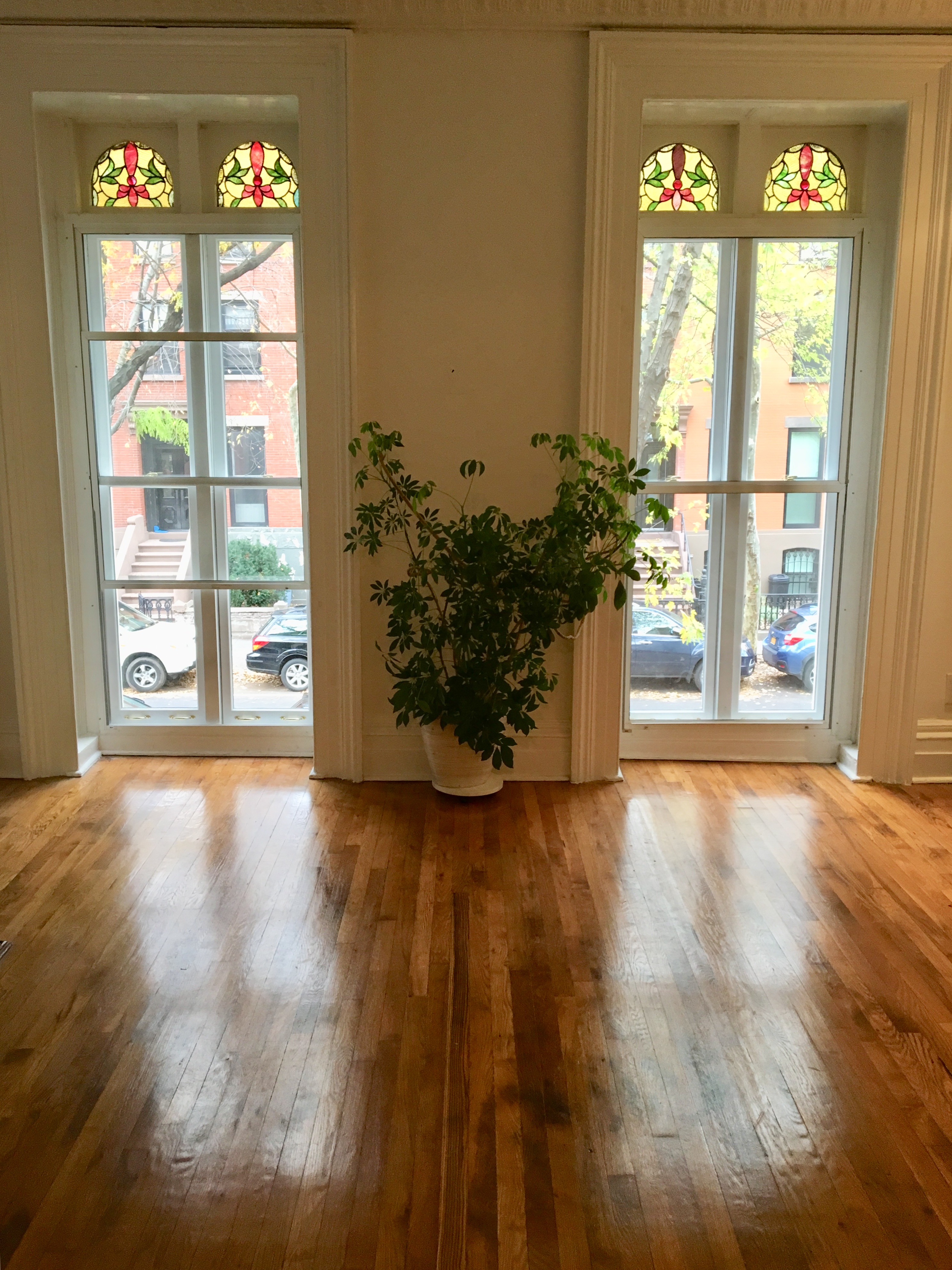
The apartment hunt, you ask? It ended on a well tree’d street in Boerum Hill. Sometimes it all comes down to a certain slant of light, and we found it in a lovely old home there.

“It’s where any one of us would place a writing desk,” I suggested to my walking companion, pointing out the window from the sidewalk. He looked up and nodded knowingly.

And with that he tipped his hat and walked off in the direction of the Brooklyn Bridge. Back to his beloved Manhattan.


23 Comments

Filed under apartment hunt

Into the Hut

Gertrude Stein did it in her Model T Ford while her partner, Alice, drove the car. Virginia Woolf did it standing up. Saul Bellow stood up as well. Whereas, James Joyce preferred to lie on his stomach in bed.

Nude and cold, Benjamin Franklin did it in a dry bathtub. Agatha Christie, a bathtub filled with warm water.

E.B. White did it in a boathouse on a saltwater farm in Maine. Rita Dove, by candlelight in a cabin. And Annie Dillard, in a tent pitched in her yard on Cape Cod.

Where writers write.

What are the chances? Two friends on two coasts, landing in their respective writing huts. But that is just what is happening.

Dulcie's cabinHers in Maine

Kim's hut Water

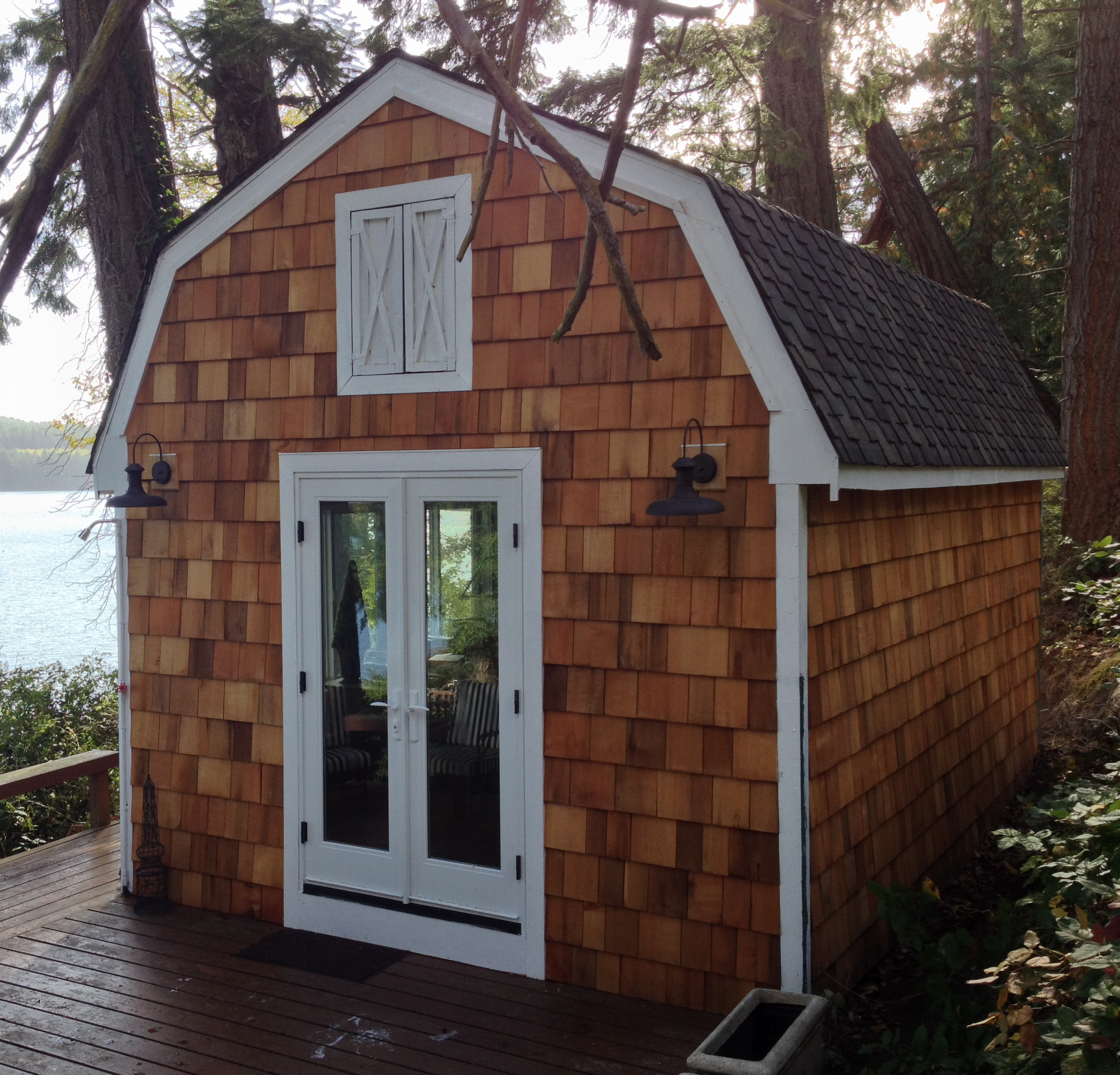
Mine on San Juan Island, Washington

In his introduction to Jill Krementz’s photographic book, The Writer’s Desk, John Updike notes “… the requirement of any writing space is that it disappear from the mind’s eye of the inhabitant, to be replaced, by the verbal vistas of poetry and prose.”

Apparently some of us build it so it can disappear.

For me, “a hut in the woods” had always been hypothetical. Nevertheless I coveted it, the proverbial writing hut. What a formidable writer I might be, I thought, if I only had a hut in the woods!

So much more than a room of one’s own, it’s a little house of one’s own.

My friend’s hut is still under construction. “The shell is done and it is insulated now from top to bottom,” she wrote last month. “But it’s still sitting beside my house waiting for walls and flooring and electricity and a bed and a fireplace and a water pitcher and a coffee pot and, well you get the picture.”

I recently asked for an update, but of course everything in Maine is frozen in place and under four or five feet of snow. I learned that she has another site in mind for her hut. Note: my friend’s hut has a gender and it’s a “she.”

“She did not make it to her pond destination before the snows descended upon us. So there she waits, very quiet, for spring thaw. She still has a lighted tree on her porch, like a twinkle in her eye, waiting for the next chapter of life to unfold.”

“So do I,” adds my friend.

My hut sits in an old growth forest at the edge of a bay. Both of us will have water views, water sounds, and water fowl.

My hut came with the house, as a shed. The old shed got a new roof, hardwood floors, French doors, new windows, electricity, insulation, cedar shingle siding, tongue and groove pine ceiling, beaded board walls. More than I ever dreamt.

I had hoped to keep the oars that were up in the rafters, but I lost the rafters when we insulated the ceiling.

And I too wanted to bring a daybed into my writing hut, but an overflow of living room furniture bumped the daybed. To make up for the missing daybed, we put an Aerobed in the hut’s loft, sleeping double.

With a settee, a pair of upholstered French chairs, and a small marble topped coffeetable on guilded legs, my hut looks like a salon. The antique pine table that our family once dined at morning, noon and night is now my writing table. A dresser holds my papers. And books, books, books are piled on an enormous baker’s rack and in a glass-fronted legal bookcase I found in a thrift store on island for forty dollars.

Investments in my writing life are starting to stack up. The MFA at Goddard, attending various writers conferences, a travel writing workshop in Tuscany, and now this. I don’t know how my friend in Maine is going to feel when her hut is up and running, but I am a little afraid of it.

In part, because it is so much more than I, or anyone, needed. And in part, because writing is hard work.

“Our task as we sit (or stand or lie) is to rise above the setting, with its comforts and distractions,” explains John Updike, “into a relationship with our ideal reader, who wishes from us nothing but the fruits of our best instincts, most honest inklings, and firmest persuasions.”

John Cheever, who wrote in a room looking into a wood, liked to imagine that his readers were out there, in that forest.

From my hut in the San Juan Islands to her hut in Maine, we are not alone.

5 Comments

Filed under writing hut

Pass Me My Blog

“Blogs make it hard for me to read full articles. Now tweets make blogs hard to read. Soon, I’ll only be able to consume shapes.” Aaron Levie, cofounder and CEO of Box

This is good news I suppose for cave painters. But as writers we have to tremble. Many of us have every intention to write books. In the meantime, we are blogging….

My daughter advises me to keep blog posts short and brisk, “perhaps no more than one or two sentences per paragraph.” (I have to listen to her. She’s the one who helped set up my blog in the first place).

OK, so I am trying. (How am I doing, honey?)

I have to be concerned about my manuscripts, however. Will there even be an audience for book-length works? Then I remember that I read, every day and every night. There’s little blue tin and tint of television light ever emitting from this house. That’s my tribe, and as endangered as it may be, I write for that.

So I see blogging as a literary linking of arms. A pat on the back that we are still here.

I’ll confess, I rather like the regularity of a weekly blog. I also like to imagine that I am E.B. White writing in my boathouse on the saltwater farm in Maine, sending my pieces off to The New Yorker. And although there is nothing particularly hurried to each day up here in Maine, it is amazing how rapidly that weekly deadline comes around. That’s a good thing for an old man like me.

I like the feedback in this too. Look at how one blog can start others writing, and how readily their comments are published. Does anyone remember the odds and the wait with “Letters to the Editor”?

Blogs are accessible. So much so, it’s become the new noun in my weekly writing workshop for seniors. In our workshop we write in longhand, read aloud what we have written at the end of each session, and many of the seniors  refer to it as their “blog.”

3 Comments

Filed under manuscripts