
BY KIMBERLY MAYER
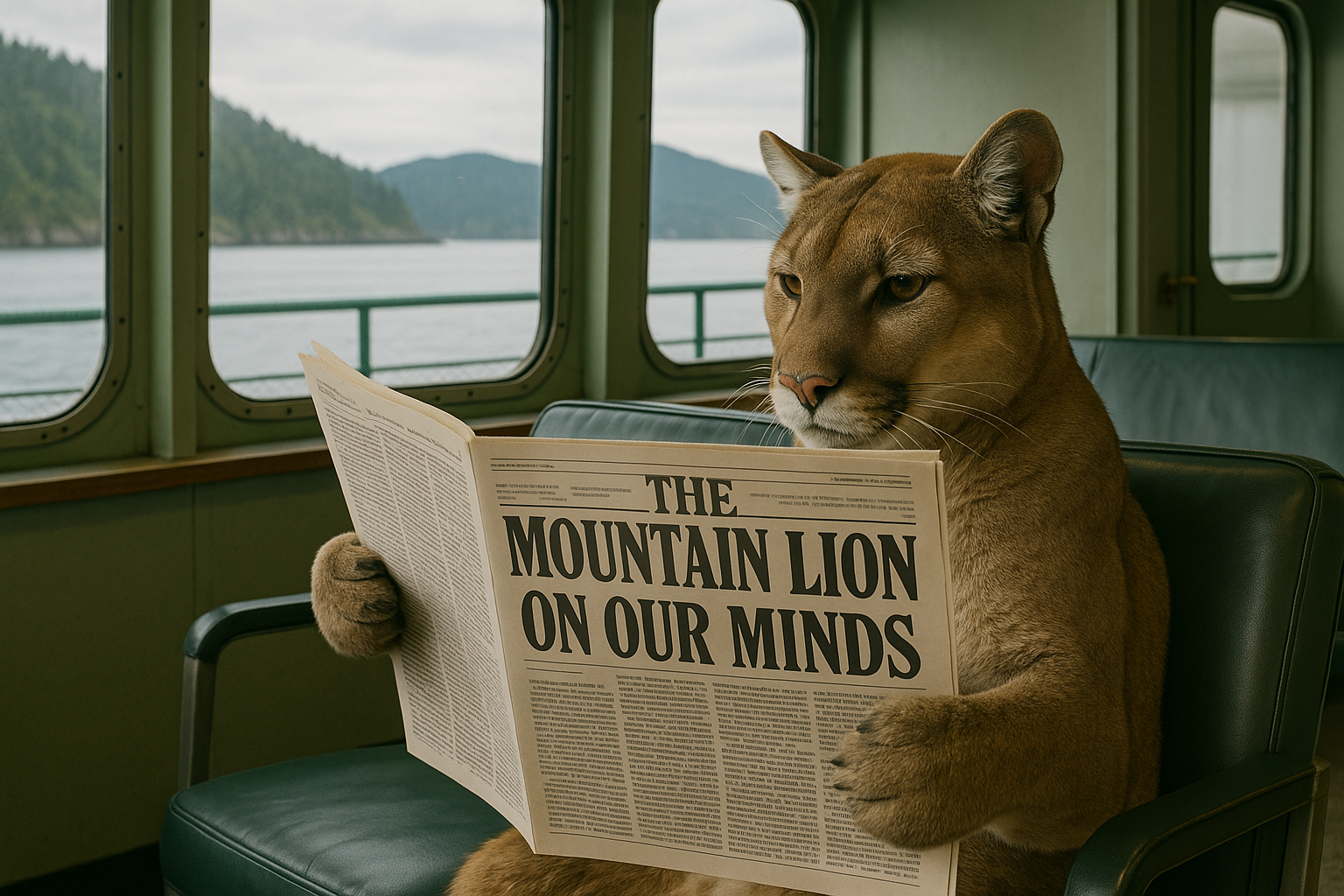
Just a few months ago my book group sat down to discuss A Tale for the Time Being by Ruth Ozeki, a writer who lives on Cortes Island, B.C. amidst bears, wolves, and mountain lions. I remember exclaiming to the group how very fortunate we are not to have large predators on San Juan Island. That was in May. By August 4th we had a mountain lion.
Islanders tend to keep track of things. Seasons are marked by what fish is running: salmon, halibut, or lingcod. Spot prawns, crabbing, and hunting seasons. Birders track birds to identify species, estimate numbers, and note migration patterns. And we track whales to better understand the Southern Resident Orca and to aid in recovery efforts. We have a sense of what belongs here and what doesn’t.
Not for a long time have large predators stalked the San Juan Islands. A few years back a lone black bear swam across the channel and went island hopping: Camano Island, Whidbey, Fidalgo, Orcas, and Shaw, finally arriving on San Juan Island for a long weekend. Then he was on his way again, but not without having turned us all a bit upside down. Now a cat is doing that.
With just two or three unverified sightings under his belt the mountain lion is free to roam anywhere and everywhere on island–mainly into our subconscious. Our collective subconscious. I’m not saying the mountain lion isn’t real, but it does have us all off balance.
Our community Facebook group, What’s Up Friday Harbor, is loaded with reports of mountain lion screams in the hills at night. People post scat photos to track his whereabouts, but few of us know what mountain lion scat looks like. Indeed, the mountain lion could be hiding anywhere in plain sight. Maybe it’s the time of year, but everything on island appears to be in his color palette: sand, woody debris, leaf litter. Golden grasses in prairies look remarkably like a savannah. Soon we’ll start seeing eyes in trees. This is how it starts.
Mass hysteria is a phenomena that transmits collective illusions of threats, real or imaginary, through a population and society as a result of rumors or fear. The Salem Witch Trials fit the bill, as did Hammersmith Ghost Hysteria (1803) when stories of a ghost circulated in a neighborhood in west London. Panic was so widespread, residents took up guns. On another note, a laughter epidemic broke out in a boarding school in Kashasha, Tanzania in 1962—forcing closure of the school. The Seattle Windshield Pitting Epidemic of 1954 became a textbook case of collective delusion. And people may remember the Great Clown Panic of 2016 that swept the US, Canada, and numerous countries like a contagion.
But given our mountain lion on island, the best story is of a convent in France in the Middle Ages in which a nun inexplicably began to meow like a cat. Other nuns joined in and soon all the nuns in the convent meowed loudly, much to the distress of the surrounding community. Studying the medieval meowing convent, Swiss physician and philosopher Johann Georg Zimmerman noted “the influence of solitude on the mind.”
Both convents and islands are isolating. The good news is that while collective delusions spread rapidly, they tend to be short lived. Of course none of this has anything to do with our mountain lion on island, who may very well be real.
Meow.
Originally published September 17, 2025 in The Journal of the San Juan Islands

 a little elbow room
 a little elbow room