Author Archives: a little elbow room

a little elbow room's avatar

About a little elbow room

Kimberly Mayer received a B.A. from Emerson College, Boston, and an M.F.A from Goddard College. Her memoir, "The Making of a Master Gardener" was awarded first place in the Pacific Northwest Writing Association Literary Contest. She recently completed her first novel, "Black Angels," and is currently at work on a sequel to it. Kimberly lives, writes, and revises in Seattle, Washington. Currently, Kimberly is a Contributing Blogger at "Pyragraph," the online magazine for the arts. http://www.pyragraph.com/?s=Kimberly+Mayer

From Bunkhouse to Studio: A Cabin’s Island Journey

BY KIMBERLY MAYER

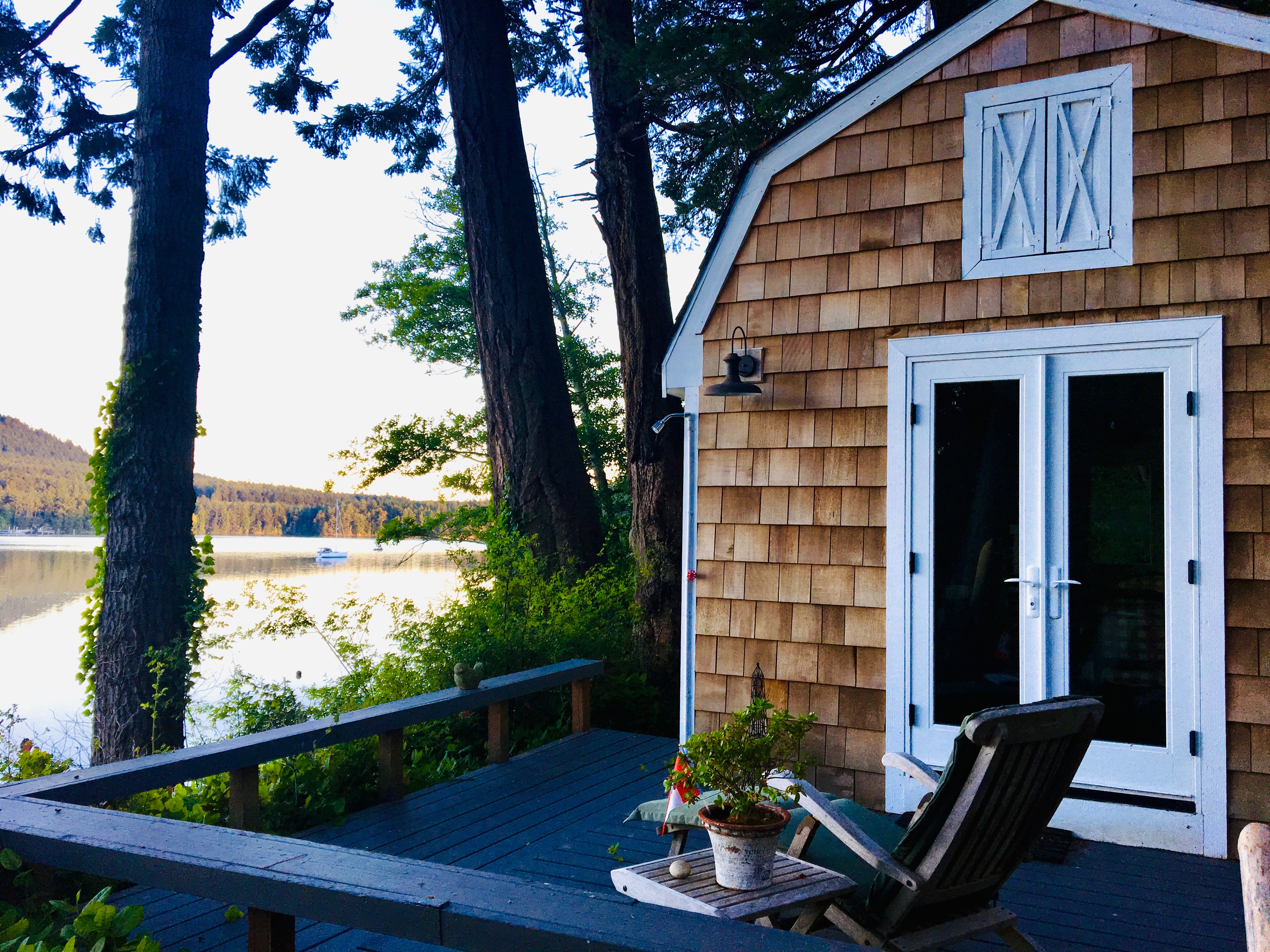
A decade ago I was a columnist at Pyragraph, an online magazine for creatives of all types. My articles focused on writing and a couple of them pertained to what I called “my writing hut” here on San Juan Island. A little larger than a shed but smaller than a barn—we’ll call it a cabin—it had been on the property before the house. The original owners used the cabin as a bunkhouse while building the house. Nearly twenty years later as second owners, we lived on a boat while remodeling both the house and cabin. 

The cabin was what I liked most about the property. Closer to the shoreline and more rustic, with the cabin I am back in the boathouses of my childhood in my mind, on a small lake in Connecticut—long before I’d ever heard of the Salish Sea. Back to a time of running free with other children every summer, kids among kids, exploring all the shoreline on foot and paddling about the lake like Native Americans—this being the boundary of our known world. And our sole responsibility, it seemed, at six, seven, eight, nine, and ten was simply to show up for meals.

I furnished the cabin on San Juan Island with a long pine refectory dining table along the window looking to the bay, and that is where I wrote. Upon the table, a collage of small square black and white photographs of those summers on the lake: learning to swim with my father, sitting with a pretty aunt upon a Sailfish, and a grandmother who always wore rubber shoes wading in the water. Where the woods meet the water and the sand feels like mud. Where ducks paddle by, and sometimes water can be heard lapping over stones. Water view, water sounds, and waterfowl. The resemblance between that lake in Connecticut and the bay on island is such that I hardly know where I am. 

And that’s my point: everything is fluid, and not always what it seems. A house is sold and a memory is unlocked. A cabin gets decidedly furnished as a writing hut, a manuscript is put together, a literary agent found, and Covid hit. The writer goes unpublished, for now, unless you count being a columnist once again. 

But the cabin has many lives! This fall it got covered with drop cloths–over books, over baskets of research, over the pine table, and over the floor. A friend and I set up easels, put on smocks and went to work. There really aren’t words to describe the longing to paint. The light is behind me now and I am not necessarily looking out the window, yet all I can do is smile. One day when I’ve grown very old it may all fold and meld together in my mind: the small lake in Connecticut, the bay on San Juan Island, the writers hut, and our art studio.

Originally published in The Journal of The San Juan Islands December 11, 2025

Leave a comment

Filed under memory, transitions, lake, bay, writing, art

We are Here! We are Here!

BY KIMBERLY MAYER

October 18th marked the largest single day of protest in U.S. history. Comprising a network of progressive organizations, No Kings’s organized 2,600 peaceful protests in nearly all states–people exercising their constitutional rights, reminding the world our country was founded in opposition to monarchy.

More than 7 million people participated in No Kings Day nationally. And on a little island in the middle of nowhere with a year-round population of 7,500, an astonishing 1,000 people of all ages assembled. It seemed everyone on San Juan Island was there, assembling at noon on the courthouse lawn then parading through town. Any passerby would note the flag on our side, creativity in homemade signs, and delightful frivolity in costumes, a far cry from House Speaker Mike Johnson’s characterization of our protests as “hate America rallies.”

Parading alongside an inflated dinosaur, a pair of chipmunks, unicorns, an eagle, orcas, and a furry fox, it’s no wonder I heard Dr. Seuss’s Horton Hears a Who in my head! For anyone not acquainted with the beloved children’s book, the story is of an elephant named Horton who, because of his enormous ears, is capable of hearing what no one else could: a small voice in a speck of dust. Which turned out to be all the Who’s in Who-ville where every voice counts.

He looked and he looked. He could see nothing there

But a small speck of dust blowing past through the air.

“I say!” murmured Horton. “I’ve never heard tell

Of a small speck of dust that is able to yell.”

“And, all over Who-ville, they whooped up a racket. 

“We are here! We are here! We are here!” they cried.

“You mean…” Horton gasped

“You have buildings there, too?”

“Oh yes,” piped the voice. “We most certainly do….

I know,” called the voice, “I’m too small to be seen

But I’m the Mayor of a town that is friendly and clean.

Our buildings, to you, would seem terribly small

But to us, who aren’t big, they are wonderfully tall. 

My town is called Who-ville, for I am a Who

And we Whos are all thankful and grateful to you.”

“Mr. Mayor! Mr. Mayor!” Horton called.

“You’ve got to prove now that you really are there!

So call a big meeting. Get everyone out.

Make every Who holler! Make every Who shout!”

“We are here! We are here! We are here!”

Originally published November 19, 2025 in The Journal of the San Juan Islands

Leave a comment

Filed under protests, Uncategorized

One Man’s Garden

BY KIMBERLY MAYER

Out on the slim peninsula between Westcott Bay and Mosquito Pass, Barb Fagan and I came calling. An Australian Sheepdog named Joey came running, and a man with a full white beard looking like David Letterman strolled down the drive to open the gate for us. Silver birch line the driveway, trees that he planted years ago. Barb was introducing me to Chet Genther. They are both members of the San Juan Island Garden Club, and it crossed my mind that I may be the only islander not familiar with him.

“I joined the Garden Club to learn to grow flowers,” he said with a smile. For Chet is a food gardener through and through. From the sanctuary for wild roses which it was, to now, every bit of his arable land is tended. “I wanted a farm,” explained Chet, “but one acre is plenty.” Plenty enough for an orchard of apples, plums, Bartlett pear, Asian pear, and crops of cantaloupe, watermelon, sweet potato, red beets, table grapes, 13 varieties of tomatoes, Marionberries, blue berries, raspberries, and strawberries as ground cover.

A Valencia orange tree which began in a solar room in Redmond, Washington has reached maturity on island under a heat lamp in the greenhouse. Orange trees self-pollinate in a breeze, so a fan simulates trade winds. Braeburn apples grow in bunches like grapes, their weight on branches considerable. “I can’t store what I can grow,” notes Chet. Thus crops of whole trees regularly go to The Friday Harbor Food Bank. There’s a generosity to Chet’ s every step. Even his bushy white beard growth is slated for playing a Santa at Nordstrom in Bellevue over the holidays.

Barb and I had the privilege of stepping into one man’s garden. We bade goodbye, our arms laden with produce. Remembering that Chet had joined the San Juan Island Garden Club to learn to grow flowers, I had to ask Barb, did we see any flowers? She laughed. Not the right time of year of course for blooms, but it may also be that it’s fruit trees that keep flowering in this bit of paradise.

Originally published October 8, 2025 in The Journal of the San Juan Islands

3 Comments

Filed under food gardening

The Mountain Lion on Our Minds: Predator or Perception?

BY KIMBERLY MAYER

Just a few months ago my book group sat down to discuss A Tale for the Time Being by Ruth Ozeki, a writer who lives on Cortes Island, B.C. amidst bears, wolves, and mountain lions. I remember exclaiming to the group how very fortunate we are not to have large predators on San Juan Island. That was in May. By August 4th we had a mountain lion.

Islanders tend to keep track of things. Seasons are marked by what fish is running: salmon, halibut, or lingcod.  Spot prawns, crabbing, and hunting seasons. Birders track birds to identify species, estimate numbers, and note migration patterns. And we track whales to better understand the Southern Resident Orca and to aid in recovery efforts. We have a sense of what belongs here and what doesn’t.

Not for a long time have large predators stalked the San Juan Islands.  A few years back a lone black bear swam across the channel and went island hopping: Camano Island, Whidbey, Fidalgo, Orcas, and Shaw, finally arriving on San Juan Island for a long weekend. Then he was on his way again, but not without having turned us all a bit upside down. Now a cat is doing that. 

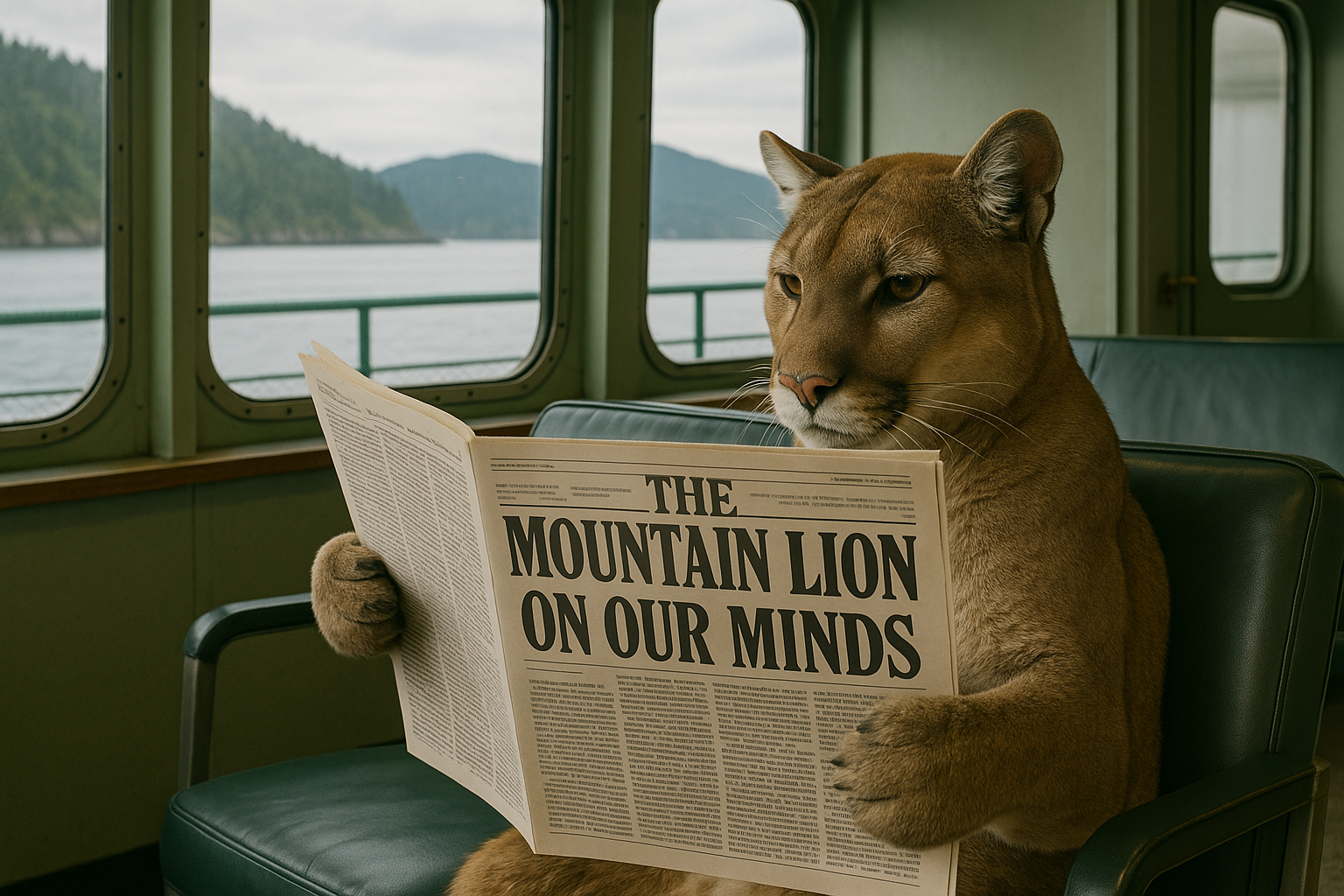
With just two or three unverified sightings under his belt the mountain lion is free to roam anywhere and everywhere on island–mainly into our subconscious. Our collective subconscious. I’m not saying the mountain lion isn’t real, but it does have us all off balance. 

Our community Facebook group, What’s Up Friday Harbor, is loaded with reports of mountain lion screams in the hills at night. People post scat photos to track his whereabouts, but few of us know what mountain lion scat looks like. Indeed, the mountain lion could be hiding anywhere in plain sight. Maybe it’s the time of year, but everything on island appears to be in his color palette: sand, woody debris, leaf litter. Golden grasses in prairies look remarkably like a savannah. Soon we’ll start seeing eyes in trees. This is how it starts. 

Mass hysteria is a phenomena that transmits collective illusions of threats, real or imaginary, through a population and society as a result of rumors or fear. The Salem Witch Trials fit the bill, as did Hammersmith Ghost Hysteria (1803) when stories of a ghost circulated in a neighborhood in west London. Panic was so widespread, residents took up guns. On another note, a laughter epidemic broke out in a boarding school in Kashasha, Tanzania in 1962—forcing closure of the school. The Seattle Windshield Pitting Epidemic of 1954 became a textbook case of collective delusion. And people may remember the Great Clown Panic of 2016 that swept the US, Canada, and numerous countries like a contagion.

But given our mountain lion on island, the best story is of a convent in France in the Middle Ages in which a nun inexplicably began to meow like a cat. Other nuns joined in and soon all the nuns in the convent meowed loudly, much to the distress of the surrounding community. Studying the medieval meowing convent, Swiss physician and philosopher Johann Georg Zimmerman noted “the influence of solitude on the mind.” 

Both convents and islands are isolating. The good news is that while collective delusions spread rapidly, they tend to be short lived. Of course none of this has anything to do with our mountain lion on island, who may very well be real. 

Meow.

Originally published September 17, 2025 in The Journal of the San Juan Islands

2 Comments

Filed under wildlife and nature, San Juan Islands

My Imaginary Mother on Island

By Kimberly Mayer

Every now and then I’ll be out walking the loop by Roche Harbor, minding my business, when a lady in a shiny golf cart whizzes past me, and with a particular wave of her hand an entire scenario opens up, unfolds, and I fall through. I might be thinking something unfathomable or confounding, and she goes by so gladly. My imaginary mother is on island.

I’m pretty sure we all thought mom would outlive dad. Something in her just didn’t age. So it made sense that we thought perhaps someday she’d come live with us. And to coax her out of driving, we’d get her a golf cart and urge her to stay local. 

But now that my imaginary mother has come to live with us, “gallivanting about” as she says, is fun again. Jumping into her buggy she picks up mail at the post office on the wharf, shops for groceries, browses boutiques, or meets new friends for lunch at Madrona Bar & Grill or Lime Kiln Cafe. Like me walking, mom notices the Queen Anne’s Lace just appearing, the deer crossing, and fox going in and out of culverts by the side of the road. In my mind she’s in heaven here. In her mind she’s probably on Martha’s Vineyard. 

Mom came to San Juan Island from Cape Cod and Duxbury, Mass. From Talbots and L.L. Bean to Pendleton and REI it’s not that much of a stretch. As well as living off the sea as much as can be. She arrived a lover of raw oysters, although we had to get her off red cocktail sauce and onto our mignonette sauce as an accompaniment.

As it happened, mom’s niece had worked with Erin French at The Lost Kitchen in Freedom, Maine. A little known gem of a restaurant until Martha Stewart strolled in one day, and the next thing you knew The Lost Kitchen appeared as a story in her magazine, Martha Stewart Living. But we didn’t need to wait for Martha, as my cousin Margot was in the kitchen with Erin, and gave us tips on what they called Oyster Hogwash Sauce at The Lost Kitchen. It’s as fine a mignonette with oysters as we know. 

Oyster Hogwash Sauce

¼ c. unseasoned rice vinegar

¼ c. seasoned vinegar

1 large shallot, peeled and minced

1 large jalapeno pepper, seeded and minced

½ bunch fresh cilantro, freshly chopped

Juice of one lime

Combine all ingredients in a bowl, stir and serve alongside freshly shucked oysters.

Note: Margot notes that while shallots and vinegar are the base, cilantro and lime aren’t always a part of it. Instead of lime juice, “We often add plums or whatever fruit is in season. Exploration is the key. Sometimes it’s cucumbers, sometimes blueberries. Sometimes juice, sometimes just the fruit, there is not a fixed way. Brines are different, seasons are different, so it’s always about the present moment.” 

Originally published August 13, 2025 in The Journal of The San Juan Islands

6 Comments

Filed under imagination, imagination, the power of imagination, the power of imagination

Monster Trucks and Midsized Regrets

Drawing by Hunter Blum

BY KIMBERLY MAYER

The year-round population of San Juan Island is a little over 8,500. In summer it swells to twice that, which makes it harder to get around the town of Friday Harbor and find parking. But it wasn’t summer yet when, in a parking lot, I witnessed an accident in slow motion. A large pick-up truck, attempting to park, dented the side of a shiny new luxury SUV. The driver hopped out of the truck and looked bewildered. Are parking spaces too small? Are vehicles too large? Are we all not trained truck drivers? The answer to all that is yes. 

Years ago the tabloid website outlet TMZ broke the story of California’s First Lady Maria Shriver caught on camera holding a cellphone to her ear while driving in Brentwood. Just one year earlier her husband, Gov. Arnold Schwarzenegger, had made the use of hand-held mobile devices illegal while driving. The story was then picked up by mainstream media. (“Shriver and her cell phone,” by Meghan Daum 10/15/2009 Los Angeles Times). People were abuzz. 

 “There’s going to be swift action,” said the governor. But the big crime to me at the time was the largeness of her car, a black Cadillac Escalade. 

In the years that followed, the American appetite only grew for ever larger SUV’s, pick-up trucks, and swollen vans. Demand for the sedan dwindled. Today, nearly half of the U.S. population owns a truck, and trucks became supersized.

“The consequences of this vehicle growth trend are far from benign. Cities and infrastructures designed for smaller vehicles are now grappling with oversized vehicles,” according to The Finn Blog 2025. Parking, road congestion, and most critically, the increase in size is more dangerous to people walking, biking, wheelchair users, and children. Blind spots are created when the driver sits higher and the front of the truck is higher. And while cars with lower hoods might have struck pedestrians in the legs, the supersize truck strikes torsos and heads.“ To put it simply, pick-up trucks and SUVs are two to three times more likely than smaller vehicles to kill people in the event of a crash,” writes Steve Davis 4/12/2021 for the nonprofit organization Smart Growth America.

These giants have finally become too much vehicle for us to handle. I know, I drive one. Not as massive as Maria Shriver’s black Cadillac Escalade, but a midsized SUV, which I consider huge. Mirrors help in the back, but not in the front. As I come over a rise to our drive, for a breathless moment I see nothing at all before me until the car levels out. My heart has always been in something smaller.

At age six my grandson is obsessed with Monster Trucks. He collects them, plays with them, draws them, wears them proudly on tee shirts, and is super excited whenever he spots one. He will get over it, but will we?

Originally published July 16, 2025 in The Journal of The San Juan Islands

1 Comment

Filed under road safety, Supersized trucks, full-size SUVs, Monster trucks

The People Who Show Up for Trees

BY KIMBERLY MAYER

In mid-May an event at Brickworks, San Juan Island, cosponsored by Friends of the San Juans and Salish Current, was entitled The Trees are Speaking. The speaker was Lynda Mapes, author of a recent book by the same title. Every chair was filled when we arrived, so we quickly set up more. People poured in. As natural history and native cultures journalist for The Seattle Times, Lynda Mapes was speaking to the choir here. We are the people who show up for trees.

When I first moved to the Pacific Northwest I listened to KUOW, Seattle’s NPR news station, every morning while brewing my coffee. It was immediately apparent that legislation in this region tries to be guided by what is best for the salmon. The presumption being what is best for the salmon turns out to be best for us. OK, I thought. I get it.

Trees too have an enormous presence in the Pacific Northwest, more so than anywhere I’d ever lived. Suddenly trees were characters in our lives! I began reading a host of tree-themed or tree-centered books: novels like The Overstory by Richard Powers, and Barkskins by Annie Proulx. Memoirs such as Hope Jahren’s Lab Girl and Suzanne Simard’s Finding the Mother Tree. Peter Wohlleben’s The Hidden Life of Trees (nonfiction), and The Golden Spruce by John Vaillant, an environmental true crime story, to name a few.

What I hadn’t considered was the sacred connection between forests and salmon, a relationship best explained by Salmon Forests. It’s so simple really. “Forests hold the soil and preserve the water and cool the streams; salmon (in migrating inland to their natal streams and rivers to spawn) bring home the nutrients from the sea that feed the forest and wildlife of the watershed,” explains Lynda Mapes. Salmon depend on cool and clean water in which to spawn. Tree canopy shade keeps the temperature cool while filtering various pollutants from the water. Because Chinook salmon die after spawning, their decaying bodies provide nutrients to the freshwater ecosystem, fertilizing the riverbanks of the forest.

And round and round it goes, the salmon and the forests. “If you want salmon, you need to protect the forest,” writes Lynda Mapes. An ancient relationship that falls on us today to preserve.


Originally published June 18, 1925 in The Journal of the San Juan Islands

2 Comments

Filed under salmon, Salmon Forest

Rules of Civility: What Holds Us Together

BY KIMBERLY MAYER

We were in San Diego crossing the bridge over the bay to Coronado Island when nearly halfway across, all traffic came to a stop. Police car after police car squeezed through the lanes—perhaps a dozen cruisers and an ambulance. Except for the short bursts to alert us they were coming through, there were no sirens whatsoever. Just stillness, silence, and no explanation for I-don’t-know-how-long. All of us motorists on the bridge on a bright and beautiful day, windows down, patiently not moving. Later we learned that someone had attempted suicide at the apex of the gently climbing bridge. 

One week later, back on San Juan Island, a sailing vessel hit rocks in Cattle Pass and began taking on water and breaking up. The mayday call came in the night and a U.S Coast Guard helicopter out of Port Angeles, a U.S. Coast Guard boat out of Bellingham, and San Juan Fire Department’s fireboat as well as sheriff boats all responded to try to find and rescue two boaters in the cold, northern water. 

In the same week a trial was getting underway. To participate in jury selection is to learn the first thing about due process. I was there for the selection process and the trial, and without saying anything about the case, the process is what impressed me. The protocol of the court, procedures that insist upon civility, the care and consideration of ordinary citizens serving as jury. 

In the end, the individual was talked down off The Coronado Bridge. One boater near San Juan Island was pulled from the water in time, the other, unfortunately, was not. In the court matter the jury deliberated for days.  

Three events in the period of three weeks: the incident on the bridge, the accident at sea, and the trial in the courtroom, and they all tie together through empathy and civility. This is what we have and mustn’t lose. One end of society is working, while the other end–at the highest level in our current administration–is doing everything to derail it. Included in their drastic reductions and defunding are federal agencies that have everything to do with our quality of life, from Health and Human Services to the Environmental Protection Agency. 

As for their assault on the press, we all know what that means.

Originally published May 21, 2025 in The Journal of The San Juan Islands

4 Comments

Filed under civility, civility

Close Encounters: Stories that got Away

By Kimberly Mayer

A short walk in the woods from my home sits The Mausoleum at Roche Harbor on San Juan Island. Not one visit do I make to the memorial that I don’t mourn my grandfather. It isn’t grandpa who is buried there, it’s the McMillin family, but like John S. McMillin, the paternal head of the family, my grandfather was a businessman and a mason. I tend to linger at the mausoleum, as if the stone edifice could answer some of my questions.

My grandfather was warm, loving, and would give the shirt off his back to anyone. But he was mum about The Masonic Order. As children we’d clamor around him asking countless questions about his Masonic ring, and he’d just smile and laugh and bounce us on his lap. I can still feel his firm hugs and the texture of his wool cardigan sweaters even in summer. But I will never hear the story. He took it with him.

Now I know members are pledged to secrecy with the masonic oath, but John S. McMillin’s colossal mausoleum is fraught with masonic signs and symbols. They’re etched in the arches, carved on the steps, and depicted by a large round limestone table surrounded by chairs that serve as crypts on a platform encircled by Roman columns. It’s a tomb on a rise in the woods. The story as McMillin saw it.

My friend’s grandfather was a VP with one of the world’s largest companies specializing in heating, ventilation, and air conditioning. In the 1940’s he was approached by The Office of Strategic Services (OSS), the first centralized intelligence agency in the country and predecessor to the CIA. Suddenly he was whisked away, multiple times, from New York to Roswell, New Mexico. His family was informed of nothing.

The most they ever heard of his involvement in Roswell may have been in 1977 when my friend took her grandparents to the theatre to see Spielberg’s “Close Encounters of the Third Kind,” which had just been released. Leaving the theatre at the conclusion of the film, her grandfather muttered, “That’s not the way it happened.” And that’s all he ever said on the subject. He too took it with him.

Just as I may never know what The Masonic Order meant to my grandfather, some kind of deep secrecy still shrouds us all eighty years after the 1947 crash site near Roswell, New Mexico. 

Originally published April 9, 2025 in The Journal of the San Juan Islands

4 Comments

Filed under Masonic, The Mausoleum at Roche Harbor, extraterrestrial life, Roswell NM

For the Love of Story

BY KIMBERLY MAYER

Lately I’m more interested in stories than stuff. What attracts me now, what I want to glean are stories–even if I have to make them up myself. Life, I find, is hallowed by story. Also natural, found objects like stones and shells—what grounds us. Food from farms we know and fruit from trees we know. Going beyond stuff is about leaning in, appreciating and embracing what we see and what we have. 

Are you with me?

A friend and I recently came upon a small studio creating hand-made, nature inspired brooches using intricate needlework and mixed materials. I delighted in a feather while she was drawn to a Drepanid moth. Never had a moth looked so beautiful. Producing only small batches, the founders of the studio suggest, “We hope if the world consumes less, it will care more.” 

In another market I picked up a bag of dryer balls, the eco-friendly alternative to fabric softeners and sheets. When it comes time to replace my current ones, I will use these. Why? It was the story printed on the tag of a female farmer who oversees the full life cycle of the sheep, raising them, sheering them, and washing the wool, and then hiring and training stay-at-home moms to custom make the dryer balls.

Not all objects are found (stones and shells), grown (fruits and vegetables), or purchased. With art it’s mainly a matter of looking. The world is full of art I have loved in galleries and museums, works that come with me like a song in my head. 

“Indeed, what is all art, if not an attempt to tell a better story,” writes Mary Pipher in Women Rowing North: Navigating Life’s Currents and Flourishing As We Age.

Originally published March 12, 2025 in The Journal of the San Juan Islands

4 Comments

Filed under story, the power of story, the power of story